
Indigo Bunting in Spring: When It Arrives, Where to Find It, and What It Really Is
Indigo Buntings arrive late April through May. Here's when and where to find them.
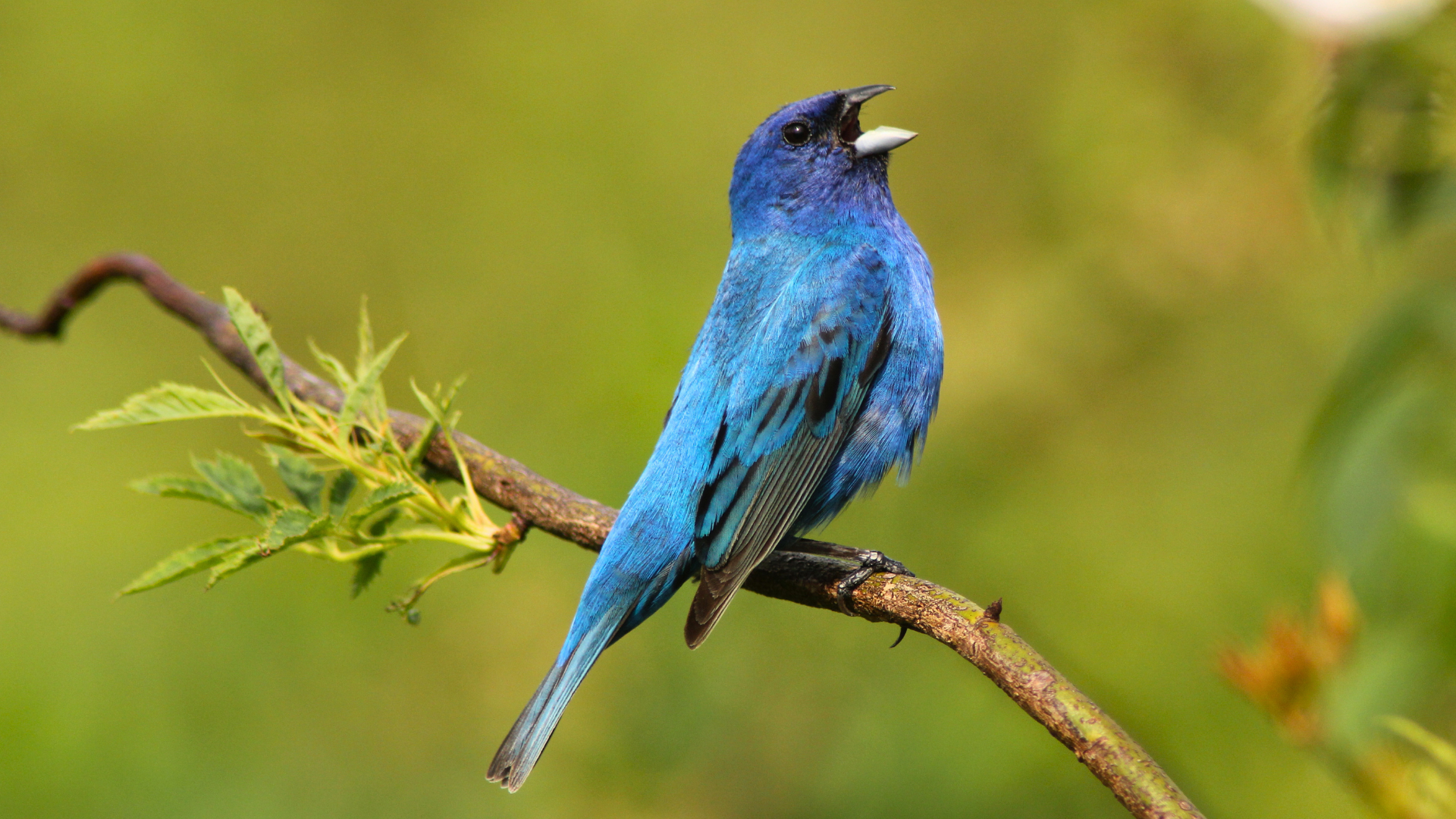
You are standing at the edge of a field, a line of forest behind you, open ground stretching ahead. You hear the song first: paired notes, high and clear, delivered with a brightness that cuts through the morning. You scan the tree line, working along the canopy, and then you find it. A blue that seems almost improbable. Not the subtle blue-grey of a heron or the soft blue of a bluebird. This is an electric, burning blue, the color of clear water in shallow sunlight, glowing against the leaves as if lit from inside.
Then the angle shifts, the bird moves, and for a moment it looks almost black.
That optical illusion is the first clue that what you are looking at is stranger and more interesting than it appears. The Indigo Bunting (Passerina cyanea) is one of the most studied birds in North America, and almost everything remarkable about it turns out to be more remarkable the further you look. This guide covers when it arrives, where to find it, and why the science behind this bird is worth knowing.
The Blue That Is Not Actually Blue
Like all other blue birds, Indigo Buntings lack blue pigment. Their jewel-like color comes instead from microscopic structures in the feathers that refract and reflect blue light, much like the airborne particles that cause the sky to look blue.
This blue color is something of a trick: their feathers do not contain any blue pigments. It is achieved by diffraction, a process in which the microscopic structure of their feathers scatter light from the sun, reflecting all colors except blue.
The practical consequence is what you experience at the field edge: in some lighting the males appear exquisitely turquoise blue, while in others they appear to be almost black. The color is not in the feather. It is in the interaction between the feather's microscopic architecture and the angle of light reaching your eye. Turn slightly, or let the bird move to a different branch, and the same feather goes from blinding blue to flat black in under a second.
Bunting plumage does contain the pigment melanin, whose dull brown-black hue you can see if you hold a blue feather up so the light comes from behind it, instead of toward it.
This is why lighting matters so much when searching for Indigo Buntings. With the sun behind you and the bird in front of you, the blue is maximal. With the sun behind the bird and you in shadow, the same male looks dark and easily missed. The birder who learns to position themselves with the sun at their back finds dramatically more buntings per hour than the birder who searches into the light.
The Star Map: How This Bird Finds Its Way Back to Your Hedgerow
The Indigo Bunting was chosen for landmark navigation research because of its relatively long annual migratory flight, up to 2,500 miles roundtrip, and its ability to return to the exact same breeding territory, down to the branch, each spring.
In the 1960s, ornithologist Stephen Emlen conducted one of the most elegant experiments in the history of ornithology using Indigo Buntings. He kept some in a planetarium and some outside, and placed funnels on top of their cages so that they could only see a certain radius of the night sky, whether real or projected. Emlen recorded their Zugunruhe orientation by placing each bunting on an inkpad. Every time the buntings attempted to fly in a certain direction, ink marks would be left in that area of the cage, allowing Emlen to see which direction they were facing.
He found that even with no other visual or social cues except the constellations, buntings exhibited the ability to orient themselves to the stars. Under cloudy skies, the buntings continued to try to fly but their orientation direction became random.
By slowly covering up groups of constellations in the planetarium setting, Emlen found that indigo buntings use the northern polar axis of the night sky, specifically constellations around the North Star, as their primary method of migratory orientation. Then Emlen shifted the North Star in the artificial sky to the east or west, and amazingly the buntings changed their orientation to the new south or the new north, depending on the migration season. Juvenile buntings learn this pattern during their first summer, likely while still in the nest.
That last detail is the one that should stop you. The juvenile Indigo Bunting in your yard in July, a drab brown bird that barely registers visually, is spending its first summer memorizing the rotation of the northern sky. It is learning which point in the heavens stays still while everything else turns, imprinting that fixed point as north. It will use that map every migration night for the rest of its life. The bird that returns to your field edge next May navigated here from Venezuela by a star chart it memorized as a nestling in this same hedgerow.
When to Expect It: Spring Arrival Timeline
In the Northeast, Indigo Buntings arrive fashionably late to the spring migration, behind the vanguard of warblers and other songbirds. Older male buntings are first to arrive on their North American breeding grounds in late April to mid-May. They will have already staked out their territories by the time the females arrive about two weeks later.
| Region | First Arrivals | Peak Window |
|---|---|---|
| Florida / Gulf Coast | Early April | Mid-April |
| Georgia / Carolinas | Mid-April | Late April |
| Virginia / Tennessee | Late April | Early May |
| Ohio / Indiana / Illinois | Late April to early May | May |
| Pennsylvania / New York | Early May | Mid-May |
| Michigan / Wisconsin | Early to mid-May | Mid-May |
| Minnesota / Iowa | Mid-May | Late May |
| New England | Mid-May | Late May |
| Ontario / Quebec | Late May | Early June |
Indigo Buntings migrate to South America by flying both over the Gulf of Mexico and around the Gulf of Mexico, with a majority of buntings choosing the trans-Gulf path. A male arriving at your field edge in early May has in many cases made a single overnight flight from the Yucatan Peninsula across open water, navigating by the stars of the northern sky the entire way.
The Song: 200 Times Per Hour at Dawn
It is hard to miss the cobalt blue male that often belts out his strident song from an exposed perch high in the tree tops. The male Indigo Bunting is very vocal, singing all day during spring and summer, whistling sharp, clear notes that last about two seconds. They can sing 200 songs per hour continuously at dawn and then keep a steady pace of about 60 songs per hour throughout the day.
Look for Indigo Buntings in weedy fields and shrubby areas near trees, singing from dawn to dusk atop the tallest perch in sight. This behavior is the primary field locating tool. Buntings are not secretive. A male on territory will sing for hours from the highest available perch, often a telephone wire, a dead snag, or the tallest branch at a forest edge. The song is his advertisement, and he delivers it at a rate that makes finding him by ear straightforward even for beginners.
The song itself is a series of paired notes, bright and buzzy, with a quality that sounds cheerful and slightly frantic simultaneously. One of the best ways to find them is to learn to recognize the bouncy quality of the paired notes in their song. Each phrase rises and falls in a pattern that birders often render as fire-fire, where-where, here-here, see-it, see-it. Once you have that paired, bouncy quality anchored, you hear buntings at field edges that you would otherwise drive past without stopping.
The Song Neighborhood: A 20-Year Tradition
Here is the fact about this species that produces genuine wonder in anyone who thinks about it carefully.
Most males learn their song from neighboring males in the territory where they settle to breed, but not from their fathers. This creates song neighborhoods, and songs learned this way can survive for up to 20 years through many generations within the same locale. The songs are different only a few hundred yards away, and the male Indigo Bunting may change songs when it switches territories.
Buntings a few hundred yards apart generally sing different songs, while those in the same song neighborhood share nearly identical songs. A local song may persist up to 20 years, gradually changing as new singers add novel variations.
The hedgerow you drive past on your way to work, with a bunting singing from the same telephone wire every May: that song may be 15 years old. Not the same bird. Not the same bird's son. A tradition passed laterally from neighbor to neighbor, maintained across generations of buntings that have never met, all singing the same local variant because the males who settled here before them sang it, and they learned it from them. The song at the forest edge of that field is a piece of local cultural history.
Where to Find Them: Habitat Specificity
Because of an increase in this species' preferred habitat of abandoned fields, forest clearings, and brushy woodland edges such as along roads and power line clearings, it is more abundant now than when the Mayflower docked at Plymouth Rock.
The specific habitat structure to look for: a boundary between open ground and woody vegetation, with the woody side containing shrubby low growth as well as taller trees. Power line cuts through forest are among the most reliable Indigo Bunting habitats in eastern North America, providing exactly the edge structure the species requires. Agricultural field edges with hedgerows, overgrown pastures with shrubby margins, roadsides with a mix of weeds and woodland edge, and regenerating clear-cuts all produce the same combination.
Look for Indigo Buntings in midsummer along rural roads, where they often sing from telephone lines or wooded edges for hours on end. During migration you may see large flocks of Indigo Buntings feeding in agricultural fields or on lawns.
The car-as-hide technique works particularly well for buntings. Drive rural roads through brushy-edge habitat between 6 and 10 AM in May, windows down, listening for the paired bouncy song. When you hear it, stop and scan the tallest perches within 100 meters: telephone wires, dead snags, the highest branch of a roadside shrub. The male will usually be visible within 30 seconds of locating the song source.
The Brown Male: Spring's Most Consistent Misidentification
Every spring, beginning birders report a brown bird with patches of blue that is almost always a first-year male Indigo Bunting, not a new species or a rare hybrid.
Females and juveniles exhibit a more subdued coloration, primarily brown with occasional hints of blue, which provides effective camouflage. First-year males arrive in spring in a transitional plumage that is largely brown with variable patches of blue on the wings, tail, and occasionally the face and breast. Some first-year males are almost entirely brown with just a hint of structural blue on the wing coverts. Others are extensively patchy, showing large blue areas on the body alongside retained brown feathers.
The features that confirm any plumage as Indigo Bunting: the conical, relatively heavy bill (larger than a sparrow's), the lack of any strong streaking on the breast (which eliminates most sparrows), and the structural blue: even in a first-year male with very little blue visible, what blue is present will flash brilliantly in good light and disappear in shadow, which is the hallmark of structural rather than pigment-based color.
An adult female Indigo Bunting is uniform brown with a faint blue wash on the wings and tail in good light, two faint wing bars, and subtle breast streaking. She is easily overlooked in the field and consistently under-reported relative to males.
What to Do When You Find One
Stop. With the sun at your back. Buntings on territory in May are remarkably tolerant of stationary observers, particularly from a car. A male singing from a telephone wire 30 meters away will often continue singing regardless of a vehicle stopped below him.
Watch for the angle of light to shift the color. The transition from electric blue to near-black and back again is not a function of the bird changing, but of your relative position to the sun changing as the bird moves. Tracking that shift, watching the color appear and disappear, gives you a direct experience of the structural color mechanism that no photograph or description fully conveys.
Males begin singing during spring migration and continue throughout the breeding season. A singing male in late April at a field edge is not yet on territory. He is passing through, fueling up, singing because the breeding hormones are already running. The male you find at the forest edge of a field in early May, if the habitat is right, may still be there in June.
The Short Version
Older male Indigo Buntings are first to arrive on their North American breeding grounds in late April to mid-May. Hear the paired bouncy song at a shrubby field edge, scan the tallest perch, position yourself with the sun at your back, and find the blue. Keep watching as the bird moves, and you will see the structural color phenomenon in real time. The bird that comes back to this same hedgerow next spring memorized its star map here as a nestling and navigated by Polaris all the way from Venezuela to return.
It is a small bird that contains an extraordinary amount of science. The forest edge of a field in May is as good a place as any to encounter it.
The allure of off-the-beaten-path travel
Lorem ipsum dolor sit amet, consectetur adipiscing elit ut aliquam, purus sit amet luctus venenatis, lectus magna fringilla urna, porttitor rhoncus dolor purus non enim praesent elementum facilisis leo, vel fringilla est ullamcorper eget nulla facilisi etiam dignissim diam quis enim lobortis scelerisque fermentum dui faucibus in ornare quam viverra orci sagittis eu volutpat odio facilisis mauris sit amet massa vitae tortor.

Unveiling the charm of lesser-known Destinations
Orci sagittis eu volutpat odio facilisis mauris sit amet massa vitae tortor condimentum lacinia quis vel eros donec ac odio tempor orci dapibus ultrices in iaculis nunc sed augue lacus.
- Lorem ipsum dolor sit amet consectetur facilisi etiam dignissim diam quis enim
- Mauris aliquet faucibus iaculis dui vitae ullamco sit amet luctus
- Posuere enim mi pharetra neque proin dic rhoncus dolor purus non enim
- Dui faucibus in ornare posuere enim mi pharetra neque proin dicit
Finding solitude in hidden gem locations
Lorem ipsum dolor sit amet, consectetur adipiscing elit ut aliquam, purus sit amet luctus venenatis, lectus magna fringilla urna, porttitor rhoncus dolor purus non enim praesent elementum facilisis leo, vel fringilla est ullamcorper eget nulla facilisi etiam dignissim diam quis enim lobortis scelerisque fermentum dui faucibus in ornare quam viverra orci sagittis eu volutpat odio facilisis mauris sit amet massa vitae tortor condimentum lacinia quis vel eros donec ac odio tempor orci dapibus ultrices.
The thrill of discovering untouched natural beauty
Dolor sit amet, consectetur adipiscing elit ut aliquam, purus sit amet luctus venenatis, lectus magna fringilla urna, porttitor rhoncus dolor purus non enim praesent elementum facilisis leo, vel fringilla est ullamcorper eget nulla.
- Lorem ipsum dolor sit amet consectetur tempor orci dapibus ultrices
- Mauris aliquet faucibus iaculis dui vitae ullamco elementum facilisis
- Posuere enim mi pharetra neque proin dic fermentum dui faucibus in ornare
- Purus sit amet luctus posuere enim mi pharetra neque proin dic
“Ut enim ad minim veniam, quis nostrud exercitation ullamco laboris nisi ut aliquip ex ea commodo consequat uis aute irure dolor in reprehenderit in voluptate velit”
Exploring cultural marvels off the tourist radar
Donsectetur adipiscing elit ut aliquam, purus sit amet luctus venenatis, lectus magna fringilla urna, porttitor rhoncus dolor purus non enim praesent elementum facilisis leo, vel fringilla est ullamcorper eget nulla facilisi etiam dignissim diam quis enim lobortis scelerisque fermentum dui faucibus in ornare quam viverra orci sagittis eu volutpat odio facilisis mauris sit amet massa vitae tortor condimentum lacinia quis vel eros donec ac odio tempor orci dapibus ultrices in iaculis nunc sed.