
Rose-breasted Grosbeak Spring Migration: Timing, Song, and Feeder Tips
Rose-breasted Grosbeaks return north from mid-April through May. Here's the state-by-state guide.
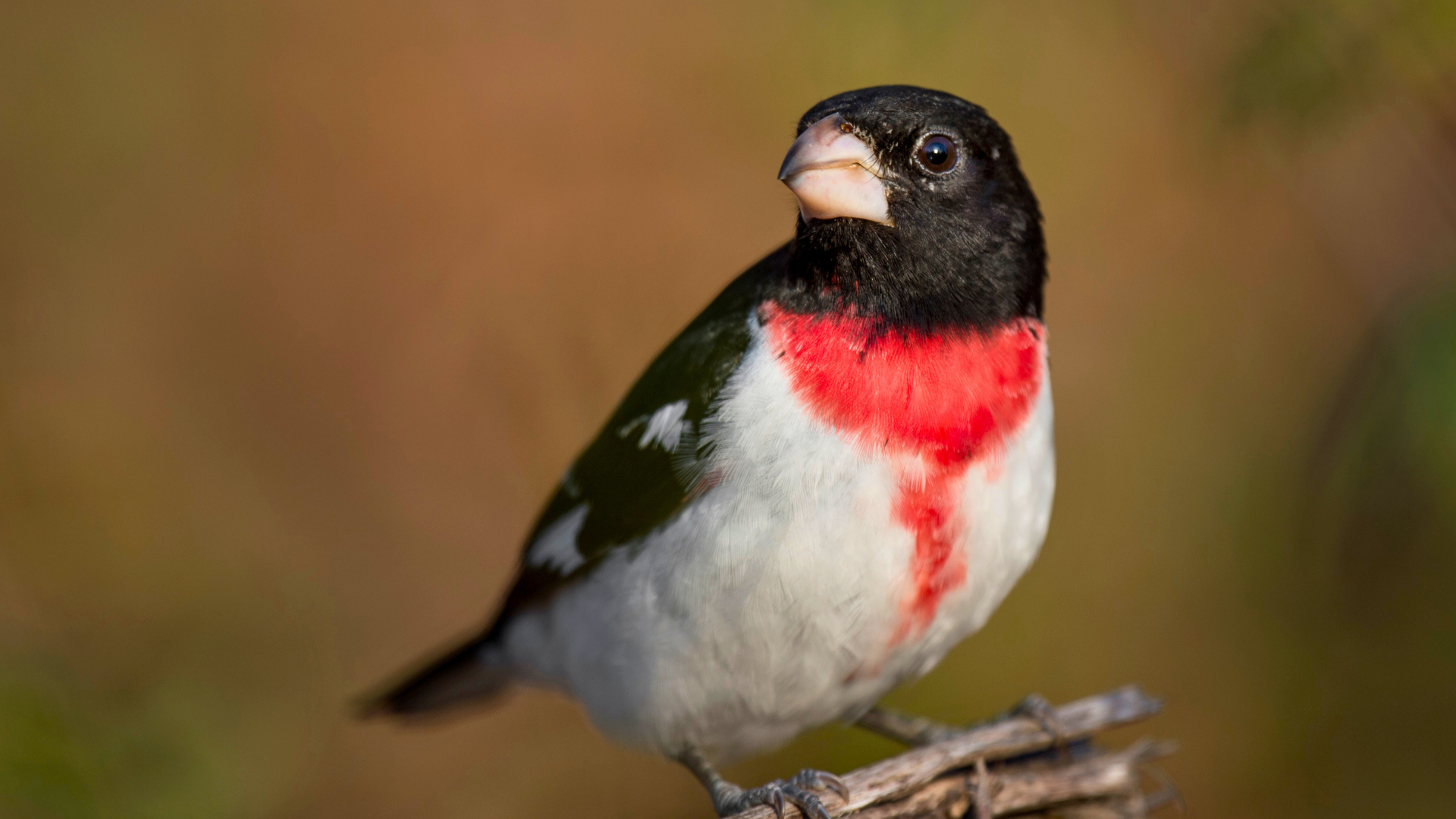
You hear it before you see it. Beautiful notes, rich and fluty, dropping through the canopy with a sweetness that stops you mid-step. You scan the treetops, working through the new leaves, and there it is: a black-and-white bird with a rose-red triangle burning on its chest, singing from a high branch as if it owns every tree in the forest. Which, for this morning at least, it does.
The Rose-breasted Grosbeak is one of the most rewarding first-of-year sightings in spring birding, partly because the male's song is genuinely beautiful, partly because the plumage is startling in its precision, and partly because the bird arrives with the kind of confident visibility that some migrants never manage. This guide covers when to expect it in your region, what it went through to get there, how to find it in the field, and how to make your feeder the first stop it makes.
Where Rose-breasted Grosbeaks Are Coming From
The Rose-breasted Grosbeak breeds in cool-temperate North America, migrating to tropical America in winter. The northern birds migrate south through the United States east of the Rocky Mountains, to winter from central-southern Mexico through Central America and the Caribbean to Peru and Venezuela.
Most of them fly across the Gulf of Mexico in a single night, although some migrate over land around the Gulf. A Rose-breasted Grosbeak weighing 45 grams crossing 1,000 kilometers of open water in a single overnight flight is one of the more extraordinary physical accomplishments in North American ornithology. The bird arrives at your feeder having burned most of its available fat reserves to make that crossing. It needs fuel immediately.
Departures from wintering grounds occur from mid-March to mid-April. What triggers that departure is not temperature but photoperiod. Rose-breasted Grosbeaks were the only one of 70 migratory songbird species in the eastern United States shown in males to have produced sperm while still far south of their breeding location, which confirms that the physiological preparation for the breeding season begins long before the bird reaches your woodlot. The grosbeak you hear singing in late April has been biologically ready for weeks.
Spring Arrival Timeline: State by State
Rose-breasted Grosbeaks begin their northward spring migration in mid-March to mid-April, leaving their Central and South American wintering grounds, with arrival in the northern United States and southern Canada typically from mid-April to early May.
First arrivals in Florida reach late March to early April. In North Carolina, first arrivals are typically around April 15. In Pennsylvania, the species usually arrives in late April or early May but occasionally by the third week of April.
RegionFirst ArrivalsPeak WindowFloridaLate MarchEarly AprilGeorgia / CarolinasEarly to mid-AprilMid-AprilVirginia / MarylandMid-AprilLate AprilOhio / Indiana / IllinoisLate AprilEarly MayPennsylvania / New YorkLate April to early MayMayMichigan / WisconsinEarly MayMid-MayMinnesota / IowaEarly MayMid-MayNew EnglandEarly to mid-MayMid-MayOntario / QuebecMid-MayLate MayManitoba / SaskatchewanLate MayEarly June
The last birds do not return to the northern breeding grounds until mid to late May. For birders in southern Canada and the northern tier states, this means the window between first arrival and the end of migration is compressed into two to three weeks of mid-May, making timing your feeder deployment critical.
Male grosbeaks tend to arrive a few days to a week before the females. The first bird at your feeder will almost certainly be an adult male, and it will be unmistakable. The females arrive quieter, browner, more easily overlooked, and are worth paying attention to specifically.
The Song: What You Are Hearing and Why It Is Special
The Rose-breasted Grosbeak's song is rich whistled phrases, like an improved version of the American Robin's voice. That description is accurate but undersells the quality. The Robin's song is repetitive and somewhat mechanical. The grosbeak's song is more varied, more melodious, with a sweetness and polish that experienced birders describe as the Robin having taken singing lessons. The song is a subdued mellow warbling, resembling a more refined, sweeter version of the American Robin's voice. Males start singing early, occasionally even when still in winter quarters.
The call note is equally distinctive: a loud, bold squeak very similar to the sound of a basketball player's foot pivoting on a gym floor. This call, given frequently in flight and while foraging, is how you locate grosbeaks moving through the canopy before you can see them. Once you know the squeaky call, you will hear grosbeaks you would otherwise miss entirely.
One of the most extraordinary behavioral facts about this species applies directly to song: the birds sing while incubating. Both the male and female take turns on the nest, and both sing while sitting on the eggs. This is exceptional among North American songbirds. A male grosbeak singing from a low position in a tree at odd hours of the day, without the usual territorial display posture, may be incubating eggs just below your sight line.
Finding Rose-breasted Grosbeaks in the Field
In leafy woodlands of the East, the Rose-breasted Grosbeak often stays out of sight among the treetops. The song is your primary locating tool. Hear it, then scan from the highest visible branches downward. Adult males in spring plumage are not cryptic once you have the right search image: black hood, white underparts, and that rose-red triangle, triangular and sharply defined, on the breast. In morning light filtering through new leaves, the rose patch catches the light in a way that is different from any other North American bird.
Deciduous woods, orchards, and groves, especially edges or openings with a combination of shrubs and tall trees, are the preferred breeding habitat rather than unbroken forest. In migration, Rose-breasted Grosbeaks may occur in any wooded or semi-open area. During spring migration, before birds have settled into territory, they are more likely to be found in accessible habitat: park edges, hedgerows along agricultural fields, riverine forest, suburban yards with large trees.
These birds often travel in flocks and usually migrate at night. A fallout morning after a strong southerly migration night can produce multiple grosbeaks in a single patch of trees, feeding with the urgency of birds that have been flying since dark. The squeaky call coming from three directions at once in a park at 6 AM is a reliable indicator that you are in a good patch.
The Immature Male: The Identification Challenge Nobody Warns You About
Every spring, beginning birders report an unusual warbler or a strange sparrow that turns out to be a first-year male Rose-breasted Grosbeak. It is one of the most consistent misidentifications of the migration season, and it happens because most feeder and field guides illustrate only the adult male.
At one year of age, in their first breeding season, males are scaly above like fully adult males in winter plumage, and still retain the immature's browner wings. The rose breast patch is present but duller, more peachy-orange than the vivid rose-red of the adult. The black of the head is mottled with brown. The overall impression is of a heavily streaked bird with a thick pale bill and a suggestion of color on the breast that does not quite resolve into the expected pattern.
The features that give it away regardless of age or sex: the bill. That thick, pale bill looks oversized compared with most feeder birds. No sparrow or warbler has anything approaching the triangular, pale bill of a grosbeak. Once you have that bill in your binoculars, the identification is settled regardless of what the plumage is doing.
The Female: Not an Afterthought
Females look completely different and are the reason people may miss this species. At first glance she can resemble a large sparrow, but the overall build is heavier, and the bill is much larger than any sparrow.
The adult female has dark grey-brown upperparts, darker on wings and tail, a white supercilium, a buff stripe along the top of the head, and black-streaked white underparts, which except in the center of the belly have a buff tinge. The wing linings are yellowish, and on the upperwing are two white patches.
The combination of features that separates a female Rose-breasted Grosbeak from a large sparrow: the bill size and shape (triangular, pale, massive relative to head size), the strong two-toned head pattern (dark crown, bold white supercilium), and the yellow wing linings visible in flight. A female grosbeak flushing from a shrub and showing those yellow underwing flashes is distinctive once you know to look for it.
Feeder Tips: Timing, Setup, and the Grape Jelly Discovery
Spring migration is often the best time to see Rose-breasted Grosbeaks at feeders. Birds are hungry from travel and more willing to drop into a yard for sunflower seed.
The feeder setup that works: black-oil sunflower seed is the primary attraction, and safflower seed is a strong secondary option. Offer safflower or black-oil sunflower seed during the migration window to improve your chances. A platform or hopper feeder is preferred over a tube feeder, as grosbeaks are large birds that need landing room.
The grape jelly discovery: Rose-breasted Grosbeaks regularly visit oriole feeders loaded with grape jelly and orange halves, particularly during migration. This is reported consistently by backyard birders across the eastern United States but almost never appears in official species accounts. A bird that has just crossed the Gulf of Mexico on stored fat is not selective about sugar sources. If you have an oriole setup out in late April, do not be surprised to find a grosbeak at the jelly cup.
Have feeders deployed and stocked at least two weeks before your expected first arrival date. These birds fly across the Gulf of Mexico in just one night and arrive with near-depleted fat reserves. The feeder that is waiting at first light is the one that holds the bird. The feeder that goes up after the first report in your county gets the stragglers.
For the full feeder timing logic that applies to Rose-breasted Grosbeaks and hummingbirds equally, see our guide on when to put out hummingbird feeders in spring, and for the Baltimore Oriole feeder approach that pairs naturally with the grape jelly setup, see our guide on when Baltimore Orioles return north in spring.
Tracking the 2026 Migration in Real Time
In general, Rose-breasted Grosbeaks return in late April or early May. For real-time 2026 tracking, check eBird's species map filtered to the current week. When reports start appearing two states south of your location, your window is opening. The eBird Rose-breasted Grosbeak page shows recent sightings on a live map updated continuously through the season.
The Short Version
Rose-breasted Grosbeaks begin their northward spring migration in mid-March to mid-April, with arrival in the northern United States and southern Canada typically from mid-April to early May. Hear the song first: rich, fluty, sweeter than a Robin's. Scan the treetops for the rose-red triangle. Check the bill on any large unfamiliar bird at your feeder. Have sunflower seed and grape jelly out before your expected first date. Go back to the same woodlot at dawn for a week and you will find one.
Beautiful notes, from somewhere in the canopy, always worth stopping for.
The allure of off-the-beaten-path travel
Lorem ipsum dolor sit amet, consectetur adipiscing elit ut aliquam, purus sit amet luctus venenatis, lectus magna fringilla urna, porttitor rhoncus dolor purus non enim praesent elementum facilisis leo, vel fringilla est ullamcorper eget nulla facilisi etiam dignissim diam quis enim lobortis scelerisque fermentum dui faucibus in ornare quam viverra orci sagittis eu volutpat odio facilisis mauris sit amet massa vitae tortor.

Unveiling the charm of lesser-known Destinations
Orci sagittis eu volutpat odio facilisis mauris sit amet massa vitae tortor condimentum lacinia quis vel eros donec ac odio tempor orci dapibus ultrices in iaculis nunc sed augue lacus.
- Lorem ipsum dolor sit amet consectetur facilisi etiam dignissim diam quis enim
- Mauris aliquet faucibus iaculis dui vitae ullamco sit amet luctus
- Posuere enim mi pharetra neque proin dic rhoncus dolor purus non enim
- Dui faucibus in ornare posuere enim mi pharetra neque proin dicit
Finding solitude in hidden gem locations
Lorem ipsum dolor sit amet, consectetur adipiscing elit ut aliquam, purus sit amet luctus venenatis, lectus magna fringilla urna, porttitor rhoncus dolor purus non enim praesent elementum facilisis leo, vel fringilla est ullamcorper eget nulla facilisi etiam dignissim diam quis enim lobortis scelerisque fermentum dui faucibus in ornare quam viverra orci sagittis eu volutpat odio facilisis mauris sit amet massa vitae tortor condimentum lacinia quis vel eros donec ac odio tempor orci dapibus ultrices.
The thrill of discovering untouched natural beauty
Dolor sit amet, consectetur adipiscing elit ut aliquam, purus sit amet luctus venenatis, lectus magna fringilla urna, porttitor rhoncus dolor purus non enim praesent elementum facilisis leo, vel fringilla est ullamcorper eget nulla.
- Lorem ipsum dolor sit amet consectetur tempor orci dapibus ultrices
- Mauris aliquet faucibus iaculis dui vitae ullamco elementum facilisis
- Posuere enim mi pharetra neque proin dic fermentum dui faucibus in ornare
- Purus sit amet luctus posuere enim mi pharetra neque proin dic
“Ut enim ad minim veniam, quis nostrud exercitation ullamco laboris nisi ut aliquip ex ea commodo consequat uis aute irure dolor in reprehenderit in voluptate velit”
Exploring cultural marvels off the tourist radar
Donsectetur adipiscing elit ut aliquam, purus sit amet luctus venenatis, lectus magna fringilla urna, porttitor rhoncus dolor purus non enim praesent elementum facilisis leo, vel fringilla est ullamcorper eget nulla facilisi etiam dignissim diam quis enim lobortis scelerisque fermentum dui faucibus in ornare quam viverra orci sagittis eu volutpat odio facilisis mauris sit amet massa vitae tortor condimentum lacinia quis vel eros donec ac odio tempor orci dapibus ultrices in iaculis nunc sed.