
Ruby-Throated Hummingbird Arrival Dates by State (2026 Map)
When do Ruby-throated Hummingbirds arrive in your state? Use our 2026 state-by-state arrival table, peak timing guide, and live migration trackers.
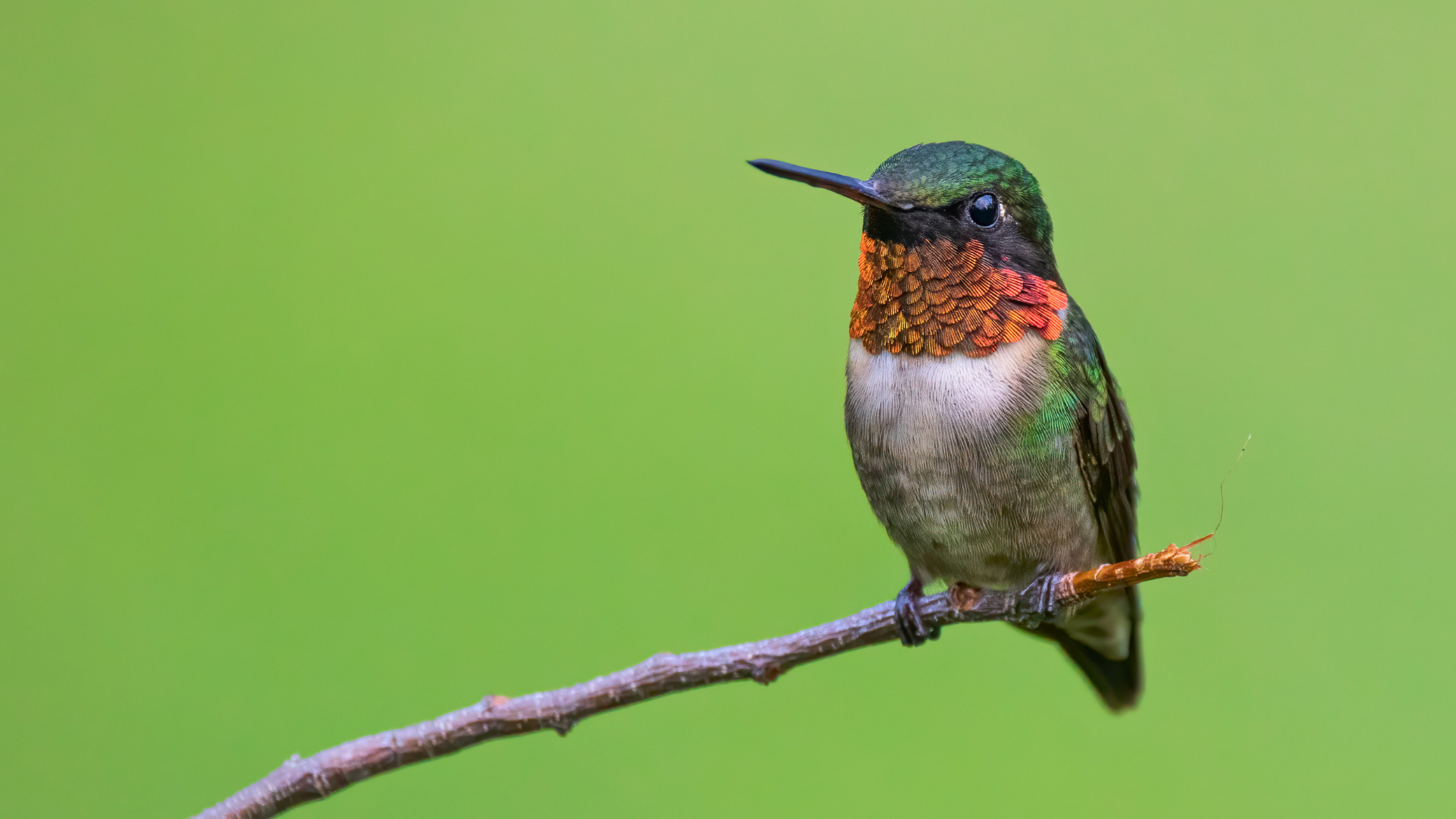
The first Ruby-throated Hummingbird of the year is unlike any other bird sighting. There is no gradual buildup, no flock trickling in over days. One morning, the feeder is empty and the yard is quiet. The next, a male is hovering at eye level, iridescent throat catching the light, looking directly at you as if assessing whether you meet his standards. That first arrival moment hits differently when you understand what the bird just accomplished to get there.
This guide covers exactly when to expect Ruby-throated Hummingbirds in your state for spring 2026, the biological reasons the timing unfolds the way it does, and the real-time tools that let you watch the 2026 migration front approach your yard day by day.
Where They Are Coming From
Many hummingbirds spend the winter in Central America or Mexico, and migrate north to their breeding grounds in the southern United States as early as February, and to areas further north later in the spring.
The journey northward is not leisurely. During migration, a hummingbird's heart beats up to 1,260 times a minute, and its wings flap 15 to 80 times a second. To support this high energy level, a hummingbird will typically gain 25 to 40 percent of their body weight before they start migration in order to make the long trek over land and water. Research indicates a hummingbird can travel as much as 23 miles in one day. However, during migration as they cross the Gulf of Mexico they may cover up to 500 miles at a time. Their average speed in direct flight is in the range of 20 to 30 mph.
A bird weighing roughly 3 grams crossing 500 miles of open water on stored fat is one of the more extraordinary things that happens in North American skies every spring. By the time it reaches your yard in Georgia or Ohio or Minnesota, that bird has already done something remarkable.
Males First, Always
Males will usually migrate first followed by the females about 10 to 14 days later.
This matters practically. The first hummingbird you see at your feeder in spring will almost certainly be a male: small, iridescent green above, with that unmistakable ruby gorget that appears black in flat light and blazes red when the sun catches it at the right angle. Females follow later, quieter and less conspicuous, green above and white below with no throat patch.
Hummingbirds are known to return to the same location from one year to the next, even to the same feeder. Those early males are not just passing through. They are actively scouting territories, and a feeder that is clean, filled, and waiting gives your yard a measurable advantage in that competition. We cover the feeder timing mechanics in detail in our companion guide, when to put out hummingbird feeders in spring.
What Drives the Timing
The migration does not follow temperature. It follows light. Although there are differing views in the birding community as to what triggers the start of migration, it is generally thought that hummingbirds sense changes in daylight duration, and changes in the abundance of flowers, nectar and insects.
This is why late cold snaps do not delay the migration significantly. A male Ruby-throated Hummingbird that arrives in Tennessee during a cold April week is not making a mistake. His internal calendar, calibrated over thousands of years of evolutionary pressure, is telling him the time is right regardless of the overnight low. He will find insects sheltering in bark, sap wells drilled by Yellow-bellied Sapsuckers, and whatever nectar your feeder provides until the native flowers catch up.
Research comparing arrival records from 1880 to 1969 with more recent data from 2001 to 2010 found that Ruby-throated Hummingbirds arrived earlier in the more recent period throughout the eastern United States, with advances varying by latitude. Climate is shifting the calendar, which means historical averages are a baseline, not a guarantee. The live tracking tools described at the end of this guide give you the real-time picture that historical data alone cannot.
State-by-State First Arrival Dates (Spring 2026)
These dates represent historical first-arrival windows for male Ruby-throated Hummingbirds, compiled from decades of citizen science records via Journey North and Hummingbird Central. First arrival means the earliest confirmed sightings, typically scout males. Peak arrival, when most birds pass through or settle, runs one to two weeks later.
The Difference Between First Arrival and Peak Arrival
Most guides give you a single date and call it done. That single date is almost always the first-arrival window, the earliest a scout male might show up. But for most backyard birders, peak arrival is the more useful number.
Peak arrival is when activity genuinely picks up: multiple birds visiting the feeder, territorial chasing, females appearing, and the buzzing wingbeat becoming a regular presence in the yard rather than an occasional surprise. Peak arrival runs roughly one to two weeks after first arrival in most states, and corresponds with the main body of the migration wave rather than its leading edge.
If you are in Ohio and the table shows mid to late April as your first arrival window, expect peak activity in early May. Plan your feeder maintenance, nectar freshness, and yard readiness around that peak date rather than the first-arrival date, and you will be set up for the full season rather than just the opening act.
How Climate is Shifting These Dates
The historical records matter, but they are not static. Arrival dates were advanced at all latitudes when comparing historical records from 1880 to 1969 with more recent data from 2001 to 2010. Warmer winter and spring temperatures in North American breeding grounds were correlated with earlier arrivals at lower latitudes.
In practical terms, this means birds in the southern states are arriving measurably earlier than they did a generation ago. If you live in Georgia or Tennessee and your parents told you hummingbirds always showed up in mid-April, your calendar may need to shift toward late March. The data supports moving your feeder date earlier, not later.
For northern states, the shift has been less pronounced, which means Minnesota and Maine birders can still rely reasonably closely on historical averages while keeping one eye on the live maps.
How to Track the 2026 Migration in Real Time
Two citizen science platforms give you a live picture of the 2026 migration front as it moves north:
Hummingbird Central runs a live 2026 spring migration map updated daily with first-sighting reports submitted by observers across the continent. When you see confirmed sightings appearing consistently two states south of your location, it is time to have your feeder clean and filled.
Journey North maintains a dedicated Ruby-throated Hummingbird tracking map with a long historical record that lets you compare 2026 arrivals against previous years. The combination of both resources gives you a predictive window that no fixed calendar can match.
The practical rule is simple: watch for reports two states south. When those reports become consistent rather than isolated, your window has opened.
What to Do When Your First Bird Arrives
The first sighting is not the finish line. It is the starting gun.
A male that finds your feeder on day one and is not challenged will claim that feeder as part of his territory. He will perch nearby, chase other hummingbirds away, and return to it dozens of times a day through the breeding season. That is the ideal outcome: a resident bird, not a transient.
To make your yard sticky for that first male, a second feeder placed on the opposite side of the house or in a spot not visible from the first feeder reduces his ability to monopolize both. This allows subordinate males and arriving females to feed without constant harassment, which increases the total number of birds using your yard through the season.
For the full details on feeder setup, nectar recipe, and the timing of your second feeder, see our guide on when to put out hummingbird feeders in spring. The two articles work together as a complete spring preparation system.
The Short Version
First arrivals in the spring, usually males, are back in Texas and Louisiana in late February to mid March. In more northern states and Canadian provinces, first arrivals are not until April or May. Use the state-by-state table above for your baseline, add one to two weeks for peak activity, then verify with live 2026 reports on Hummingbird Central and Journey North.
The migration is already underway in the south. The front is moving north at roughly 20 miles per day. Your yard is on the route.
The allure of off-the-beaten-path travel
Lorem ipsum dolor sit amet, consectetur adipiscing elit ut aliquam, purus sit amet luctus venenatis, lectus magna fringilla urna, porttitor rhoncus dolor purus non enim praesent elementum facilisis leo, vel fringilla est ullamcorper eget nulla facilisi etiam dignissim diam quis enim lobortis scelerisque fermentum dui faucibus in ornare quam viverra orci sagittis eu volutpat odio facilisis mauris sit amet massa vitae tortor.
Unveiling the charm of lesser-known Destinations
Orci sagittis eu volutpat odio facilisis mauris sit amet massa vitae tortor condimentum lacinia quis vel eros donec ac odio tempor orci dapibus ultrices in iaculis nunc sed augue lacus.
- Lorem ipsum dolor sit amet consectetur facilisi etiam dignissim diam quis enim
- Mauris aliquet faucibus iaculis dui vitae ullamco sit amet luctus
- Posuere enim mi pharetra neque proin dic rhoncus dolor purus non enim
- Dui faucibus in ornare posuere enim mi pharetra neque proin dicit
Finding solitude in hidden gem locations
Lorem ipsum dolor sit amet, consectetur adipiscing elit ut aliquam, purus sit amet luctus venenatis, lectus magna fringilla urna, porttitor rhoncus dolor purus non enim praesent elementum facilisis leo, vel fringilla est ullamcorper eget nulla facilisi etiam dignissim diam quis enim lobortis scelerisque fermentum dui faucibus in ornare quam viverra orci sagittis eu volutpat odio facilisis mauris sit amet massa vitae tortor condimentum lacinia quis vel eros donec ac odio tempor orci dapibus ultrices.
The thrill of discovering untouched natural beauty
Dolor sit amet, consectetur adipiscing elit ut aliquam, purus sit amet luctus venenatis, lectus magna fringilla urna, porttitor rhoncus dolor purus non enim praesent elementum facilisis leo, vel fringilla est ullamcorper eget nulla.
- Lorem ipsum dolor sit amet consectetur tempor orci dapibus ultrices
- Mauris aliquet faucibus iaculis dui vitae ullamco elementum facilisis
- Posuere enim mi pharetra neque proin dic fermentum dui faucibus in ornare
- Purus sit amet luctus posuere enim mi pharetra neque proin dic
“Ut enim ad minim veniam, quis nostrud exercitation ullamco laboris nisi ut aliquip ex ea commodo consequat uis aute irure dolor in reprehenderit in voluptate velit”
Exploring cultural marvels off the tourist radar
Donsectetur adipiscing elit ut aliquam, purus sit amet luctus venenatis, lectus magna fringilla urna, porttitor rhoncus dolor purus non enim praesent elementum facilisis leo, vel fringilla est ullamcorper eget nulla facilisi etiam dignissim diam quis enim lobortis scelerisque fermentum dui faucibus in ornare quam viverra orci sagittis eu volutpat odio facilisis mauris sit amet massa vitae tortor condimentum lacinia quis vel eros donec ac odio tempor orci dapibus ultrices in iaculis nunc sed.