
How to Identify Warblers by Song in Spring: A Beginner's Guide
Learn warbler songs in spring with three analytical questions and six anchor species.
Every spring, the same scene plays out in woodlots across eastern North America. A birder stands looking up, binoculars fogging slightly in the cool morning air, surrounded by sound. Songs coming from three directions at once, some familiar, most not. A flash of yellow moves through the canopy, then stops. Then another bird calls from somewhere in the understory and you cannot place it at all.
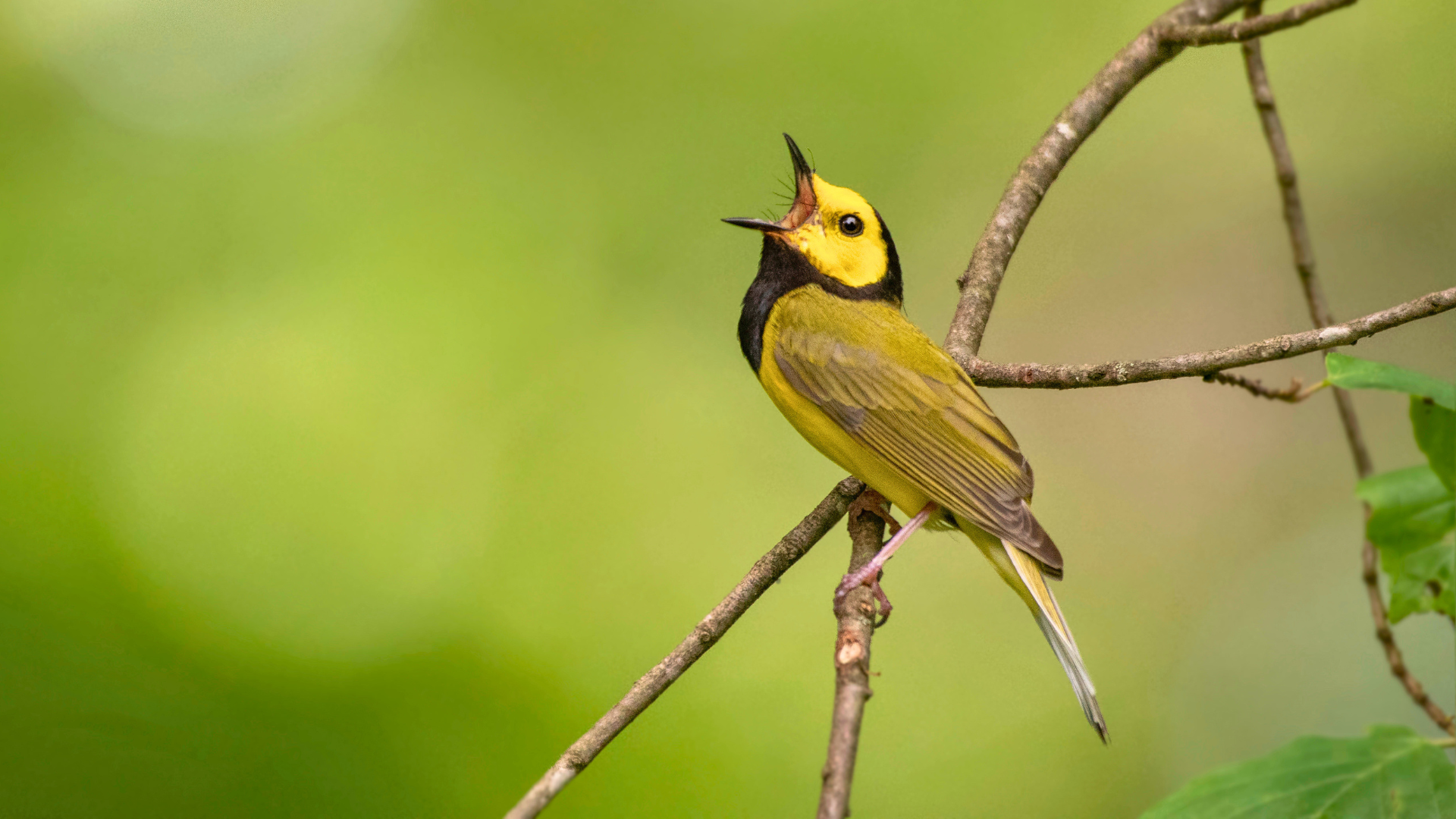
The feeling of being surrounded by songs you cannot name is one of the most common experiences in birding, and one of the most fixable. Warbler song identification is not a talent some people have and others do not. It is a skill that builds through practice, and the single most effective practice is also the simplest: when you hear a song, find the bird. Watch it sing. Lock the sound to the image while both are happening at once. Your brain is built for exactly this kind of audiovisual pairing, and once it makes that connection, it holds it.
That is the method. This guide gives you the framework to use it.
Why Spring Is the Best Time to Learn
Learning warbler vocalizations can be a great help in locating and identifying birds during the spring. Many skilled birders identify warblers by sound before they see the singer. Warblers sometimes vocalize during fall migration, but much less frequently.
This asymmetry between spring and fall song is significant for beginners. In spring, male warblers are singing at peak intensity on or near their breeding territories. The song is loud, frequent, and consistent. The same bird may sing from the same tree for 20 minutes, giving you repeated opportunities to close the distance and get eyes on it while it is still singing.
In fall, warblers are largely silent. The same 35 species that filled the May woodlot with song will pass through in September as near-silent shapes, often in confusing non-breeding plumage. Learning songs in fall is like trying to learn faces from passport photos of people in identical grey coats.
Spring is the window. The songs are there. The birds are there. The conditions for building permanent auditory memory are better than at any other point in the year.
The Framework: Three Questions for Every Song
Before touching a single species, you need an analytical vocabulary. By using a few simple, objective terms, you can understand the structure and quality of a song, and identify what is unique about it. Three basic qualities cover most warbler songs: sound quality, pitch trend, and structure.
Ask these three questions about every warbler song you hear, in this order.
Question 1: What is the sound quality?
There are three useful terms for sound quality: Buzzy, like a bee; Clear, something you could whistle; and Trilled, a lot of sounds in a row that are too fast to count. Sometimes a bird can sing more than one quality in a song.
This first question alone eliminates a huge portion of the warbler field guide. A buzzy song belongs to a different cluster of species than a clear whistled song. A trill is its own category. Before you know species, you know families of sound.
Question 2: What is the pitch trend?
Is the overall pitch of the song rising, falling, steady, or variable? Look for the overall trend of the song. If there is a slight fall in pitch but otherwise the song is mostly rising, it would still be considered a rising song.
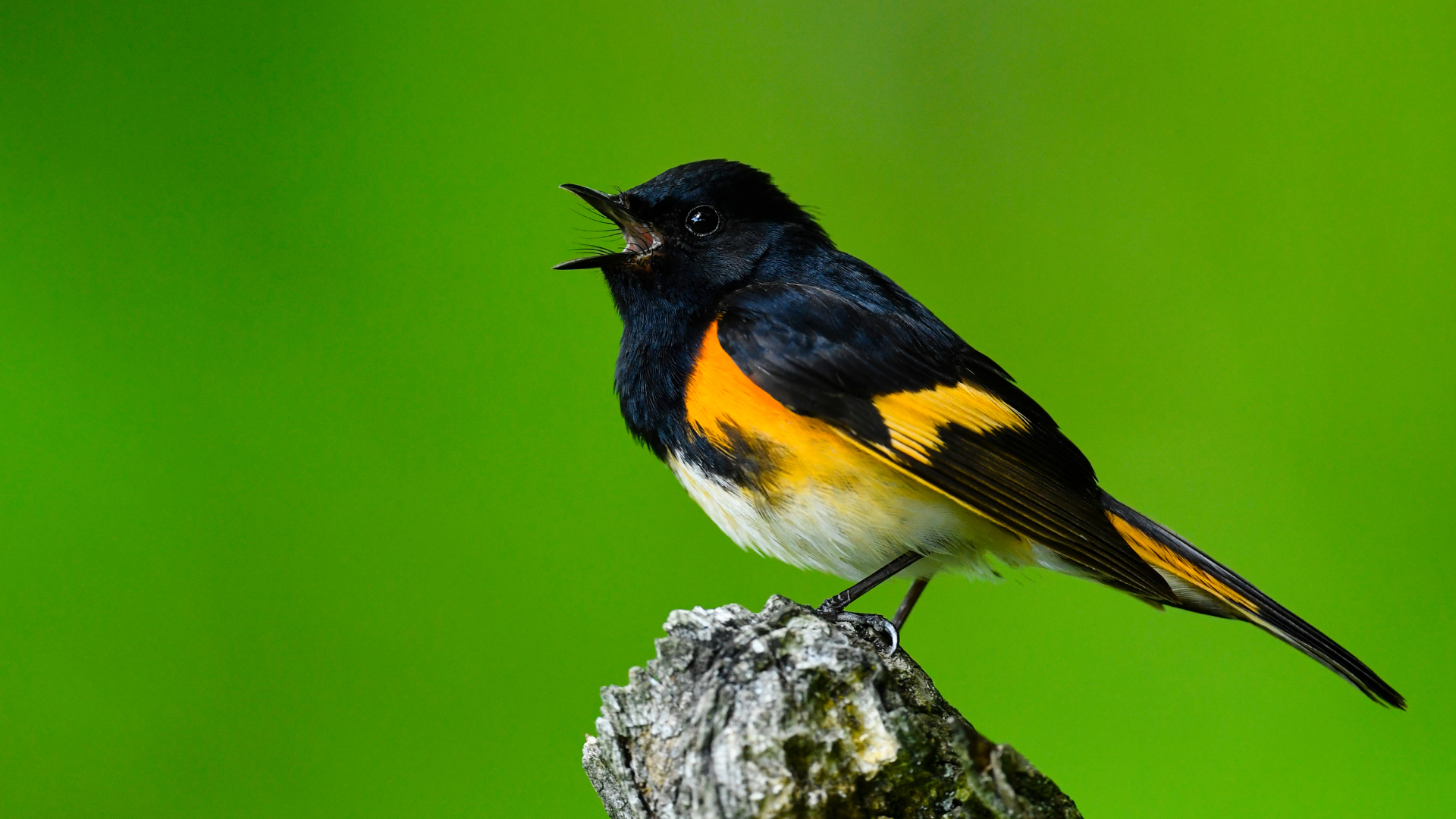
A song that climbs feels different from one that drops. The Prairie Warbler's song rises steadily through its phrase. The American Redstart's typically drops at the end. Once you are asking about pitch direction, you start to hear structure you were previously missing.
Question 3: How many sections does it have?
We break songs down into sections. A section begins whenever there is a dramatic change in pitch or speed. Counting the number of sections in a song can be one of the most effective ways to identify it.
Some warbler songs are long and complex. Nashville Warbler has a two-part song. Tennessee Warbler has a three-part song. Louisiana Waterthrush has long slurred introductory whistles that descend into a jumble of quieter notes. Counting sections sounds technical until you do it once. Then it becomes a reflex.
Apply these three questions to any song you hear, and you have narrowed the candidate list before consulting any reference.
Six Anchor Songs for Spring Beginners
Rather than overwhelming you with 35 species, here are six songs chosen because they anchor the three-quality framework with distinct, learnable examples. Know these six and you have a working foundation for the whole warbler chorus.
1. Ovenbird (Seiurus aurocapilla)
Quality: Clear. Pitch: Rising. Sections: One, repeated.
The Ovenbird's song is the loudest voice in the spring forest understory and one of the most recognizable once you know it. The Ovenbird sings teacher-teacher-teacher, which gets progressively louder. Each repetition is slightly more emphatic than the last, building in intensity through the phrase. This bird sings from the forest interior at mid-height, often invisible, but the escalating teacher phrase is unmissable once learned. When you hear something emphatic and rising in a mature forest and cannot see the source, start looking at mid-height in the understory.
2. Common Yellowthroat (Geothlypis trichas)
Quality: Clear. Pitch: Steady. Sections: One, repeated.
The Common Yellowthroat sings witchity-witchity-witchity from low shrubby habitat, wet edges, and marsh margins. It is one of the most abundant warblers in North America and one of the first songs beginners learn because it is loud, repetitive, and delivered from exposed perches in accessible habitat. When you hear witchity from a cattail marsh or a shrubby wet edge, you are hearing the Common Yellowthroat. Find it, watch it sing, and that pattern is locked for life.
3. Yellow Warbler (Setophaga petechia)
Quality: Clear and sweet. Pitch: Rising then level. Sections: Two.
The Yellow Warbler sings sweet-sweet-sweet, I'm-so-sweet. The song has a two-part quality: a series of sweet clear notes that rise, then a final emphatic phrase that levels or drops slightly. This bird sings from willows, alders, and shrubby edges near water, and it is one of the more cooperative warblers for close observation. Males sing persistently and are often visible at eye level or below. The visual of a bright yellow bird with rusty streaks singing from a willow branch, heard alongside that clear sweet song, is one of the most satisfying first connections a beginning birder makes.
4. Black-throated Green Warbler (Setophaga virens)
Quality: Buzzy. Pitch: Variable. Sections: Two.
The Black-throated Green Warbler sings zee-zee-zee-zoo-zee, or trees-trees-murmuring-trees. The buzzy quality is immediately distinctive from the clear whistled songs above. This bird sings from the canopy of mature deciduous and mixed forest, and the song carries well despite coming from height. Once you have anchored the buzzy quality on this species, you can start separating other buzzy warblers by their specific patterns and pitch trends.
5. Northern Parula (Setophaga americana)
Quality: Buzzy trill. Pitch: Rising then dropping sharply. Sections: One with a distinctive ending.
The Northern Parula sings a buzzy trill that gets progressively louder and then drops over the top. The last drop-off makes it fairly easy to identify. The rising buzz that suddenly flips down at the end is one of the most distinctive song endings in the warbler family. Once you know that drop, you identify Northern Parula from the first note of that terminal flip before consciously processing any other feature.
6. Chestnut-sided Warbler (Setophaga pensylvanica)
Quality: Clear. Pitch: Rising with emphatic ending. Sections: Two.
The Chestnut-sided Warbler sings please-please-pleased-to-meet-cha, with emphasis on the final syllable. The song's emphatic downward conclusion on meetcha is the identifying feature. This bird uses recently regenerated forest edges, shrubby clearings, and forest gaps, often at eye level, making it one of the more visually accessible spring warblers. Watching a male Chestnut-sided Warbler, white below with chestnut flanks and yellow crown, deliver that please-to-meetcha from a low perch is one of the complete spring warbler experiences: song, behavior, and plumage simultaneously.
The Method That Works Better Than Any App
Every experienced birder arrived at their current level by time in the field. There is no shortcut around that, and no app replaces it. But there is a technique that makes every hour of field time more effective than it would otherwise be.
When you hear a song you do not know, do not immediately reach for Merlin or a field guide. First, find the bird. Watch it sing. Stay on it for as long as it keeps singing. While it is singing, you are building the audiovisual connection your brain uses for long-term retention: the visual of where the bill opens, the posture of the bird on the branch, the timing between phrases. You are not just memorizing a sound. You are encoding a complete behavioral event.
Spring is when warblers are at their most vocal. The framework above gives you the system. But the framework only converts into skill when you apply it to a bird you can actually see singing.
Once you have the visual connection, consult Merlin or Xeno-canto to confirm and name what you experienced. Then listen again, looking at the spectrogram if one is available. The combination of the field experience and the reference review is what converts a single encounter into a permanent identification.
How to Use Merlin Honestly
Merlin Sound ID is the most useful birding technology released in the past decade. It identifies songs in real time from your phone's microphone, displays the spectrogram, and logs identified species automatically. For beginning warbler song learners, it has one superpower and one limitation worth knowing.
The superpower: Merlin shows you what is around you that you are not hearing yet. Open it in a productive woodlot on a May morning and the species list builds faster than your ears alone could assemble it. This is genuinely useful for knowing what to look and listen for.
The limitation: Merlin does not teach you to hear. If you spend a spring morning walking with Merlin running and never stopping to find and watch a singing bird, you will have a species list and no song knowledge. The app identifies the birds. It does not build the auditory memory that makes you independent of it.
Use Merlin to inventory what is present. Then put the phone in your pocket, find a singing bird, and watch it until it stops. That is the combination that actually develops skill.
The Dawn Chorus Practice Window
The single best practice session available to a beginning warbler song learner is the dawn chorus, the 30 to 45 minutes around and just after first light when singing intensity peaks across the entire warbler community.
The song of the Yellow-rumped Warbler (Setophaga coronata) is the most common one heard during the first half of spring migration, and the song of the American Redstart (Setophaga ruticilla) is one of the most common during the second half. These two species bracket the season and give you consistent reference points. By the time you can pick both out of the dawn chorus without effort, you have built enough auditory anchors to start separating the species between them.
The dawn chorus is useful for beginners for a specific reason: at first light, individual singers are most distinct from each other. As the morning progresses and multiple birds sing simultaneously, the songs layer into a complex mix that is harder to parse. At 5:30 AM in late April, a single Ovenbird in the understory 40 meters away may be the only voice in the immediate vicinity. You can hear it completely, isolate it, apply the three-question framework, and find the bird before other songs begin competing for your attention.
Go to the same patch of woods at dawn repeatedly through the season. Familiarity with the acoustic background of one place lets you notice new arrivals immediately.
Using Habitat as a Pre-Filter
One technique that dramatically reduces the difficulty of warbler song ID is using habitat before using your ears.
Birds who stay on or near the ground sing louder songs in a lower pitch, because sound does not travel as well on the forest floor. Birds who spend most of their time in the treetops are more likely to sing quieter and higher-pitched songs, because there are fewer impediments to block the sound.
This gives you a pre-filter before you analyze any song feature. A loud, emphatic song from the forest floor suggests Ovenbird, Louisiana Waterthrush (Parkesia motacilla), or Kentucky Warbler (Geothlypis formosa). A thin, high song from the canopy of mature conifers narrows the field to Blackburnian (Setophaga fusca), Black-throated Green, or Cape May (Setophaga tigrina). A witchity from wet shrubby edge is Common Yellowthroat before you even look up.
Knowing what species to expect in the habitat you are standing in cuts the candidate list from 35 to 8 before the sound analysis begins. Combined with the three-question framework, it makes a morning of unknown songs into a morning of educated guesses, most of which turn out to be correct.
Where to Go to Learn: The Best Practice Habitats
You do not need a famous migration hotspot. You need a patch with singing birds that you can return to repeatedly. Repetition at a familiar site builds faster than novelty at a new one.
For warbler song learning in spring, the most productive habitats are mixed deciduous woodland with a shrubby understorey, wet edges and alder thickets near water, and regenerating forest clearings with dense low vegetation. Each holds a different community of species, and visiting all three within your local area gives you the widest species exposure per unit of time.
For a broader look at how to read woodland structure for bird diversity, see our guide on how to find a fallout during spring migration, which covers the habitat features that concentrate migrants most reliably and applies directly to productive warbler song learning sessions.
The Short Version
Learn three questions: what is the quality, what is the pitch trend, how many sections. Apply them to the six anchor songs above. Go to a familiar patch at dawn, put Merlin in your pocket, and find singing birds. Watch them sing. Come back to the same patch until the common songs are automatic.
The warblers are arriving now. The males are singing at full intensity. The window in which this practice is most productive opens in late April and closes in June. The best time to start is the next morning you can be outside at dawn.