
How to Find a Fallout During Spring Migration
How to predict, find, and recognize a spring migration fallout: weather and habitat.
It was raining birds and raining water at the same time. Warblers were everywhere, in every shrub, on every branch, moving through the vegetation at eye level with the frantic urgency of birds that had been flying through rain all night and needed to eat immediately. The sensory overload of a true fallout is something you cannot prepare for. You can read about it a hundred times and still not be ready for the moment it actually happens around you.
A migration fallout is not a good morning in the park. It is not a busy day at a well-known hotspot. A fallout is a massive number of migratory birds, usually passerines and landbirds, which inundate an area due to a weather event. It is a completely different scenario from your typical flock doing its thing. When birds are doing their normal thing, foraging in the trees, singing their songs, that is bird migration. But a true fallout describes something else entirely.
A fallout is birds that should be somewhere else, forced down by conditions they could not fly through, concentrated into whatever habitat was immediately below them when they had no choice but to land. Once you have been inside one, you understand immediately why birders talk about them in reverent tones. This guide covers how to predict them, where to be when they happen, and how to recognize one while it is in progress.
What Actually Causes a Fallout
The mechanism is a two-stage weather event, and understanding both stages is what separates a birder who stumbles into fallouts occasionally from one who actively hunts them.
The key recipe for a fallout: southerly component winds over the southern half of the Gulf of Mexico, western Caribbean, and northern Central America at sunset, followed by northerly component winds and rain over the Gulf of Mexico or adjacent coast the morning following. These conditions generally happen when cold fronts pass through the region, bringing north winds with cooler and drier air that interacts with the warm southerly winds typical over the Gulf. These boundaries are often unstable, and the weather in their immediate vicinity can be intense, with strong winds and heavy precipitation.
In plain terms: stage one is a large migration night loaded with birds moving north on favorable southerly winds. Stage two is the arrival of a cold front or rain boundary that intercepts those birds mid-flight and forces them to land.
The same principle applies across the entire continent, not just the Gulf Coast. Migration fallout occurs when migrating birds are forced to pause their travels, often in areas they would not normally stop, because of unfavorable weather conditions. The best fallout days are the ones where lots of birds have moved overnight on a nice south wind with clear skies, but a shift in wind direction toward dawn, or a line of fog or rain, grounds them en masse. Those living just to the south of a line of precipitation are best positioned for a heavy showing of birds in the morning.
The geographic position relative to the frontal boundary matters enormously. Along an abrupt line where the rain or fog starts, birds may be quite literally dropping out of the sky along that frontal boundary. Being just south of that line, in the zone where birds first encounter the forcing conditions, puts you at the leading edge of the concentration.
The Fallout vs. the Washout: A Critical Distinction
This is the difference that experienced fallout hunters understand and most guides skip entirely.
Not every cold front produces a fallout. Strong north winds will not produce a fallout. What few birds are found under those conditions are hunkered down, taking shelter from the bad weather. A much-anticipated fallout can become a washout.
The distinction between a fallout and a washout comes down to the sequence of events:
A fallout happens when a large movement of birds on southerly winds is intercepted by a frontal boundary. The birds were moving, the front stopped them, they concentrate in the first available habitat. The morning after, they are exhausted and hungry but the weather has often improved enough that they feed actively. This is the raining-birds scenario. Warblers working through every layer of vegetation at once, too tired and hungry to be wary.
A washout happens when north winds suppress migration before it begins, or when the front arrives so early or so violently that birds never loaded up in the first place. The trees are quiet. The birds that are present are hunkered down, not feeding actively, often invisible. The morning feels dead even though the weather looks similar to a fallout setup.
The key diagnostic: check BirdCast's live migration map for the night before. Did birds actually move? A live map showing heavy migration aloft at midnight before the front arrived means you have fallout potential. A live map showing low or absent migration means the front suppressed departure and you are looking at a washout.
How to Predict a Fallout: The Evening Before
Active fallout hunting requires a specific evening routine. Here is the sequence that works:
Step 1: Confirm a large movement is loaded. Check BirdCast's forecast map for tonight. Orange or red over your region or the region to your south means birds are expected to be aloft in significant numbers. This is the fuel that a fallout requires.
Step 2: Find the frontal boundary. Open Windy and look for the wind shift line. Where southerly winds are giving way to northerly or northwesterly flow, and where precipitation is forecast along that boundary, is the fallout zone. Position yourself just south of that line.
Step 3: Watch for rain timing. Areas where birds encounter rain in addition to northerly winds will be more likely to experience fallout conditions, particularly if that rain occurs over water where birds are flying. If the rain arrives in the first few hours after midnight rather than at dawn, birds encounter it while they are committed to flight at altitude and have no choice but to descend quickly. Rain that arrives at dawn grounds birds that are already looking to land. Both produce fallouts. Rain that arrives in the afternoon after birds have already landed is irrelevant to the morning's birding.
Step 4: Check the live radar from midnight onward. BirdCast's live migration map layers weather data and migration intensity to show where birds are. A live map showing high migration intensity followed by a sudden collapse as the frontal boundary arrives is the radar signature of a fallout in progress. The collapse is birds landing.
Step 5: Set your alarm. If all four conditions align, be at your chosen site at or before first light. The concentration of birds in fallout conditions is highest in the first two hours after dawn, when exhausted birds are feeding most intensely and have not yet fully dispersed through the available habitat.
Where Birds Land: The Habitat Interception Framework
With normal weather, millions of songbirds migrate through the night. They land early in the morning, rest and feed through the day, and resume their travel the following night. While over land, the birds can disperse over a wide area and the daily fallout goes mostly unobserved.
A true fallout concentrates birds because they cannot disperse. The forcing conditions compel them to land wherever habitat is available below them at the moment of descent. Understanding what birds see from altitude when forced to land is the key to interception.
First available habitat after open water. If there is a cold front with northerly winds and rainy weather, migrants are forced to make landfall at the nearest suitable location. This is why the Gulf Coast sites are legendary: birds crossing 1,000 kilometers of open water have no option but to land in the first trees they reach. The same principle applies anywhere birds cross a large open area: a Great Lakes crossing, a river valley, a stretch of open agricultural land. The first patch of trees on the far side concentrates birds that had nowhere else to go.
Isolated habitat patches in open landscapes. The most spectacular fallouts happen where good habitat is scarce: a small woodlot surrounded by fields, a city park surrounded by concrete, a grove of trees on a coastal headland. Every bird in the sky targets the same patch because it is the only option.
South-facing slopes and forest edges. On the morning after a front, birds that landed in the first available cover will move toward warmth and insects as the weather clears. South and southeast facing edges, particularly where sun hits the vegetation early, concentrate birds in the mid-morning feeding period that follows a fallout.
Water features within fallout habitat. A drip, a fountain, or a small puddle in fallout habitat acts as a concentration magnet within the concentration. In a park full of grounded migrants, the birds with the highest energy deficit seek water first. A reliable water feature on a fallout morning can produce 15 species of warbler in 45 minutes.
Recognizing a Fallout While It Is Happening
The behavioral signature of a true fallout is distinct from normal migration activity, and recognizing it changes your strategy in the field.
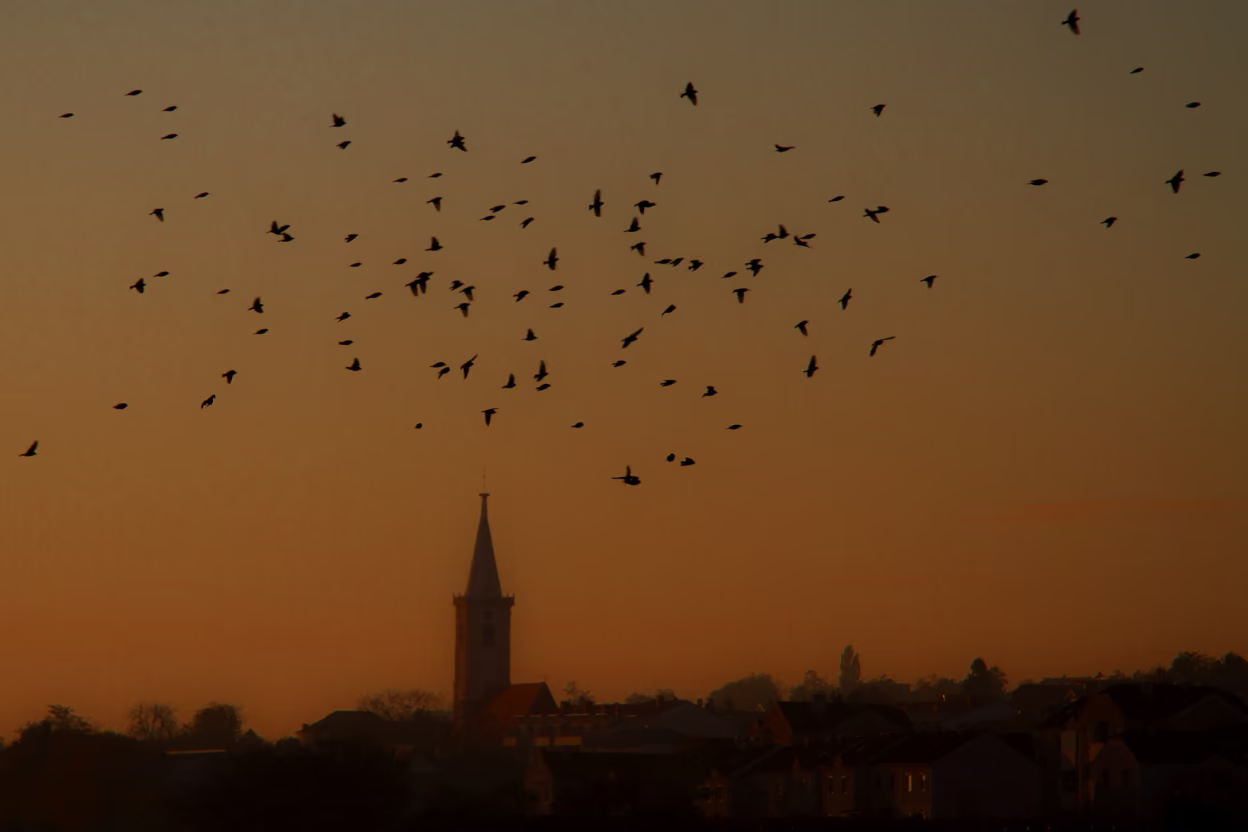
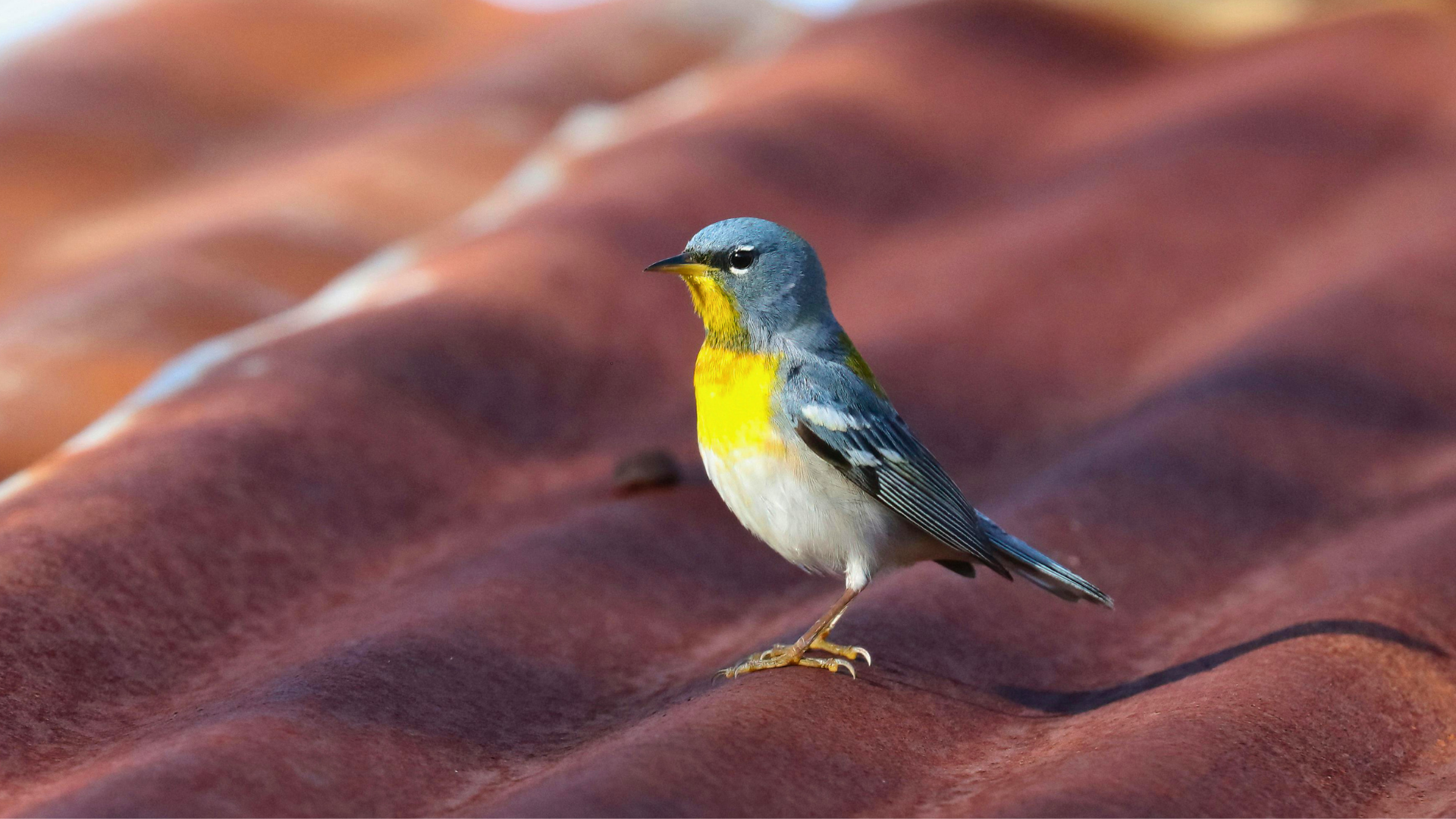
In a fallout, birds are not behaving normally. Thousands of birds literally fall out of the sky, warblers spiraling down like tumbleweeds, orioles hanging from every branch. The birds are exhausted, often wet, and feeding with an urgency that overrides their normal wariness. A Blackburnian Warbler (Setophaga fusca) that would normally require a sore neck and twenty minutes of patience to observe is working through waist-high shrubs at arm's length, too depleted to care about your presence.
The specific behavioral cues that tell you a fallout is in progress:
Birds feeding at every vertical level simultaneously. In normal migration, species segregate by foraging height. In a fallout, canopy species like Blackburnian are on the ground, ground species like Ovenbirds (Seiurus aurocapilla) are in the shrubs, and everything is mixed. If you see this vertical compression, you are in a fallout.
Unusual approachability. Every tree and bush is dripping with thrushes, tanagers, vireos, buntings, orioles, sparrows, and warblers, with birds clinging to small trees and vines at eye level. Birds in fallout conditions are often so depleted that they allow close approach that would be impossible under normal circumstances. A bird that allows you within two meters is telling you something about its energy state.
High species diversity in a small area. A single fallout tree can hold eight species of warbler simultaneously, species that would normally be spread across many hectares of habitat and different vertical zones. When your binoculars reveal a new species every thirty seconds without moving your feet, you are in a fallout.
Constant movement without territorial behavior. Migrant warblers in fallout conditions are not singing, not chasing each other, and not defending food sources the way residents do. They are feeding with grim efficiency, moving constantly through available vegetation, tolerating proximity to other species and individuals in a way that is never seen on breeding territory.
Fallout Beyond the Gulf Coast: Interior and Northern Events
The Gulf Coast fallout is the canonical example, but the same mechanics produce spectacular events throughout the interior and along northern flyways. Every birder in North America is within range of fallout conditions during spring migration.
Southwest winds helped push an influx of migrating birds toward coastal Massachusetts during one documented April event, where bouts of precipitation and fog quickly complicated their flight plans. It was one of the best April fallouts experienced in Massachusetts, with over 250 Northern Flickers (Colaptes auratus), 154 Golden-crowned Kinglets (Regulus satrapa), and 58 Hermit Thrushes (Catharus guttatus) counted at a single site in a single day.
The St. Lawrence system produces some of the most dramatic northern fallouts in North America. When a cold front intercepts a large movement along the river valley corridor, the concentration effect of birds funneled by the water barrier, combined with the limited suitable habitat on the north shore, creates events that rival Gulf Coast fallouts in density if not in raw exoticism. A strong frontal passage during the peak warbler window in late May, intercepting a large southerly movement above the St. Lawrence, can produce the raining-birds experience at sites anywhere along the Quebec north shore.
An adverse weather system may completely stall the migration for days, so when the migration does resume there is a huge pulse of birds concentrated along the migration front. Any morning after a surge, big fallouts can be seen. When you put all the adverse conditions together, migration stalled for days, a big open-water crossing, no favorable wind, precipitation and thick fog, the stage is set for a spectacular fallout.
The stall-and-surge setup is particularly relevant for interior birders. When a stationary frontal boundary suppresses migration for three or four days, and then favorable conditions return overnight, the backlog of grounded birds all moves at once. The front that follows that surge, if it arrives with rain, produces a concentration of birds representing multiple nights of stalled migration simultaneously. These are the events that produce species lists nobody believes.
After the Fallout: Reading the Second Day
The morning of a fallout is the spectacle. The day after is often underestimated.
Birds that landed in fallout conditions feed intensely through the day as they recover their energy reserves. Many will remain in the fallout patch for 24 to 48 hours before conditions allow them to resume migration. The second morning of a fallout event, when the weather has fully cleared and birds are refueled and active, often produces better visual observation than the fallout morning itself, because birds are no longer exhausted and hunkered. They are singing, active, visible, and still present in concentrations far above normal.
The species that linger longest after a fallout are worth targeting specifically: thrushes, whose energy deficit from long flights takes longer to recover, and species that are near the northern limit of their range at that location, which may be genuinely disoriented and uncertain of their next move.
Check eBird's Explore page for the fallout site the morning after to track what others are finding, and compare the species list to the day before. The persistence of species through day two tells you which birds are recovering versus which have already moved on.
For the weather-reading system that gets you to a fallout site at the right moment, see our guide on how to read weather radar for bird migration, and our guide on how to use BirdCast for spring birding, which together give you the complete prediction toolkit this article assumes.
The Short Version
A fallout requires two things: a large migration night on southerly winds, and a frontal boundary or rain that forces birds down before they can land normally. Check BirdCast for migration intensity the night before. Find the frontal boundary on Windy. Position yourself just south of where the rain will arrive. Be at the best available habitat, the most isolated patch of trees in the most open landscape, at first light. When birds are feeding at every vertical level simultaneously, allowing close approach, and your species list is doubling every ten minutes, you are in it.
The next one is out there. The radar will show you when to move. The birds will tell you when you have found it.