
Spring Hawk Watching 101: Ridge Sites, Flight Counting, and the Great Lakes Barrier
Spring hawk watching guide: ridge sites, Great Lakes barriers, and species timing.
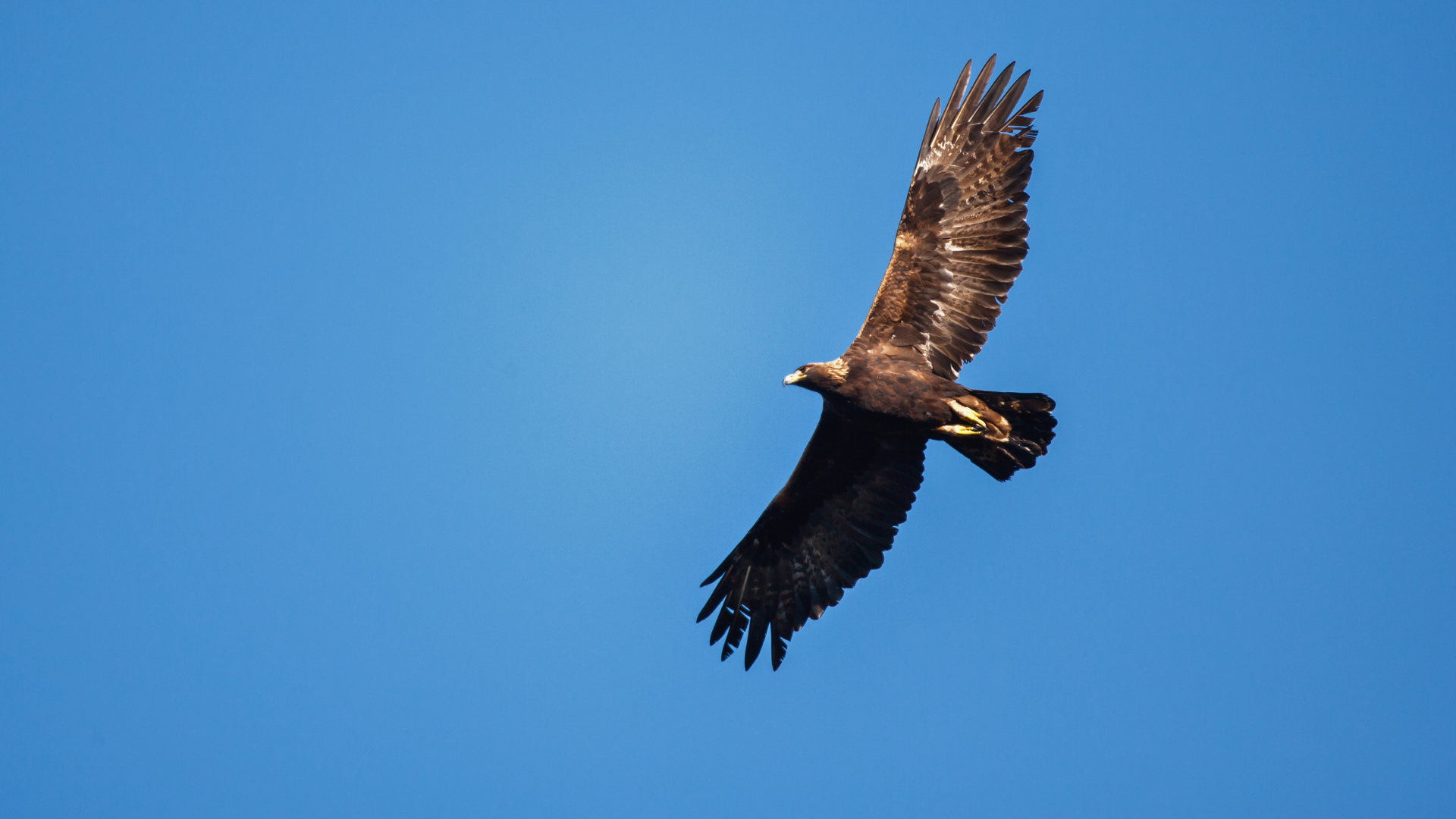
There is a specific kind of stillness that happens on a ridge watch when the flight suddenly turns on. You are scanning an empty sky, thermals not quite developed yet, and then a Sharp-shinned Hawk materializes over the tree line. Then three more. Then a kettle of fifteen forming and drifting northeast. Then a Golden Eagle appears below the ridge, tracking the contour of the slope so close you can see the pale panels on its wings without lifting your binoculars.
That is the experience at Belvedere Raoul-Roy in Parc National du Bic on a good spring morning: Sharp-shinned Hawks streaming through in dozens, early season Golden Eagles sliding past below you along the ridge face, the flight building as the thermals develop and the wind finds the right angle off the slope. It is a different experience from any other kind of birding. The birds are not hiding in vegetation and responding to pishing. They are moving through open sky on their own schedule, following geography that is millions of years older than your presence on it.
This guide covers how spring hawk migration works, why certain sites concentrate birds so dramatically, how to find and read a hawk watch site, and the basics of flight counting methodology that turns a morning on a ridge into a contribution to long-term raptor science.
Why Spring Hawk Migration Is Different From Fall
Most hawk watching content focuses on fall. The numbers are larger in fall, the site network is better documented, and the tradition of Appalachian ridge watching runs deeper in fall. But spring hawk migration has qualities that fall cannot match, and for certain species and sites, it is the superior season.
Spring birds are moving with urgency. They are not dispersing juveniles exploring new territory. They are breeding adults on a deadline, racing to reach nesting grounds before the season opens. In Sharp-shinned Hawks, juveniles tend to migrate first in fall, often pushing up against coasts as they search for prey and migration routes. Spring migration is a different composition entirely, often dominated by adults in fresh breeding plumage moving with directional purpose.
Spring flights are more compressed in time. A fall migration at a ridge site may dribble birds through for 10 weeks. A spring flight concentrates into a narrower window, and the peak days can be extraordinary. At Braddock Bay on Lake Ontario, a massive raptor movement on April 23, 2007 produced almost 17,000 raptors counted, including 12,976 Broad-winged Hawks, 1,684 Turkey Vultures, and 1,519 Sharp-shinned Hawks in a single day.
Spring birds also cut weather corners differently. Adults know the route. They push harder into marginal conditions, use thermals more efficiently, and travel faster. The flight that comes through on a spring morning after a cold front passes is often tighter, faster, and more dramatic than its fall equivalent.
How Ridge Sites Work: Thermals and Updrafts
Birds of prey tend to migrate over land, where mountain ridges serve as important leading lines. The air currents associated with mountain ridges allow migrating hawks to conserve energy during flight, and hawks will follow these ridges as long as they point in the general direction of migration.
Two distinct mechanisms concentrate hawks at ridge sites, and understanding the difference shapes how you read a site and plan your day.
Updrafts are deflection currents. Wind hits a ridge face perpendicularly and is deflected upward, creating a continuous band of rising air along the ridge crest. Hawks exploit this by soaring along the deflection current without flapping, covering distance at minimal energy cost. Updraft flights are strongest when winds are perpendicular to the ridge at 15 to 30 mph, and they produce a sustained, linear movement of birds along the ridge face. These flights happen regardless of cloud cover and sun angle, and can continue from dawn to dusk in the right wind conditions.
Thermals are columns of warm air rising from sun-heated ground. Broad-winged Hawks and buteos are thermal specialists, circling up inside a thermal until they reach altitude, then gliding toward the next thermal in the direction of migration. Thermal-dependent flights do not start until the sun has warmed the ground sufficiently, typically two to three hours after sunrise, and they shut down when cloud cover blocks solar heating. The best thermal flights happen on sunny days with light to moderate winds, and produce the classic spectacle of kettles: spiraling groups of hawks riding a thermal column upward together.
Knowing which mechanism your site uses tells you when to arrive. An updraft ridge watch means be there at first light. A thermal-dependent buteo flight means the coffee can wait until 9 AM.
The Great Lakes Barrier Effect
Broad-winged and Red-tailed Hawks generally avoid flying long distances over water because they rely primarily on thermal lift to help reduce their energy expenditure. Thermals are created by columns of warm air rising from the heated earth. These thermals allow birds to soar high with little effort. Water inhibits the development of good thermals.
This is the mechanism behind the most spectacular spring hawk watching sites in North America. The Great Lakes are massive barriers to thermal-dependent raptor migration. A Broad-winged Hawk cannot ride thermals across Lake Ontario. It must go around.
In spring, northbound buteos and others such as Turkey Vulture fly up the upper peninsula of Michigan and lower Michigan to avoid the Great Lakes, or swing east around Lakes Erie and Ontario, so vast numbers are seen at Braddock Bay and Derby Hill, New York, on the southern shore of Lake Ontario.
Braddock Bay is at a point on the southern shore of Lake Ontario where the lakeshore abruptly turns southeast for 7.5 miles. This location concentrates raptors that are migrating east along the southern shore of Lake Ontario and who are attempting to go around the Great Lakes rather than pass over them. As these birds move east along the Lake Ontario shore, they suddenly find themselves with water not only to the north, but to their east as well. The result is a geographic funnel that concentrates birds from an enormous catchment area into a single narrow point.
Beginning in March and continuing into May, sites including Braddock Bay and Derby Hill Bird Observatory on Lake Ontario, and the Hamburg and Ripley hawk watches on Lake Erie, submit daily reports of migrating hawks, eagles, and vultures.
At the northern end of the system, Whitefish Point is one of the most important spring flight corridors for raptors in North America. The point juts into Lake Superior and acts as the last land bridge before the open lake, funneling everything moving north into a narrow corridor. The hawk count begins in mid-March, starting slowly with Bald Eagles as the primary birds as they power over Whitefish Bay to Canada. Rough-legged Hawks start their return to the Canadian arctic in March as well, with as many as 3,000 counted in a single season. The persistent snow cover acts as a spotlight, illuminating the undersides of these arctic buteos as they pass overhead.
The same barrier principle operates at Quebec sites like Parc National du Bic. The St. Lawrence River acts as a partial water barrier and orientation line, and ridge systems perpendicular to the migration axis concentrate birds at elevation. A site like Belvedere Raoul-Roy sits at the intersection of both effects: a ridge that generates updrafts and a geographic feature that concentrates birds moving along the river valley.
The Spring Species Sequence
Spring hawk migration is not a single wave. It is a sequence of pulses, each species arriving in its own window determined by wintering grounds, breeding schedule, and migration strategy.
March: The season opens with eagles and large buteos. Bald Eagles (Haliaeetus leucocephalus) are early, pushing north as soon as ice begins to break. Golden Eagles (Aquila chrysaetos) are among the first raptors to move in spring, and early March Golden Eagle flights at northern sites can be exceptional, particularly along the St. Lawrence and around the Great Lakes. Rough-legged Hawks (Buteo lagopus) begin their return to Canadian arctic breeding grounds in March. Turkey Vultures (Cathartes aura) appear by late March at southern sites, earlier than most people expect.
Early to mid-April: The accipiters build. Sharp-shinned Hawks (Accipiter striatus) reach peak numbers in April at most eastern sites. Cooper's Hawks (Accipiter cooperii) follow close behind. Northern Harriers (Circus hudsonius) move through steadily. Osprey (Pandion haliaetus) appear regularly, often in good numbers at water-adjacent sites. Merlin (Falco columbarius) and American Kestrel (Falco sparverius) begin moving through.
Late April to early May: The Broad-winged Hawk (Buteo platypterus) pulse. This is the signature event of eastern spring hawk watching. Broad-winged Hawks migrate over sites like Derby Hill and Braddock Bay in a much shorter time period than species like Red-tailed Hawk, which has a protracted migration pattern. On the right day, tens of thousands can pass a single site. The species is a dedicated thermal user, and Broad-wing days are entirely weather-dependent: clear skies, building thermals, and light to moderate southwest winds are the recipe.
May: The season closes with late migrants. American Kestrels peak in May at many northern sites. Peregrine Falcons (Falco peregrinus) move through. Mississippi Kites (Ictinia mississippiensis) appear at southern sites in late April and early May.
How to Find a Good Hawk Watch Site
The established sites are the starting point. The HawkCount database, maintained by the Hawk Migration Association of North America, lists active hawk watch sites across the continent with daily count data submitted in real time during migration. Filter for spring counts in your region and you will find every active watch within range.
Beyond the established network, the principles for finding your own site are straightforward:
Ridges perpendicular to migration flow. In the east, the primary migration axis is northeast-southwest. A ridge running northeast-southwest concentrates updraft flight along its crest most effectively when the prevailing westerly winds hit it at roughly 90 degrees. Find ridges with this orientation on a topographic map and you have candidate sites.
Peninsulas and points on large water bodies. Any geography that concentrates birds against a water barrier creates hawk watch potential. The Great Lakes are the obvious examples, but large inland lakes, the Chesapeake, and coastal points all apply the same principle. A peninsula pointing into a large lake on a spring morning can hold birds from a catchment area of hundreds of square kilometers.
Elevation with clear sky view. You need to see the sky, not just the ridge. A site with a 180-degree view of open sky to the south and west is worth far more than a higher elevation with obstructed sight lines. The Belvedere overlooks at Parc National du Bic work precisely because the elevation gives you open sky in multiple directions and puts you at or above the flight line of birds using the ridge.
Flight Counting: How It Works
Standing on a ridge and watching hawks is a pleasure. Counting them accurately and submitting that count to a long-term database is what transforms the pleasure into science.
Daily counts including hourly totals are submitted to the Hawk Migration Association of North America, an organization that maintains the data of watches throughout North America. This data has been used to document population trends in raptor species across decades, identify range shifts, and detect the effects of environmental contaminants and habitat loss.
The methodology is straightforward in principle and challenging in practice:
Count everything that passes. Every raptor that moves through the field of view during the count period is tallied. The official counter at a site maintains continuous vigilance, binoculars up, throughout the count day.
Use a tally counter. A mechanical or digital tally counter held in one hand allows you to click birds without taking your eyes off the sky. Most counters use one per species category during heavy flights, keeping separate tallies for Sharp-shinneds, Cooper's, Broad-wings, and so on, then reconciling at the end of each hour.
Count kettles systematically. A kettle of Broad-winged Hawks in a thermal can contain anywhere from 20 to several thousand birds. The standard technique is to count in blocks: divide the kettle visually into sections and count one section, then multiply. A kettle that fills a quarter of your field of view and you count 40 birds in a tenth of that section contains approximately 1,600 birds. Speed matters because kettles form and dissipate quickly and birds are simultaneously streaming out of the top as new birds enter at the base.
Record hourly totals. The temporal pattern of a flight is as scientifically valuable as the total. Hourly totals show when the flight peaked, how long it sustained, and how it responded to changes in weather conditions through the day. These patterns, accumulated over years, reveal the relationship between weather systems and migration intensity with remarkable precision.
Submit to HawkCount. Even informal counts from non-official sites contribute useful data when submitted. The HawkCount submission system accepts counts from any location. Your ridge site, even if it has never been formally counted before, adds a new data point to the continental network every time you submit.
Weather Conditions for Spring Hawk Watching
Optimum conditions for flights at spring Great Lakes sites occur when there are strong southerly winds, 10 miles per hour or more, accompanied by rising temperatures. These conditions occur when a low-pressure system approaches from the west and passes to the north, or when a warm air mass moves from the Gulf of Mexico.
The day-after-frontal-passage setup is the classic recipe for an exceptional spring ridge watch. A cold front comes through overnight: rain, north winds, grounded birds. The front clears by morning, the pressure rises, winds swing southwest, the sun heats the ridge, and the birds that were waiting behind the front lift off en masse. The first clear morning after a multi-day northerly wind event is the single most reliable predictor of a heavy hawk flight.
At Lake Ontario sites, strong southerly winds tend to concentrate migrating raptors along the lake shore and usually keep them low as they avoid getting blown out over the lake. Light winds make them go higher. Higher birds are harder to count and harder to identify but cover more distance per unit of energy. Low birds are a spectacle: Sharp-shinneds threading through at eye level, Golden Eagles reading the slope below you, Broad-wings in kettles close enough to see the band pattern on their tails.
Check Windy the night before for the 850 hPa wind layer, which shows you the upper-level flow that drives migration. Southwest flow at altitude with clearing skies at the surface: set your alarm. For the full weather-reading workflow, see our guide on how to read weather radar for bird migration.
Essential Equipment
You need less than you think. The basics are binoculars, a camp chair or the ability to sit comfortably for hours, and layered clothing. Ridge sites are cold in spring, particularly in March and April, often 10 degrees colder than the valley below due to wind exposure. The Belvedere Raoul Roy at Parc du Bic faces the St. Lawrence without shelter. Dress for winter on a March hawk watch, not for the temperature in the parking lot.
A spotting scope is not strictly necessary for hawk watching in the way it is for shorebirding, because raptors move rather than hold still. But for distant kettles and for identifying the smaller accipiters at range, a scope adds identification confidence. The most useful hawkwatching accessory is a notebook: recording the species composition, timing, and behavior of a flight in real time teaches you more about raptor migration than any field guide.
For real-time count data from active sites during your visit, the HawkCount website and its companion app allow you to follow live counts from sites across the continent. Watching the Braddock Bay count build in real time while you are at your own local site, noting the lag between their peak and yours, teaches you the geography of migration in a way that no map can.
The Short Version
Go to a ridge, a peninsula, or a lakeshore point on the first clear morning after a multi-day north wind event in April. Arrive early enough for the updraft flight and stay through the thermal window, which peaks from mid-morning to early afternoon. Bring binoculars, a chair, and warm clothes. Keep a tally of every species and submit it to HawkCount. Watch for the first kettle of Broad-wings to form, because once that happens, the morning will take care of itself.
For a complete list of active spring hawk watch sites with live daily counts, visit the Hawk Migration Association of North America HawkCount database.
Spring migration is moving north right now. The ridge is waiting.
The allure of off-the-beaten-path travel
Lorem ipsum dolor sit amet, consectetur adipiscing elit ut aliquam, purus sit amet luctus venenatis, lectus magna fringilla urna, porttitor rhoncus dolor purus non enim praesent elementum facilisis leo, vel fringilla est ullamcorper eget nulla facilisi etiam dignissim diam quis enim lobortis scelerisque fermentum dui faucibus in ornare quam viverra orci sagittis eu volutpat odio facilisis mauris sit amet massa vitae tortor.
Unveiling the charm of lesser-known Destinations
Orci sagittis eu volutpat odio facilisis mauris sit amet massa vitae tortor condimentum lacinia quis vel eros donec ac odio tempor orci dapibus ultrices in iaculis nunc sed augue lacus.
- Lorem ipsum dolor sit amet consectetur facilisi etiam dignissim diam quis enim
- Mauris aliquet faucibus iaculis dui vitae ullamco sit amet luctus
- Posuere enim mi pharetra neque proin dic rhoncus dolor purus non enim
- Dui faucibus in ornare posuere enim mi pharetra neque proin dicit
Finding solitude in hidden gem locations
Lorem ipsum dolor sit amet, consectetur adipiscing elit ut aliquam, purus sit amet luctus venenatis, lectus magna fringilla urna, porttitor rhoncus dolor purus non enim praesent elementum facilisis leo, vel fringilla est ullamcorper eget nulla facilisi etiam dignissim diam quis enim lobortis scelerisque fermentum dui faucibus in ornare quam viverra orci sagittis eu volutpat odio facilisis mauris sit amet massa vitae tortor condimentum lacinia quis vel eros donec ac odio tempor orci dapibus ultrices.
The thrill of discovering untouched natural beauty
Dolor sit amet, consectetur adipiscing elit ut aliquam, purus sit amet luctus venenatis, lectus magna fringilla urna, porttitor rhoncus dolor purus non enim praesent elementum facilisis leo, vel fringilla est ullamcorper eget nulla.
- Lorem ipsum dolor sit amet consectetur tempor orci dapibus ultrices
- Mauris aliquet faucibus iaculis dui vitae ullamco elementum facilisis
- Posuere enim mi pharetra neque proin dic fermentum dui faucibus in ornare
- Purus sit amet luctus posuere enim mi pharetra neque proin dic
“Ut enim ad minim veniam, quis nostrud exercitation ullamco laboris nisi ut aliquip ex ea commodo consequat uis aute irure dolor in reprehenderit in voluptate velit”
Exploring cultural marvels off the tourist radar
Donsectetur adipiscing elit ut aliquam, purus sit amet luctus venenatis, lectus magna fringilla urna, porttitor rhoncus dolor purus non enim praesent elementum facilisis leo, vel fringilla est ullamcorper eget nulla facilisi etiam dignissim diam quis enim lobortis scelerisque fermentum dui faucibus in ornare quam viverra orci sagittis eu volutpat odio facilisis mauris sit amet massa vitae tortor condimentum lacinia quis vel eros donec ac odio tempor orci dapibus ultrices in iaculis nunc sed.