
How to Find Shorebirds in Flooded Agricultural Fields in Spring
Find spring shorebirds in flooded fields using water depth and scope technique.
Most birders think of shorebirds as a coastal proposition. Tidal mudflats, sandbars, the edges of estuaries. That framing misses one of the most productive and underbirded habitats in North America during spring migration: the flooded agricultural field.
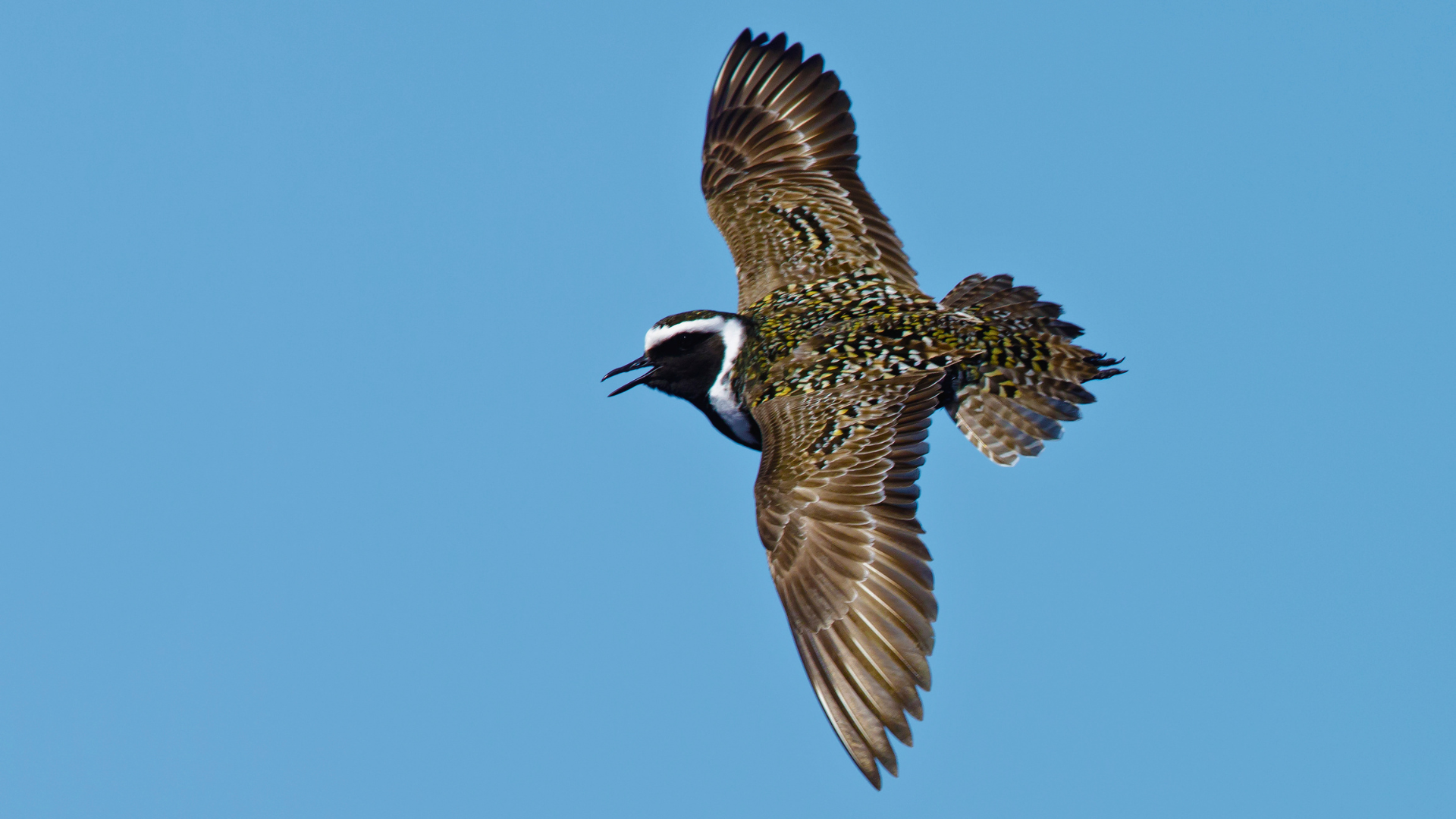
A muddy corner of a corn field. A low-lying section of a soy field still holding water from last week's rain. A recently irrigated strip of farmland with just enough standing water to reflect the sky. Pull over, set up your spotting scope, and you may be looking at something that stops you in your tracks. There are few spring birding experiences that match a flock of 50 American Golden-Plovers dropping into a wet field and spreading across it, feeding in the morning light. Once you have seen that, you go looking for it every year.
This guide covers how to find flooded fields worth stopping at, how to read them quickly from the road, which species to expect in spring and in what order, and the identification skills that help you catch the birds you might otherwise drive past.
Why Flooded Fields Work as Shorebird Habitat
Flooded agricultural fields provide productive foraging sites for migrating shorebirds due to their potentially high invertebrate production. When a field floods, dormant invertebrate eggs and larvae in the soil activate rapidly. Worms rise to the surface. Aquatic insects colonize within days. The result is a temporary but extremely rich food source concentrated in a shallow, accessible layer of water and mud, precisely the conditions shorebirds are built to exploit.
In regions which have experienced substantial wetland loss, managed wetlands and flooded agricultural fields make up the core habitat network that shorebirds and other waterbirds rely on to rest and feed during migration. This is not a marginal habitat. In many parts of the interior United States and Canada, flooded agricultural fields are now the primary shorebird stopover habitat available, replacing the natural wetlands that have been drained over the past century. Small, isolated wetlands in the Prairie Pothole Region of North America host millions of migrant shorebirds each spring, and the same logic applies to flooded fields across every flyway.
The Water Depth Rule
This is the single most important thing to understand before you start looking.
For many shorebird species, foraging is limited to water depths less than 10 cm deep. Smaller shorebirds with short bills and short legs such as sandpipers have the most narrow habitat requirements, using saturated wetland soils and regions flooded up to just 5 cm deep. Shallow water areas are not only more accessible to smaller shorebirds, but facilitate higher foraging efficiency as they recede and concentrate prey.
In practical field terms: you are looking for puddles, not ponds. The ideal flooded field from a shorebird perspective has water between 2 and 10 centimeters deep, with visible muddy edges and exposed substrate where birds can probe. Deep water holds ducks. Barely wet mud holds the smallest peeps. The transition zone between the two, where water thins to a film over saturated soil, is where the highest species diversity concentrates.
When you pull up to a field and the water looks ankle-deep or more across most of its extent, keep driving. When you see shallow water with visible mud edges, exposed weed stubble breaking the surface, and birds actively moving and probing rather than swimming, you have found something worth stopping for.
How to Find Flooded Fields in the First Place
This is the step most guides skip entirely. Knowing what a good field looks like does not help if you cannot find one.
Drive the county road grid after rain. The most reliable method is also the simplest. After 24 to 48 hours of significant rain during peak migration weeks, drive the rural road network in your area and scan low-lying fields systematically. Agriculture concentrates in flat terrain, flat terrain collects water, and low corners of large fields flood first. You are looking for standing water visible from the road, especially in fields with recent tillage or minimal crop cover, which reduces visual obstruction and gives birds an open sight line.
Use Google Maps satellite view in advance. Before you drive, look at the agricultural areas within 30 to 60 kilometers of your location in satellite view. Identify the low-lying fields, the ones that appear darker or show drainage patterns. Note fields adjacent to drainage ditches and those at the base of slight grades. These are the fields that flood first and hold water longest. Save a list of candidate locations before migration peaks so you are not searching from scratch when conditions align.
Use eBird to find active sites. Search eBird's Explore tool for your county or region and filter recent checklists for shorebird species. When someone reports 12 species of shorebirds at an address you do not recognize, it is almost certainly a flooded field. Click through to the checklist location on the map, note the coordinates, and add it to your list.
Know your local weather window. Flooded fields are ephemeral. After rain stops, most agricultural fields drain or evaporate within three to five days depending on soil type, temperature, and drainage infrastructure. The best birding in a flooded field is typically 24 to 72 hours after a rain event, before the water drops below the usable threshold. Check the forecast the night before and prioritize fields you already know hold water based on previous visits.
How to Bird a Flooded Field Efficiently
Work from the car. This is not laziness. It is method. In open agricultural settings, a car acts as a remarkably effective hide. Shorebirds that would flush instantly from a standing human will often continue feeding as a car rolls slowly to a stop along a field edge. Stay in the vehicle, cut the engine, and observe.
Use a spotting scope. There is no substitute here. A flooded field full of shorebirds 200 meters away, seen through binoculars alone, gives you shapes and sizes. A spotting scope gives you bill length, primary projection, supercilium detail, and the tertial pattern that separates a Baird's Sandpiper from a White-rumped. Keep your scope mounted and ready to deploy quickly through the car window. The time between pulling up to a field and having glass on a bird matters, because flocks can flush with no warning.
Cover ground before committing. Before you set up for a long session at any one field, drive the road network and assess multiple fields first. Note which ones hold birds and which are empty. Then return to the most productive and settle in. A flooded field that looks empty when you first pass it at speed may be holding 40 birds sitting tight in a low corner not visible from the road until you slow down and scan with binoculars.
Scan the sky as you drive. This is one of the most important and underused techniques for flooded field birding. Shorebirds in flight call consistently, and knowing those calls lets you identify species before they land, while they are still crossing the road overhead.
The Flight Call Advantage
This deserves its own section because it is the skill that separates productive flooded field birding from casual roadside stopping.
Shorebirds flush and relocate constantly throughout the day. A flock that was in one corner of a field 20 minutes ago may now be in a different field entirely, or crossing open sky between fields. If you are relying solely on visual scanning, you miss every bird that does not happen to be on the ground in front of you at the moment you look.
Learning the flight calls of the common spring shorebirds is the single biggest upgrade you can make to flooded field birding. The calls are brief, distinctive, and given consistently during flight. They carry well across open farmland. A car window open while you drive the field roads becomes an acoustic net that catches species you would never find by eye alone.
The calls to prioritize learning for spring flooded field work in the east and midwest are these:
American Golden-Plover (Pluvialis dominica): a rich, whistled queedle or queep, with a distinctly mellow quality compared to the harder calls of sandpipers. Flocks often call as a unit, producing a rolling chorus when a group of 20 or more is moving together. This is the call that makes you pull over.
Pectoral Sandpiper (Calidris melanotos): a rough, buzzy prrt, lower and coarser than most small sandpiper calls. One of the most common and early spring flooded field birds, and its call is distinctive once you know it.
Lesser Yellowlegs (Tringa flavipes): a clear tu-tu or tu, lighter than Greater Yellowlegs and given in ones or twos rather than the three-note series of its larger relative.
Greater Yellowlegs (Tringa melanoleuca): a loud, descending three-note tew-tew-tew, forceful and carrying well across open ground.
Dunlin (Calidris alpina): a distinctive buzzy kreep, nasal and slightly harsh. Spring Dunlin in full breeding plumage with the black belly patch are one of the more striking flooded field birds and worth scanning for specifically in April.
Invest time in learning these calls on Xeno-canto or the Merlin Sound ID library before peak migration, and you will find far more birds per hour of field time than you would by eye alone.
The American Golden-Plover Exception: Check the Dry Fields
This is the insight that surprises most birders new to interior agricultural habitats.
American Golden-Plovers are not primarily wet field birds. While they will use shallow flooded areas, they are just as likely, often more likely, to be found in dry plowed fields, short-grass areas, and recently burned or mowed grassland. A dry cornfield freshly turned after winter, with dark exposed soil and no standing water, is classic American Golden-Plover habitat. They are looking for earthworms and beetle larvae in the soil, not aquatic invertebrates at the water's edge.
When you are scanning a flooded field for shorebirds and also checking the adjacent dry margins and upland areas, you are using the full habitat matrix. A flock of 50 American Golden-Plovers in a dry portion of an agricultural field adjacent to your flooded target is not an unusual spring scenario in the Midwest and Great Plains, and it is entirely missable if you are only watching the water.
Spring Species Sequence in Flooded Fields
The flooded field community changes through the season. Here is a rough sequence for the eastern half of North America:
Late March to early April: Killdeer (Charadrius vociferus) already on territory, Wilson's Snipe (Gallinago delicata) in wet depressions. First Pectoral Sandpipers appearing. American Golden-Plovers pushing through dry fields in the Midwest.
Early to mid-April: The main push begins. Lesser Yellowlegs, Greater Yellowlegs, Dunlin in late winter plumage transitioning to breeding. Least Sandpiper (Calidris minutilla) arriving. American Golden-Plover peak in the Great Plains and Mississippi Valley. Solitary Sandpiper (Tringa solitaria) in wetter, more vegetated margins.
Mid to late April: White-rumped Sandpiper (Calidris fuscicollis) beginning to appear. Hudsonian Godwit (Limosa haemastica) pushing through the interior in small flocks. Baird's Sandpiper (Calidris bairdii) in short-grass margins. Wilson's Phalarope (Phalaropus tricolor) in flooded fields with slightly deeper water.
Late April to May: White-rumped Sandpiper peak. Semipalmated Sandpiper (Calidris pusilla) replacing Least in many areas. Stilt Sandpiper (Calidris himantopus) appearing. Short-billed Dowitcher (Limnodromus griseus) in flooded fields with mid-depth water. Buff-breasted Sandpiper (Calidris subruficollis) in short-grass areas adjacent to fields.
Access and Etiquette
One practical note that almost no birding guide addresses: most flooded agricultural fields are on private land.
Birding from a public road is always acceptable, and county road grids in most agricultural areas of the US allow you to get within binocular and scope range of most fields without leaving pavement. In many cases, this is sufficient. The temptation to walk out into a field for closer looks is understandable, but should be resisted without explicit landowner permission. Disturbing a field during active planting or management, or flushing a large flock of shorebirds that just landed after an overnight flight, are real costs to both the farmer and the birds.
Flooding consistency, either at a site that was continually flooded over many months or a site that had been flooded in previous years, is associated with higher shorebird density. The fields that reliably hold shorebirds year after year are often managed by farmers who are aware of the wildlife value and sometimes actively supportive of it. A polite introduction and expression of appreciation can occasionally open access that benefits everyone.
The Short Version
Look for water between 2 and 10 centimeters deep with visible muddy edges. Find fields using county road grids after rain, Google Maps satellite view, and recent eBird checklists. Work from the car with a spotting scope deployed and ready. Drive the network first, assess multiple fields, then commit to the most productive. Keep the window down and learn the flight calls before you go, especially American Golden-Plover, Pectoral Sandpiper, and the two yellowlegs. Check the dry fields adjacent to the wet ones for Golden-Plovers and Buff-breasted Sandpipers. Submit your records to eBird.
The flock you are looking for is out there in a low corner of a field you have probably driven past a hundred times. Next time it rains, go back and look again.
The allure of off-the-beaten-path travel
Lorem ipsum dolor sit amet, consectetur adipiscing elit ut aliquam, purus sit amet luctus venenatis, lectus magna fringilla urna, porttitor rhoncus dolor purus non enim praesent elementum facilisis leo, vel fringilla est ullamcorper eget nulla facilisi etiam dignissim diam quis enim lobortis scelerisque fermentum dui faucibus in ornare quam viverra orci sagittis eu volutpat odio facilisis mauris sit amet massa vitae tortor.
Unveiling the charm of lesser-known Destinations
Orci sagittis eu volutpat odio facilisis mauris sit amet massa vitae tortor condimentum lacinia quis vel eros donec ac odio tempor orci dapibus ultrices in iaculis nunc sed augue lacus.
- Lorem ipsum dolor sit amet consectetur facilisi etiam dignissim diam quis enim
- Mauris aliquet faucibus iaculis dui vitae ullamco sit amet luctus
- Posuere enim mi pharetra neque proin dic rhoncus dolor purus non enim
- Dui faucibus in ornare posuere enim mi pharetra neque proin dicit
Finding solitude in hidden gem locations
Lorem ipsum dolor sit amet, consectetur adipiscing elit ut aliquam, purus sit amet luctus venenatis, lectus magna fringilla urna, porttitor rhoncus dolor purus non enim praesent elementum facilisis leo, vel fringilla est ullamcorper eget nulla facilisi etiam dignissim diam quis enim lobortis scelerisque fermentum dui faucibus in ornare quam viverra orci sagittis eu volutpat odio facilisis mauris sit amet massa vitae tortor condimentum lacinia quis vel eros donec ac odio tempor orci dapibus ultrices.
The thrill of discovering untouched natural beauty
Dolor sit amet, consectetur adipiscing elit ut aliquam, purus sit amet luctus venenatis, lectus magna fringilla urna, porttitor rhoncus dolor purus non enim praesent elementum facilisis leo, vel fringilla est ullamcorper eget nulla.
- Lorem ipsum dolor sit amet consectetur tempor orci dapibus ultrices
- Mauris aliquet faucibus iaculis dui vitae ullamco elementum facilisis
- Posuere enim mi pharetra neque proin dic fermentum dui faucibus in ornare
- Purus sit amet luctus posuere enim mi pharetra neque proin dic
“Ut enim ad minim veniam, quis nostrud exercitation ullamco laboris nisi ut aliquip ex ea commodo consequat uis aute irure dolor in reprehenderit in voluptate velit”
Exploring cultural marvels off the tourist radar
Donsectetur adipiscing elit ut aliquam, purus sit amet luctus venenatis, lectus magna fringilla urna, porttitor rhoncus dolor purus non enim praesent elementum facilisis leo, vel fringilla est ullamcorper eget nulla facilisi etiam dignissim diam quis enim lobortis scelerisque fermentum dui faucibus in ornare quam viverra orci sagittis eu volutpat odio facilisis mauris sit amet massa vitae tortor condimentum lacinia quis vel eros donec ac odio tempor orci dapibus ultrices in iaculis nunc sed.