
Bald Eagle Facts, Habitat, and Where to Spot
Learn bald eagle facts including size, habitat, diet, and the best places to spot bald eagles across the USA and Canada.
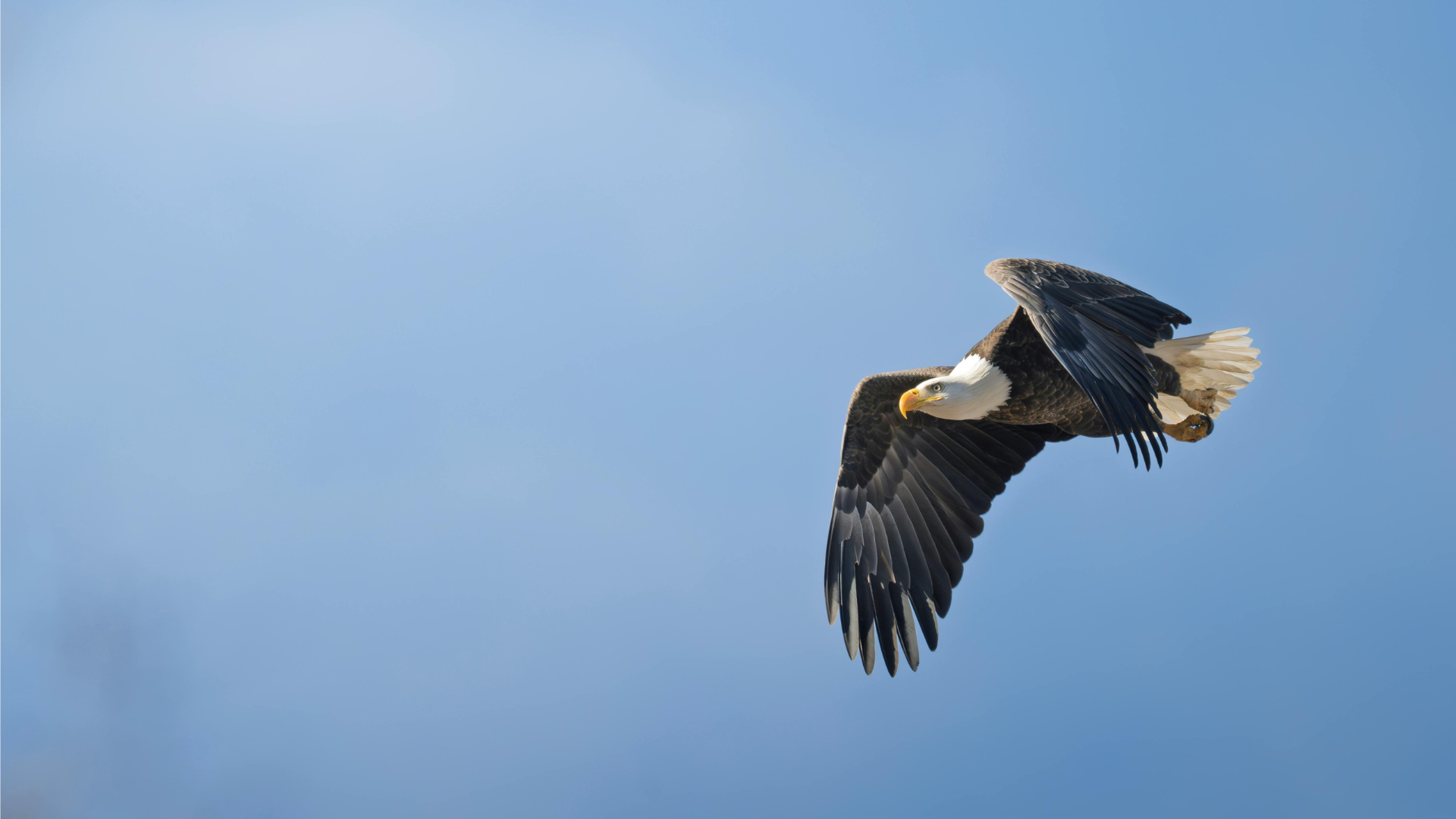
The bald eagle is one of the most iconic birds in North America, a living symbol of wilderness, recovery, and raw power. Whether you have spotted one soaring over a frozen lake or watched one plunge toward a river to snatch a salmon, these birds have a way of stopping you cold. This guide covers everything you need to know about bald eagle size, habitat, behavior, diet, and the best places across the USA and Canada to see one in the wild.
From the story of their dramatic conservation comeback to practical tips for locating them near water, this is your complete field companion for one of the continent's most thrilling birds of prey.
Bald Eagle Physical Characteristics
Adult bald eagles are unmistakable. Their brilliant white head and tail contrast sharply with a dark brown body, and that heavy yellow bill commands attention even at a distance. But it takes time to get there. Bald eagles do not acquire their full adult plumage until around five years of age, which means beginners frequently overlook younger birds entirely.
How Big Do Bald Eagles Get?
Bald eagles are among the largest raptors on the continent. Here are the key measurements that matter in the field:
- Wingspan: 6 to 7.5 feet (roughly 1.8 to 2.3 meters)
- Body length: 28 to 40 inches (71 to 102 cm)
- Weight: 6.5 to 14 pounds (3 to 6.3 kg), with females consistently larger than males
- Tail length: Long, wedge-shaped, and pure white in adults
Female bald eagles are noticeably larger than males, a trait called reverse sexual dimorphism that is common across raptors. In some populations, particularly in Alaska and Canada, individuals toward the upper end of these ranges are regularly observed. When soaring overhead, the flat, plank-like wing posture is one of the easiest field marks to lock onto.
Juvenile Bald Eagle Identification
Young bald eagles cause real identification confusion. For their first four years, they show a complex series of molts that range from heavily mottled brown and white in year one to progressively cleaner patterns as they mature. Key tips for juvenile identification:
- Year 1: Entirely dark brown with variable white mottling on the belly and wing linings; bill is dark
- Year 2-3: Bill begins to yellow; white patches on the underwings become more defined
- Year 4: Head and tail lighten noticeably but still show dark streaking
- Year 5+: Classic white head and tail, yellow bill, and dark body fully established
One of the most reliable clues at any age is sheer size. Bald eagles dwarf red-tailed hawks and most other raptors sharing the same airspace. Their heavy, deep wingbeats followed by long glides are distinctive even before you can resolve plumage detail.
Bald Eagle Habitat Preferences
Bald eagles are almost always found near water. Large lakes, rivers, coastal estuaries, reservoirs, and wetlands all attract them because the habitat supports their primary prey: fish. They prefer areas with tall, mature trees for nesting and roosting, ideally with unobstructed flight lines to open water. Old-growth forest adjacent to productive fisheries represents ideal bald eagle country.
Seasonal habitat use shifts somewhat. In summer, breeding pairs concentrate near productive fishing waters in the northern USA, Canada, and Alaska. In winter, open water becomes critical. Eagles follow rivers and lakes that remain unfrozen, and they also congregate near salmon spawning runs, sometimes in remarkable numbers. Along the Pacific Coast, the combination of large rivers, abundant fish, and mature conifers makes this one of the continent's most consistently productive regions for finding them year-round.
Nesting Habitat and Nest Size
Bald eagle nests, called eyries, are among the largest bird structures in North America. A single nest may be used and added to year after year, eventually reaching extraordinary dimensions:
- Average nest width: 4 to 5 feet across when first built
- Record nest dimensions: Up to 10 feet wide and 20 feet deep, weighing over a ton
- Preferred nest trees: Tall, sturdy trees such as white pines, cottonwoods, and Douglas firs near water
- Nest reuse: The same nest is often used for decades; pairs repair and add material each breeding season
Eagles typically nest from January through July depending on latitude. In Florida and the Gulf States, nesting starts as early as November. In Alaska and northern Canada, pairs may not begin until March or April. Clutches usually contain one to three eggs, with two being most common, and both parents share incubation duties over roughly 35 days.
Bald Eagle Diet and Fishing Behavior
Fish make up the bulk of the bald eagle diet, and watching one hunt is a highlight of any birding trip. Eagles soar low over water, lock onto a target, and dive feet-first in a controlled plunge, snatching fish from just below the surface with powerful yellow talons built for gripping slippery prey. They do not fully submerge like ospreys; instead, they grab from the top layer of water and immediately power back to a perch to feed.
Beyond fish, bald eagles are highly opportunistic. Their diet also regularly includes:
- Waterfowl and shorebirds, caught in the air or on the water
- Small mammals including rabbits, squirrels, and muskrats
- Carrion, especially in winter when live prey is harder to obtain
- Food pirated from other birds, including ospreys and other eagles
The tendency to steal food from ospreys is well documented and easy to observe at shared fishing areas. An eagle will often pursue a loaded osprey until it drops its fish, then snatch the prey before it hits the water. Benjamin Franklin famously cited this behavior as a reason he preferred the wild turkey as a national symbol, though the bald eagle ultimately won out.
Bald Eagle vs Golden Eagle: Key Differences
These two large eagles share some range overlap and cause regular identification problems, especially with immature bald eagles. Here is how to separate them cleanly in the field:
- Head and bill: Adult bald eagles show a white head and massive yellow bill. Golden eagles have a dark brown head with a golden-buff wash on the nape and a smaller, more graceful bill.
- Body size: Both are large, but bald eagles tend to be heavier and broader-winged. Golden eagles are slightly slimmer with a longer tail relative to body size.
- Wing posture: Bald eagles hold their wings flat in a soar. Golden eagles often show a slight dihedral (V-shape) similar to a turkey vulture.
- Leg feathering: Golden eagles have feathering all the way down to the toes. Bald eagles show bare yellow legs on adults.
- Habitat preference: Golden eagles favor open uplands, mountainous terrain, and arid grasslands. Bald eagles are almost always near large bodies of water.
Immature golden eagles show a clean white base to the tail and white wing patches that are more symmetrical and crisp than those on juvenile bald eagles. With practice, the two become readily separable, but always take your time with a large, dark, mottled eagle before committing to an ID.
Do Bald Eagles Migrate?
Migration in bald eagles is more flexible than in many songbirds. Northern populations, particularly those breeding in Canada and Alaska, do migrate south in autumn as lakes and rivers freeze over. They follow major river corridors and coastlines, with concentrations forming wherever open water and fish remain accessible through winter.
However, not all bald eagles migrate. Populations in the Pacific Northwest, along the Gulf Coast, and in Florida are largely resident year-round. In winter, migratory eagles mix with resident birds, producing impressive concentrations along productive rivers. The upper Mississippi River and Missouri River systems, the Columbia River in the Pacific Northwest, and coastal areas from the Chesapeake Bay south all host large winter aggregations.
Migration routes are not rigidly fixed. Eagles respond to weather and food availability, so watching conditions on a given year can significantly influence where and when large numbers appear. The general movement from northern breeding grounds runs from September through December, with the return north occurring between February and April.
Best Places to See Bald Eagles in the USA and Canada
Finding bald eagles has become considerably easier since their dramatic recovery from the brink of extinction. By the late 1960s, DDT contamination had reduced the lower 48 population to fewer than 500 breeding pairs. Today, more than 300,000 individuals are estimated across North America. Here are the best watching locations:
Top Spotting Locations
- Conowingo Dam, Maryland: One of the most celebrated bald eagle watching spots on the East Coast. Large numbers of eagles gather here in late autumn and winter to feed on fish at the base of the dam on the Susquehanna River.
- Skagit Valley, Washington: The Skagit River hosts one of the largest winter concentrations of bald eagles in the lower 48, with hundreds congregating to feed on spawned-out chum salmon from December through February.
- Chilkat Bald Eagle Preserve, Alaska: The single most spectacular bald eagle gathering on Earth. Up to 3,000 eagles converge along the Chilkat River near Haines, Alaska, each November to feed on a late run of chum salmon. A truly bucket-list event for any birder.
- Upper Mississippi River National Wildlife Refuge (Iowa/Illinois/Wisconsin/Minnesota): Open water below locks and dams keeps eagles concentrated throughout winter, with December through February being peak season.
- Klamath Basin, California/Oregon border: A critical winter aggregation site along the Pacific Flyway, with hundreds of eagles present from November through March.
- Fraser Valley, British Columbia: A productive wintering area for both bald and golden eagles, with concentration points along the Fraser River system through the winter months.
- Lake Erie shoreline, Ontario: Eagles winter along the lake's unfrozen sections and are frequently observed at the Long Point and Rondeau Provincial Park areas.
- Nova Scotia coast: Year-round residents along the Atlantic coast, with particularly good viewing from coastal headlands during autumn migration.
When scouting for eagles at any location, focus on tall bare snags and large trees near the water's edge. Eagles spend the majority of their time perched, often returning to the same trees day after day. Early morning and late afternoon, when fishing activity peaks, offer the best opportunities to watch active hunting behavior.
Bald Eagle Conservation: From Endangered to Recovery
The bald eagle's recovery is one of the most important conservation success stories in North American wildlife history. Listed as endangered under the Endangered Species Act in 1967, the species faced threats from DDT-related eggshell thinning, direct persecution, and habitat loss. The banning of DDT in 1972 combined with legal protection under the Bald and Golden Eagle Protection Act and intensive captive breeding programs reversed the decline dramatically. The species was delisted from endangered status in 2007. Today, the recovering population serves as both an ecological indicator and an argument for the effectiveness of science-based conservation policy.
Frequently Asked Questions
How big do bald eagles get?
Bald eagles have a wingspan of 6 to 7.5 feet and weigh between 6.5 and 14 pounds, with females larger than males. They are among the largest birds of prey in North America. Alaskan and Canadian birds tend to be at the larger end of this range.
Bald eagle vs golden eagle: how do you tell them apart?
Adult bald eagles are identified by their white head and tail with a yellow bill. Golden eagles show an all-dark body with a golden-buff nape and a smaller bill. In flight, bald eagles hold their wings flat while golden eagles often show a slight V-shape. Habitat is also helpful: bald eagles are almost always near large water bodies, while golden eagles prefer open uplands and mountains.
What are the best places to see bald eagles in Canada?
Top Canadian spots include the Jacques-Cartier River near Lac-Beauport in Quebec (peak February through April), the Fraser Valley in British Columbia (winter months), Lake Erie shoreline in Ontario, and coastal areas of Nova Scotia. Look for large trees or snags overlooking open water for the best chances of finding perched birds.
Do bald eagles migrate?
Not all bald eagles migrate. Northern populations in Canada and Alaska move south in autumn as waterways freeze, following river corridors to areas with open water. Southern populations in Florida, the Gulf Coast, and the Pacific Northwest are largely resident. Winter concentrations form along productive rivers and coastal areas from September through March.
How large is a bald eagle nest?
Bald eagle nests are among the largest bird structures in North America. A frequently reused nest can reach 10 feet wide and 20 feet deep, occasionally weighing over a ton. They are built in tall, sturdy trees near water and may be used and expanded by the same pair for decades.
Conclusion
The bald eagle's recovery from near extinction to a thriving, widespread population is one of the great wildlife comebacks of the modern era. From the salmon rivers of Alaska to the ice-fringed lakes of Quebec, these birds are more accessible to birders today than at any point in the past century. Whether you are tracking down a winter roost on the Susquehanna or scanning a frozen Quebec river for the first returning eagles of spring, knowing their size, habitat preferences, behavior, and identification features puts you far ahead in the field. Get out to the water's edge, find the tall snags, and watch for that flat-winged silhouette breaking over the treeline.
The allure of off-the-beaten-path travel
Lorem ipsum dolor sit amet, consectetur adipiscing elit ut aliquam, purus sit amet luctus venenatis, lectus magna fringilla urna, porttitor rhoncus dolor purus non enim praesent elementum facilisis leo, vel fringilla est ullamcorper eget nulla facilisi etiam dignissim diam quis enim lobortis scelerisque fermentum dui faucibus in ornare quam viverra orci sagittis eu volutpat odio facilisis mauris sit amet massa vitae tortor.
Unveiling the charm of lesser-known Destinations
Orci sagittis eu volutpat odio facilisis mauris sit amet massa vitae tortor condimentum lacinia quis vel eros donec ac odio tempor orci dapibus ultrices in iaculis nunc sed augue lacus.
- Lorem ipsum dolor sit amet consectetur facilisi etiam dignissim diam quis enim
- Mauris aliquet faucibus iaculis dui vitae ullamco sit amet luctus
- Posuere enim mi pharetra neque proin dic rhoncus dolor purus non enim
- Dui faucibus in ornare posuere enim mi pharetra neque proin dicit
Finding solitude in hidden gem locations
Lorem ipsum dolor sit amet, consectetur adipiscing elit ut aliquam, purus sit amet luctus venenatis, lectus magna fringilla urna, porttitor rhoncus dolor purus non enim praesent elementum facilisis leo, vel fringilla est ullamcorper eget nulla facilisi etiam dignissim diam quis enim lobortis scelerisque fermentum dui faucibus in ornare quam viverra orci sagittis eu volutpat odio facilisis mauris sit amet massa vitae tortor condimentum lacinia quis vel eros donec ac odio tempor orci dapibus ultrices.
The thrill of discovering untouched natural beauty
Dolor sit amet, consectetur adipiscing elit ut aliquam, purus sit amet luctus venenatis, lectus magna fringilla urna, porttitor rhoncus dolor purus non enim praesent elementum facilisis leo, vel fringilla est ullamcorper eget nulla.
- Lorem ipsum dolor sit amet consectetur tempor orci dapibus ultrices
- Mauris aliquet faucibus iaculis dui vitae ullamco elementum facilisis
- Posuere enim mi pharetra neque proin dic fermentum dui faucibus in ornare
- Purus sit amet luctus posuere enim mi pharetra neque proin dic
“Ut enim ad minim veniam, quis nostrud exercitation ullamco laboris nisi ut aliquip ex ea commodo consequat uis aute irure dolor in reprehenderit in voluptate velit”
Exploring cultural marvels off the tourist radar
Donsectetur adipiscing elit ut aliquam, purus sit amet luctus venenatis, lectus magna fringilla urna, porttitor rhoncus dolor purus non enim praesent elementum facilisis leo, vel fringilla est ullamcorper eget nulla facilisi etiam dignissim diam quis enim lobortis scelerisque fermentum dui faucibus in ornare quam viverra orci sagittis eu volutpat odio facilisis mauris sit amet massa vitae tortor condimentum lacinia quis vel eros donec ac odio tempor orci dapibus ultrices in iaculis nunc sed.