
Nocturnal Migration: How to Hear Birds Flying Over at Night
Hear spring nocturnal bird migration overhead: from naked ears to recorders and spectrograms.
You are walking back to your car after dinner, somewhere unremarkable: a city block, a parking lot, the sidewalk outside your building. It is late April, the sky is dark, and then something catches your ear. A thin, high chip. Then another. Then three more in quick succession, coming from directly overhead, moving through and gone in under two seconds.
Most people never notice. If you are a birder, something turns over in your chest. That is migration. That is a warbler, or a sparrow, or a thrush, calling from altitude as it crosses the city in the dark, bound for a spruce forest two states north of where you are standing. What stopped you for a moment is the audible edge of one of the largest biological events on the continent.
What you cannot hear, what no human ear catches unaided, is everything else up there. On a strong migration night, what sounds like silence above your head might be carrying tens of thousands of birds. The few calls you intercept are a fraction of what is actually passing through.
This guide is about how to hear more of it, starting from nothing but your ears, and progressing to setups that can turn a single night into a species list that rivals a full day's birding.
Why Birds Call at Night When Flying
Most North American warblers, thrushes, and sparrows use nocturnal flight calls during migration. Even some more rarely encountered migrants like cuckoos, rails, and bitterns can be heard calling overhead at night.
The reasons birds migrate at night are well established. Most predators of birds are diurnal, temperatures are lower, and winds are less extreme at night. Experiments have also shown that birds use seasonal patterns of the stars to orient themselves once aloft.
Why they call while doing it is less completely understood. The leading hypothesis is contact maintenance, keeping loose flocks cohesive in three-dimensional darkness. Whatever the function, the result is the same: a sky full of birds producing brief, species-specific vocalizations, most lasting less than a second, many detectable only with equipment, but some loud enough to stop you on a city sidewalk in late April.
In a single night, hundreds of warblers, sparrows, and other birds can be heard flying over your home. The species diversity and abundance of birds that fly over on a night of heavy migration rivals what would otherwise be seen in a big day's worth of birding.
Spring Versus Fall: Why Spring NFCs Are Special
Most NFC literature focuses on fall, when migration volume is highest and species variety peaks. Spring deserves equal attention, and for one reason above all others.
For those who wish to simply hear and appreciate nocturnal migration without delving into the nuances of identification, pre-dawn thrush flights offer the best opportunity. Compared to other species, thrushes are extremely vocal, especially just before dawn. Their call notes are fairly loud compared to warblers and sparrows, and they call in the lower frequency bands, meaning that the sound carries farther. A microphone can detect thrushes flying more than a thousand feet overhead, whereas warblers and sparrows at that range are inaudible.
In practical terms, this means the pre-dawn window of a strong spring migration night is the single most accessible entry point for anyone starting out. You do not need a recorder. You do not need software. You go outside at 4 AM after a BirdCast high-intensity alert, stand in your backyard or a park, and listen up. The Hermit Thrushes come down first, then the Swainson's, then a wash of thin warbler chips as first light approaches. Hermit Thrush is the hardiest of the Catharus thrushes and the only one to overwinter in North America. Unsurprisingly, they are the first back in spring, with big flights expected in mid-April.
This pre-dawn thrush window is spring's gift. Fall has volume. Spring has those crystalline, cold-air calls dropping toward you out of the dark just before the sky turns gray.
Step One: Your Ears, Nothing Else
The first thing to understand is that you do not need any equipment to begin. Loud nocturnal flight calls can be heard without any equipment.
What you need is a BirdCast high-intensity alert for your city, clear skies, and a willingness to stand outside at an hour when the neighborhood is quiet. Street noise is your main enemy. The further you can get from traffic, even a block or two, the more you will hear.
The calls to listen for with naked ears in spring over the eastern US are these:
Thrushes, the most audible. Swainson's Thrush (Catharus ustulatus) gives a short, liquid upward slur, almost like a spring peeper but with a burry edge. Hermit Thrush (Catharus guttatus) calls are softer, with a subtly different quality. Once you know the thrush category by ear, individual species begin to separate.
Sparrows, thin, high chips varying from flat to slightly rising or falling depending on species. Savannah Sparrow's NFC is polyphonic, producing a distinctive buzzy quality. Lincoln's Sparrow gives a sharper, cleaner chip. Most sparrow NFCs are genuinely difficult to separate by ear alone, but the category is recognizable.
Warblers, the thinnest of all: a high seep or zeep that may sound almost identical to an insect unless you are expecting it. Yellow Warbler's NFC is one of the more distinctive, a slightly descending seep. Most warbler NFCs by ear are logged as warbler sp. and left at that unless you have a recording to analyze.
Rails and waterfowl, a surprise category. Virginia Rail (Rallus limicola) and American Bittern (Botaurus lentiginosus) are secretive species that prefer to remain undetected in deep cover, and both migrate at night. They often call in flight, and their calls are detectable. Hearing a Virginia Rail calling overhead at midnight over a city rooftop is one of spring NFC's reliable highlights.
Step Two: A Recorder and Headphones
This is the upgrade that changes everything, and it costs less than most people expect.
A portable audio recorder with a pair of decent headphones connected directly to the headphone output is the most effective low-cost NFC setup available. You can use an audio recorder such as the Sony PCM-D10 or Zoom H5 with headphones to hear fainter calls, using either the built-in microphones or an external microphone.
The recorder amplifies what its microphones pick up and feeds it to your ears in real time. You stand outside holding it pointed skyward, headphones on, and you hear things your naked ears simply cannot resolve: the thin zeep of a warbler 300 feet up, the soft slur of a Gray-cheeked Thrush (Catharus minimus) that would have been inaudible without amplification.
Pointed at the open sky on a still night during a BirdCast high-intensity event, this setup is genuinely revelatory. You realize immediately that what you were hearing unaided was a fraction, the loudest fraction, of what was actually passing.
This is the setup we reach for first on a strong migration night. Recorder, headphones, dark sky, 4 AM. Everything after that is refinement.
Step Three: The Unattended Recording Setup
The limitation of active listening is that you cannot do it all night. The unattended setup solves this by recording continuously while you sleep, producing a night's worth of audio to review in the morning.
While some NFC enthusiasts like to listen live on peak migration nights, most record while they sleep. Nocturnal flight calls are typically less than a second long and notoriously challenging to identify by ear, so recording them for later review makes the identification process considerably more manageable.
The basic components are a recorder or a computer with a sound card, an omnidirectional microphone pointed at the sky, and recording software set to run continuously through the night. The microphone is positioned outside: on a roof, mounted on a pole, or simply placed on a windowsill with as much sky exposure as possible. Position your recording equipment in an exposed location, away from overhanging branches, which may obscure calls and cause unwanted background noise. The best conditions for recording are generally calm and cloudy nights, which encourage birds to fly lower, making their calls louder and more detectable.
For dedicated setups, the Wildlife Acoustics Song Meter Mini is well regarded for its sensitivity and weather resistance, and the AudioMoth is a low-cost open-source alternative popular in the NFC community. Any quality portable recorder set to record continuously works as a starting point.
Reading Spectrograms: Seeing Sound
The morning-after review of a night's recording is where NFC becomes a skill that actively improves your daytime birding.
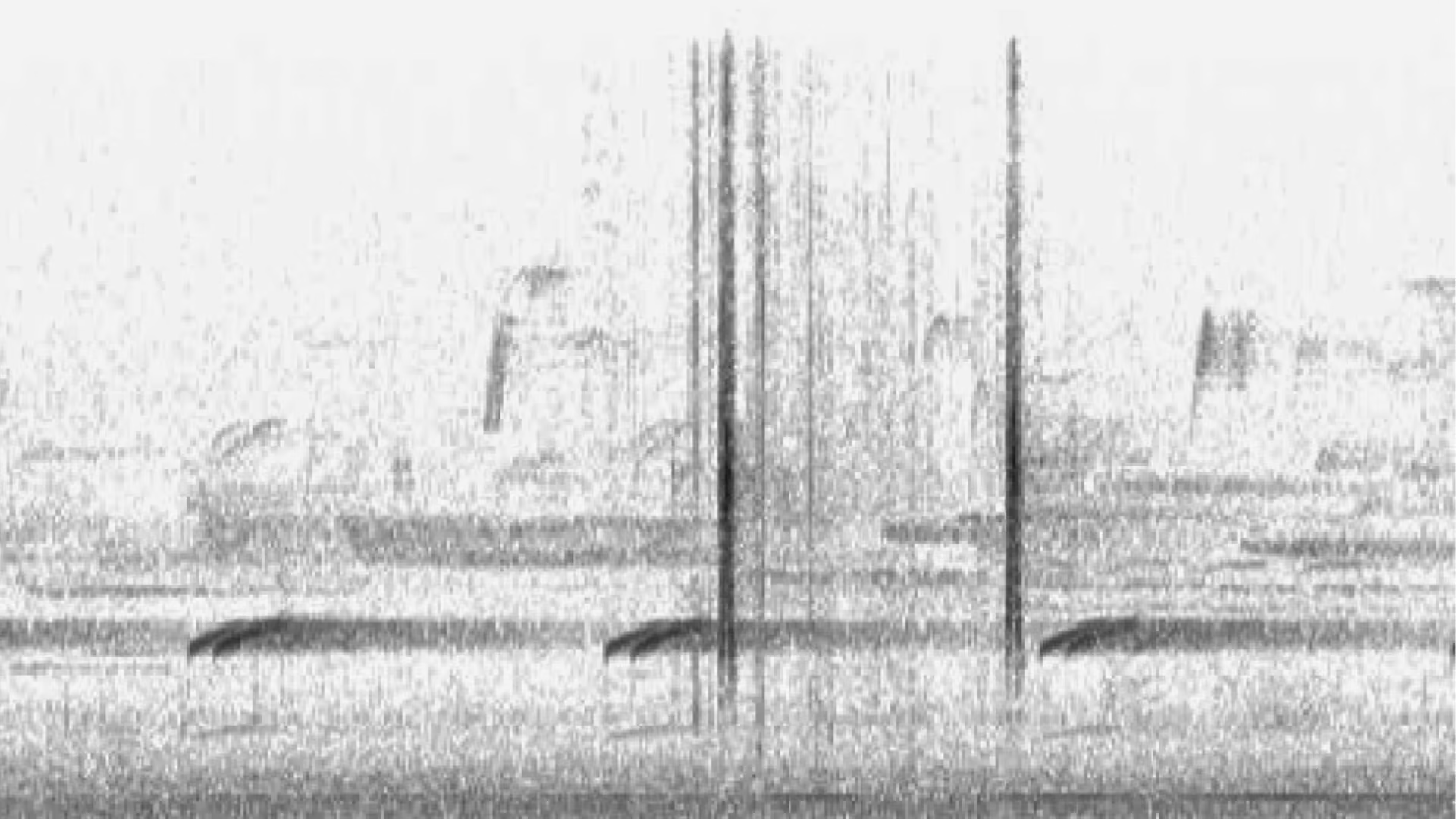
A spectrogram is a visual representation of sound: time runs left to right, frequency runs bottom to top, and the intensity of the sound is shown by brightness or color. An NFC that sounds like an indistinct chip to your ears becomes a specific shape on a spectrogram, a zigzag, an arch, a descending line, that can be matched to a reference library.
A typical sparrow NFC on a spectrogram appears as a zigzagging line at around 8kHz of roughly 50 milliseconds duration. A warbler NFC appears as a burst of high-frequency energy lasting only milliseconds. Using a selection tool in spectrogram software, you outline the call, save the segment as an audio file, and compare the shape against reference spectrograms to make an identification.
The essential reference for North American NFC identification is Flight Calls of Migratory Birds by Bill Evans and Michael O'Brien, which contains spectrograms and recordings for over 200 eastern species. The resource is now available free online at the Old Bird website, one of the most useful free tools in North American birding.
For spectrogram software, Raven Lite from the Cornell Lab is free and purpose-built for this kind of analysis. Audacity is another free option with a spectrogram view. Both work well for reviewing a night's recording and pulling out individual calls for identification.
The spectrogram skill transfers directly back to the field. Birders who spend time learning NFC spectrograms consistently report improved call recognition during the migration season. Your ear learns to parse the structure of a call because your eye has already learned what that structure looks like. The two reinforce each other.
When to Listen: Timing Your Spring NFC Sessions
The best times to listen to NFCs in spring are April through May, with the peak of warbler migration in the last two weeks of April and the first two weeks of May across most of the eastern United States.
Within any given night, migration typically builds in the hours after sunset, peaks around midnight, and declines toward dawn as birds begin to descend. The exception is thrushes, which are most vocal just before first light, making the 4 to 5 AM window specifically productive for that group.
The single most useful tool for timing your sessions is BirdCast. A high-intensity alert for your city means a migration night worth being outside for, or worth setting your recorder running. We cover the full BirdCast decision system in our guide on how to use BirdCast for spring birding.
On nights of strong migrations, a well-positioned microphone in an ordinary suburban location has recorded thousands of calls. The most calls occur during spring and fall migration, and calls are detected at all times of the night.
Location: It Does Not Have to Be Perfect
One of the most persistent misconceptions about NFC recording is that you need to live near a major flyway or a coastal migration hotspot to hear anything worthwhile.
Migration moves on a broad front across the eastern United States. The birds do not funnel through specific corridors at altitude the way they concentrate at ridge tips and coastal points when flying low. Your suburban backyard, your city rooftop, your apartment building's flat roof: any of these, with a clear sky above, is a valid NFC station.
The city street where you first catch a chip call overhead on a late April night is not a lesser experience than a dedicated field station. It is the same migration. You just happened to be standing under it at the right moment.
Submitting Your Records: Contributing to the Science
Every NFC record you document contributes to a growing continental dataset actively used by researchers studying migration timing, species distribution, and population trends.
Cornell Lab's eBird now has a dedicated protocol for sharing NFC checklists. Filing an NFC checklist is straightforward: select the NFC-specific protocol when creating your checklist, and log whatever species or call categories you detected. Uncertain identifications can be logged as warbler sp. or thrush sp., and partial data is still valuable data.
Xeno-canto, the global bird sound library, maintains a dedicated NFC category where you can submit recordings and spectrograms for community review. Difficult calls reviewed by experienced NFC listeners there are often resolved to species level that you could not confirm alone.
The Short Version
Go outside tonight if BirdCast shows a high-intensity alert for your area. Stand somewhere with a clear sky above you and as little road noise as possible. Listen up. At 4 AM in late April, with a strong southerly flow pushing migrants north, there will be birds over your head that you cannot see, cannot count, and can barely hear. The few chip calls that reach your ears are the audible edge of something vast.
When you are ready to hear more of it, connect a pair of headphones to a portable recorder and point it at the sky. When you are ready to document it, let it run all night and spend the next morning learning to read spectrograms with the free Evans and O'Brien guide at oldbird.org.
Spring migration is happening overhead right now. Most of it is invisible. Some of it, on the right night, in the right silence, you can hear with nothing but your ears and the knowledge of what to listen for.