
Bird Migration Flyways Explained: North America's 4 Major Routes
Explore North America's 4 bird migration flyways: Atlantic, Mississippi, Central, and Pacific. Learn key species, top viewing spots, and conservation threats.
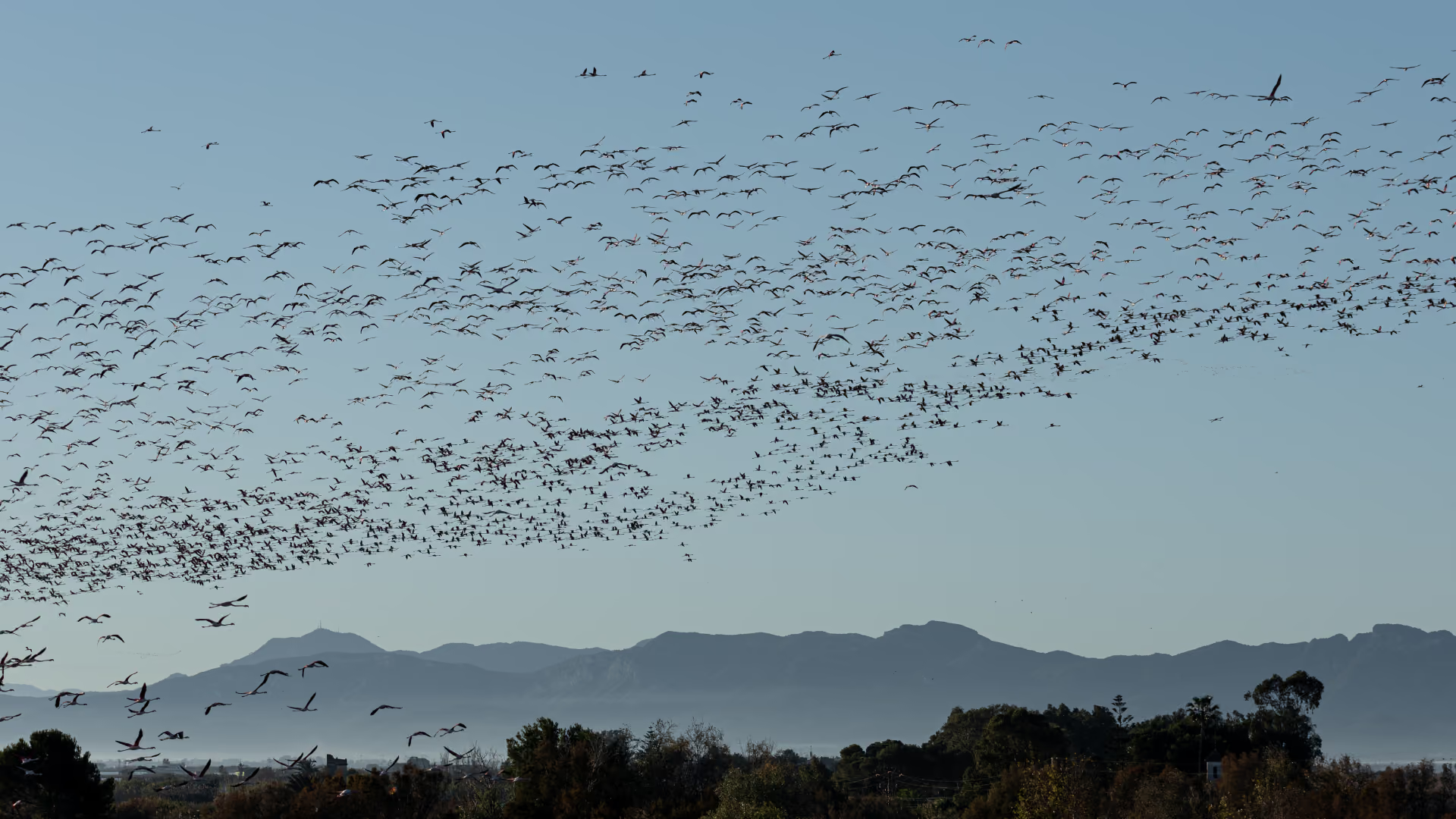
Twice a year, billions of birds move across North America in one of the most dramatic natural events on the planet. They travel along broad corridors shaped by geography, wind patterns, and millennia of evolutionary pressure. These corridors are known as bird migration flyways, and understanding them transforms how you watch birds, plan birding trips, and think about conservation. Whether you are watching warblers filter through a Quebec woodlot in May or tracking Sandhill Cranes over a Nebraska river, you are witnessing these ancient routes in action.
North America has four officially recognized flyways, each with its own characteristic species, key stopover sites, and conservation challenges. This guide breaks down each one with species examples and the best places to experience migration firsthand.
What Are Bird Migration Flyways?
A flyway is a broad geographic corridor that migratory birds follow during their seasonal movements between breeding and wintering grounds. The concept was formalized by wildlife managers in the mid-20th century, originally to help regulate waterfowl hunting, but it has since become a cornerstone of bird conservation science. Flyways are wide bands influenced by mountain ranges, coastlines, river valleys, and prevailing winds that funnel birds along predictable paths.
The four North American flyways are the Atlantic Flyway, the Mississippi Flyway, the Central Flyway, and the Pacific Flyway. Each spans the full length of the continent, connecting Arctic and boreal breeding grounds with tropical and subtropical wintering areas in Central and South America. Migratory birds use magnetic field sensitivity, star maps, sun angles, and landmark recognition to navigate these routes with stunning precision.
The Atlantic Flyway
The Atlantic Flyway runs along the eastern seaboard from the Arctic tundra of Greenland and Labrador south through the Atlantic coast states and into the Caribbean and South America. Its western boundary roughly follows the Appalachian Mountains, and it funnels an extraordinary diversity of species through coastal wetlands, barrier islands, and forest corridors.
Key Species on the Atlantic Flyway
The Atlantic Flyway is the primary route for many shorebirds, waterfowl, raptors, and songbirds. Red Knots make one of the most remarkable journeys of any bird on this flyway, traveling from Tierra del Fuego to the Arctic and back each year, with Delaware Bay serving as a critical refueling stop. Black-bellied Plovers, Dunlin, and Sanderlings concentrate along coastal beaches during migration. For birders in Quebec, the Atlantic Flyway connects directly to the St. Lawrence estuary, a major shorebird staging area in late summer and fall.
Hawkwatch sites like Cape May in New Jersey record tens of thousands of Sharp-shinned Hawks, Cooper's Hawks, and Merlins during peak October days.
The Mississippi Flyway
The Mississippi Flyway is arguably the most important waterfowl migration route in the world. Centered on the Mississippi River drainage basin, it stretches from the boreal forests and prairie potholes of Canada through the heart of the continent to the Gulf Coast and beyond. Roughly 40 percent of all North American waterfowl use this flyway, making it a critical resource for ducks, geese, and swans.
Key Species on the Mississippi Flyway
Mallards, Green-winged Teal, Lesser Scaup, and Canada Geese move through in enormous numbers each fall. The Mississippi Flyway also carries the bulk of eastern songbird migration, with wood warblers, vireos, tanagers, and thrushes crossing the Gulf of Mexico from Yucatan and making landfall along the Texas and Louisiana coasts in events known as fallouts, when thousands of exhausted birds drop into coastal trees.
The Central Flyway
The Central Flyway covers the Great Plains, stretching from the Arctic tundra of northern Canada through the prairie provinces, the American Midwest, and into Mexico and Central America. It is most famous for one of the greatest wildlife spectacles on Earth: the congregation of Sandhill Cranes along the Platte River in Nebraska each spring.
The Platte River Spectacle
Each March, an estimated 500,000 Sandhill Cranes stage along a 50-mile stretch of the Platte River near Kearney, Nebraska. The birds arrive from wintering grounds in Texas, New Mexico, and Mexico and spend several weeks feeding on waste corn in surrounding fields before continuing north to breeding grounds in Canada and Alaska. Witnessing the cranes launch from river roosts at dawn is widely regarded as one of the greatest natural spectacles in North America.
Key Species on the Central Flyway
Beyond cranes, the Central Flyway moves more than 50 percent of North America's duck population and vast numbers of shorebirds through the prairie pothole region. American Golden-Plovers, Buff-breasted Sandpipers, and White-rumped Sandpipers use the grasslands as key staging areas. Swainson's Hawks travel one of the longest raptor migration routes in the world, from Canadian prairies to the Argentine pampas and back.
The Pacific Flyway
The Pacific Flyway runs along the western edge of the continent from Alaska and the Yukon south through the Pacific states and into Mexico and Central America. The Rocky Mountains form its eastern boundary, and the Pacific coast provides critical stopover habitat at estuaries, wetlands, and coastal headlands.
Key Species on the Pacific Flyway
The Pacific Flyway is essential for shorebirds moving between Alaskan breeding grounds and South American wintering areas. Dunlin, Western Sandpipers, and Semipalmated Plovers concentrate at sites like Boundary Bay in British Columbia. The Rufous Hummingbird makes one of the longest migrations relative to body size of any bird, traveling more than 3,000 miles from Mexican wintering grounds to breeding sites in Alaska along this flyway.
Great Salt Lake in Utah is one of the most critical wetlands in North America for Pacific Flyway birds, hosting millions of shorebirds and waterfowl during both spring and fall migration. Its declining water levels represent a growing conservation crisis with flyway-wide implications.
How Do Birds Know Which Flyway to Follow?
Bird navigation is a field of active research. Birds use multiple redundant systems to orient during migration, including the Earth's magnetic field, star patterns learned during early life, sun position, and visual landmarks like mountain ranges and coastlines. Many species are born with an innate directional preference that aligns them with their population's flyway, refined by experience over subsequent migrations.
Flyway Conservation and Climate Threats
Each flyway faces a unique set of conservation challenges, but climate change cuts across all four. Shifting temperatures are altering the timing of insect emergence and plant phenology at breeding grounds, sometimes creating a mismatch with the arrival dates of migratory birds. Rising sea levels threaten critical coastal staging areas along the Atlantic and Pacific flyways. Drought is shrinking wetlands along the Central and Pacific flyways, reducing the carrying capacity of key stopover sites.
Conservation organizations including Ducks Unlimited, the Audubon Society, and the American Bird Conservancy are working across flyway boundaries to protect stopover habitats. eBird data from Cornell Lab now allows researchers to map migration in near real-time, revealing bottlenecks and priority areas with unprecedented detail.
Frequently Asked Questions
What are the four flyways in North America?
The four flyways are the Atlantic Flyway along the eastern coast, the Mississippi Flyway through the central river basin, the Central Flyway across the Great Plains, and the Pacific Flyway along the western coast. Each runs north to south across the full length of the continent.
Which birds use the Mississippi Flyway?
The Mississippi Flyway carries roughly 40 percent of North America's ducks and geese, making it the most important waterfowl route on the continent. It also moves large numbers of songbirds, shorebirds, and raptors through the continental interior.
Where is the best place to watch Sandhill Crane migration?
The Platte River near Kearney, Nebraska is the premier location, with up to 500,000 cranes staging in March. The Rowe Sanctuary offers guided viewing experiences and has operated crane watches for decades.
How do birds navigate flyways without getting lost?
Birds use a combination of magnetic field sensitivity, star orientation, sun position, and visual landmarks. Many species also inherit a genetic directional program that orients them toward their population's traditional flyway route.
Are flyways affected by climate change?
Yes. Climate change is shifting migration timing, reducing stopover habitat quality, and creating mismatches between bird arrival dates and peak food availability. Coastal staging areas are particularly vulnerable to sea level rise.
Following the Birds Across a Continent
Understanding bird migration flyways gives every birding trip a larger context. When a warbler appears in your backyard on a May morning, it is a traveler on an ancient route that spans the hemisphere. Use eBird's migration explorer tools, plan a trip to a key stopover site, and watch the continent come alive each spring and fall.