
How to Spot Black-browed Albatross from Shore in Puerto Natales, Chile
The only guide to spotting Black-browed Albatross from shore in Puerto Natales. Learn the exact wind conditions, best viewpoint — no ferry required.
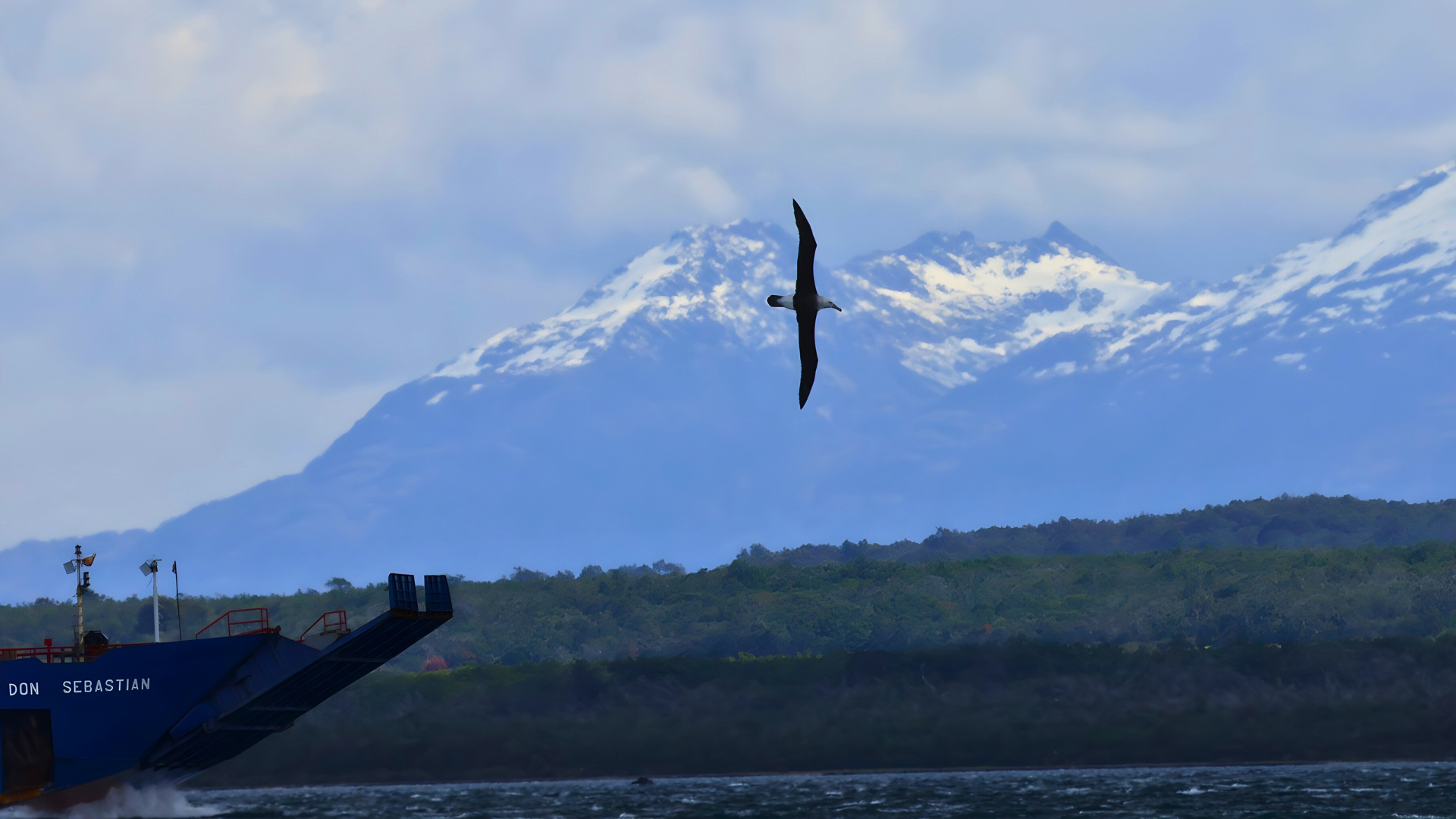
Most guides about Black-browed Albatross in Chilean Patagonia tell you the same thing: book a ferry crossing, join a pelagic tour, and wait for the open ocean. What almost none of them tell you is that under the right conditions, you can watch one of the world's great seabirds bank past snow-capped Andean peaks from the shore in front of a coffee shop in Puerto Natales. No vessel required. No booking needed. Just wind, patience, and knowing exactly where to stand.
This is the only dedicated shore-based spotting guide for Black-browed Albatross in Puerto Natales. Every competing article mentions the species in a bullet point about ferry crossings. This one tells you how to find it on foot.
About the Black-browed Albatross
The Black-browed Albatross (Thalassarche melanophris) is the most widespread albatross in the Southern Ocean and the one most likely to be seen from shore in southern Chile. It breeds in large colonies on islands off the southwestern tip of Chile, the Islas Ildefonso, Islas Diego Ramírez, and Islas Evangelistas, and forages across the Patagonian and Chilean shelf throughout the austral summer and autumn. That foraging range brings birds regularly through the deep channels and fjords of Chilean Patagonia, including the Última Esperanza Sound directly in front of Puerto Natales.
Adults are unmistakable: a bright orange-yellow bill, a white head with a bold dark stripe above the eye (the black brow that gives the species its name), and wings that are white below with irregular black borders stretching the full length. The wingspan reaches 200 to 240 centimeters. In flight, the bird is everything an albatross should be: long stiff wings locked in a banking glide, barely moving a feather as it arcs across the water using wind rather than energy. First-year birds show a darker, black-tipped bill and more uniformly dark underwings, but the sheer size and effortless glide make them unmistakably an albatross from the moment they appear.
For the full species profile including range maps, subspecies, and recent sightings, visit the Black-browed Albatross page on eBird.
Why Puerto Natales Is a Shore-Based Albatross Location
Puerto Natales sits at the northern end of the Última Esperanza Sound, Last Hope Sound, a deep fjord running roughly north to south and opening southward toward the vast network of Patagonian channels that ultimately connect to the open Southern Ocean. The town faces southwest across this fjord, with the mountains of the Andes rising behind it and open water stretching for kilometers in front.
That geography is the key. The sound acts as a funnel. When strong westerly and southwesterly winds blow in from the open channels beyond, they push seabirds that are normally far out in the deeper water much closer to town, sometimes right across the face of the waterfront. This is not a rare event in Patagonia. These are among the windiest inhabited places on Earth, and sustained westerly fronts are a regular feature of the weather calendar from October through April.
The Wind Strategy: What to Watch For
Wind is everything for shore-based albatross watching in Puerto Natales, and the threshold matters. You are not looking for a stiff breeze. You are looking for genuinely strong, sustained westerly winds above 50 kilometers per hour, maintained for two to three consecutive days. This is the kind of wind that shakes telephone poles in town, tears at your jacket on the waterfront, and makes you question whether it is worth standing outside at all. It is. That is exactly the weather you want.
Here is why. During a prolonged, powerful westerly front of that intensity, seabirds that have been working the open channels to the south get progressively pushed north and east by the accumulated wind pressure. By the second or third consecutive day of genuinely violent westerlies, birds that would normally be 20 or more kilometers out in the fjord are being forced much closer to the northern end of the sound, directly in front of Puerto Natales. The best sightings often come right at the peak of the blow, or during that crackling, gusty window when the wind is still building and you can feel the shift loading up.
A moderate westerly day will not do it. The wind needs to be strong enough that it feels extreme. If conditions feel uncomfortable, that is a good sign. If the western gusts are truly violent and have been that way for at least two full days, position yourself on the Costanera and start scanning. That is your moment.
To time this correctly, check a 5-day forecast before arriving and look for sustained westerly winds consistently above 50 km/h building over multiple days, not a single-day spike. Prioritize the second and third consecutive day of the blow, not the first. The first day begins pushing birds; by day two or three they are much closer to shore. Mornings are best, as birds pushed inshore overnight by sustained westerlies are often most concentrated close to shore at first light before redistributing as wind direction shifts through the day. Use Windguru or the Windy app for detailed marine wind forecasts for Puerto Natales, as both are far more accurate for this location than general weather apps. And do not wait for comfortable conditions. In Patagonia, the weather that produces albatrosses is the weather that drives most people indoors.
Where to Watch: Costanera Sector Sur
The watching location is the Costanera, the waterfront promenade running along the western edge of Puerto Natales facing the sound. For albatross and pelagic seabird watching, position yourself at the southern end of the Costanera, just south of the port. This area is known locally as the Sector Sur, and it gives the widest, most unobstructed view of the main body of the sound and the open water beyond.
From here you are looking southwest into the mouth of the Last Hope Sound. On a strong wind day, scan the full width of the water from left to right in slow, deliberate sweeps. Albatrosses appear as long, dark silhouettes low over the water, moving fast with barely a wingbeat, banking sharply on stiff outstretched wings. They often appear suddenly at mid-distance and pass through your field of view in seconds. A spotting scope dramatically improves your chances of picking up distant birds before they are close enough for binoculars alone.
The eBird hotspot for this exact location is Puerto Natales Costanera Sector Sur on eBird. Check the recent sightings and species bar charts there before your visit to understand what has been recorded and when. Log your own sightings too, as Black-browed Albatross records from this shore location are still relatively few in the eBird database, and every documented sighting contributes to a better picture of when and how often these birds come within range.
Identification in the Field: What You Are Looking For
At distance over open water in strong wind, identification comes down to three things: size, wing shape, and flight style. The Black-browed Albatross is significantly larger than any gull or cormorant sharing the same water. The wings are very long and narrow compared to body width, held rigidly extended rather than flexing and adjusting like a large gull. The flight is unmistakably dynamic: a long, low, arcing glide that banks steeply into and out of wind, covering huge distances with the kind of effortless speed that makes everything around it look like it is working too hard.
Close views will reveal the orange bill and the dark eyebrow mark in adults. The white head is visible at considerable distance on a good bird. Immatures will appear darker overall and may be confused briefly with Southern Giant Petrel, which is also large and appears regularly from this spot. The Giant Petrel has a heavier, stubbier build, a dull pinkish bill, and a lumbering flight style quite different from the clean, banking glide of the albatross.
Best Season
Black-browed Albatrosses are most reliably encountered near Puerto Natales between October and April, the austral spring and summer, when birds are actively foraging near their breeding colonies on the offshore islands and wind events powerful enough to push them into the sound are most frequent. November to February represents the peak of the season for both bird activity and weather dynamics. Strong westerly events above 50 km/h occur year-round in Patagonia however, and out-of-season sightings from the Costanera are entirely possible for a patient birder who is watching the forecast.
For the broader picture of when birding across Patagonia is at its best, from steppe species and coastal waterbirds to raptors and migrants, see our guide to the best time for birding in Patagonia.
What Else Appears on a Wind Day
A proper westerly blow at the Puerto Natales Costanera is not a one-species event. The same conditions that bring albatrosses inshore can produce a remarkably varied seawatch. Southern Giant Petrels are large and regular, often with multiple birds visible at once on a good wind day. Sooty Shearwaters move through in numbers during austral autumn migration, dark and fast-winged. Cape Petrels, also known as Pintados, are small, boldly patterned in black and white, and unmistakable once you know them. Chilean Skuas are heavy and predatory, brown overall, and regular in the channels. Magellanic Diving-Petrels are tiny with a whirring flight like a flying torpedo, almost impossible to miss once you know what you are looking for. Black-necked Swans and Flightless Steamer-Ducks are reliable on calmer water directly in front of town year-round, and Kelp Gulls and Dolphin Gulls are common along the waterfront at all times.
Practical Tips
Dress as if the wind is an adversary. Patagonian westerlies above 50 km/h are not comparable to a breezy afternoon anywhere else. A full windproof layer, gloves, a hat that will not leave your head, and warm mid-layers are not optional when you are standing stationary on the exposed Costanera for an extended seawatch. Cold builds fast when you are not moving, and the wind will find any gap in your gear.
Arrive early. The morning hours on a strong wind day consistently produce the most activity, as birds pushed inshore overnight by sustained westerlies are still concentrated close to shore at first light before redistributing as conditions shift. Setting up on the Costanera Sector Sur at or just after sunrise on the second or third consecutive day of a violent westerly is the single best position you can put yourself in for a shore-based Black-browed Albatross sighting in Puerto Natales.
Scan systematically. The instinct on a big open seawatch is to stare hopefully at the horizon. More productive is a slow, methodical left-to-right sweep at mid-distance, roughly 500 meters to one kilometer out, where birds in flight are most likely to be visible before they pass through your field of view and are gone. Practice this rhythm, pause every few sweeps to check closer water, and you will see far more than a birder who is simply staring at the horizon waiting for something to appear.
The allure of off-the-beaten-path travel
Lorem ipsum dolor sit amet, consectetur adipiscing elit ut aliquam, purus sit amet luctus venenatis, lectus magna fringilla urna, porttitor rhoncus dolor purus non enim praesent elementum facilisis leo, vel fringilla est ullamcorper eget nulla facilisi etiam dignissim diam quis enim lobortis scelerisque fermentum dui faucibus in ornare quam viverra orci sagittis eu volutpat odio facilisis mauris sit amet massa vitae tortor.

Unveiling the charm of lesser-known Destinations
Orci sagittis eu volutpat odio facilisis mauris sit amet massa vitae tortor condimentum lacinia quis vel eros donec ac odio tempor orci dapibus ultrices in iaculis nunc sed augue lacus.
- Lorem ipsum dolor sit amet consectetur facilisi etiam dignissim diam quis enim
- Mauris aliquet faucibus iaculis dui vitae ullamco sit amet luctus
- Posuere enim mi pharetra neque proin dic rhoncus dolor purus non enim
- Dui faucibus in ornare posuere enim mi pharetra neque proin dicit
Finding solitude in hidden gem locations
Lorem ipsum dolor sit amet, consectetur adipiscing elit ut aliquam, purus sit amet luctus venenatis, lectus magna fringilla urna, porttitor rhoncus dolor purus non enim praesent elementum facilisis leo, vel fringilla est ullamcorper eget nulla facilisi etiam dignissim diam quis enim lobortis scelerisque fermentum dui faucibus in ornare quam viverra orci sagittis eu volutpat odio facilisis mauris sit amet massa vitae tortor condimentum lacinia quis vel eros donec ac odio tempor orci dapibus ultrices.
The thrill of discovering untouched natural beauty
Dolor sit amet, consectetur adipiscing elit ut aliquam, purus sit amet luctus venenatis, lectus magna fringilla urna, porttitor rhoncus dolor purus non enim praesent elementum facilisis leo, vel fringilla est ullamcorper eget nulla.
- Lorem ipsum dolor sit amet consectetur tempor orci dapibus ultrices
- Mauris aliquet faucibus iaculis dui vitae ullamco elementum facilisis
- Posuere enim mi pharetra neque proin dic fermentum dui faucibus in ornare
- Purus sit amet luctus posuere enim mi pharetra neque proin dic
“Ut enim ad minim veniam, quis nostrud exercitation ullamco laboris nisi ut aliquip ex ea commodo consequat uis aute irure dolor in reprehenderit in voluptate velit”
Exploring cultural marvels off the tourist radar
Donsectetur adipiscing elit ut aliquam, purus sit amet luctus venenatis, lectus magna fringilla urna, porttitor rhoncus dolor purus non enim praesent elementum facilisis leo, vel fringilla est ullamcorper eget nulla facilisi etiam dignissim diam quis enim lobortis scelerisque fermentum dui faucibus in ornare quam viverra orci sagittis eu volutpat odio facilisis mauris sit amet massa vitae tortor condimentum lacinia quis vel eros donec ac odio tempor orci dapibus ultrices in iaculis nunc sed.