
Common Loon Lakeside Habits and Calls: A Complete Guide
Learn about common loon calls, diving behavior, breeding habits, and migration. A complete guide for birders watching loons on Canadian lakes and coastal waters.
Few sounds in the natural world carry the emotional weight of a common loon call echoing across a still lake at dusk. For generations of Canadians and northern Americans, the wailing yodel of the common loon is inseparable from the experience of wilderness. But the loon is far more than a symbol. It is a highly specialized diving bird with fascinating breeding behavior, extraordinary underwater abilities, and a suite of calls that serve precise social functions.
Whether you are paddling a Quebec lake in July, scanning coastal waters in winter, or simply trying to identify the haunting sound drifting across the water, this guide covers everything you need to know about common loon habits, calls, identification, and the best places to find them in Canada.
Identifying the Common Loon
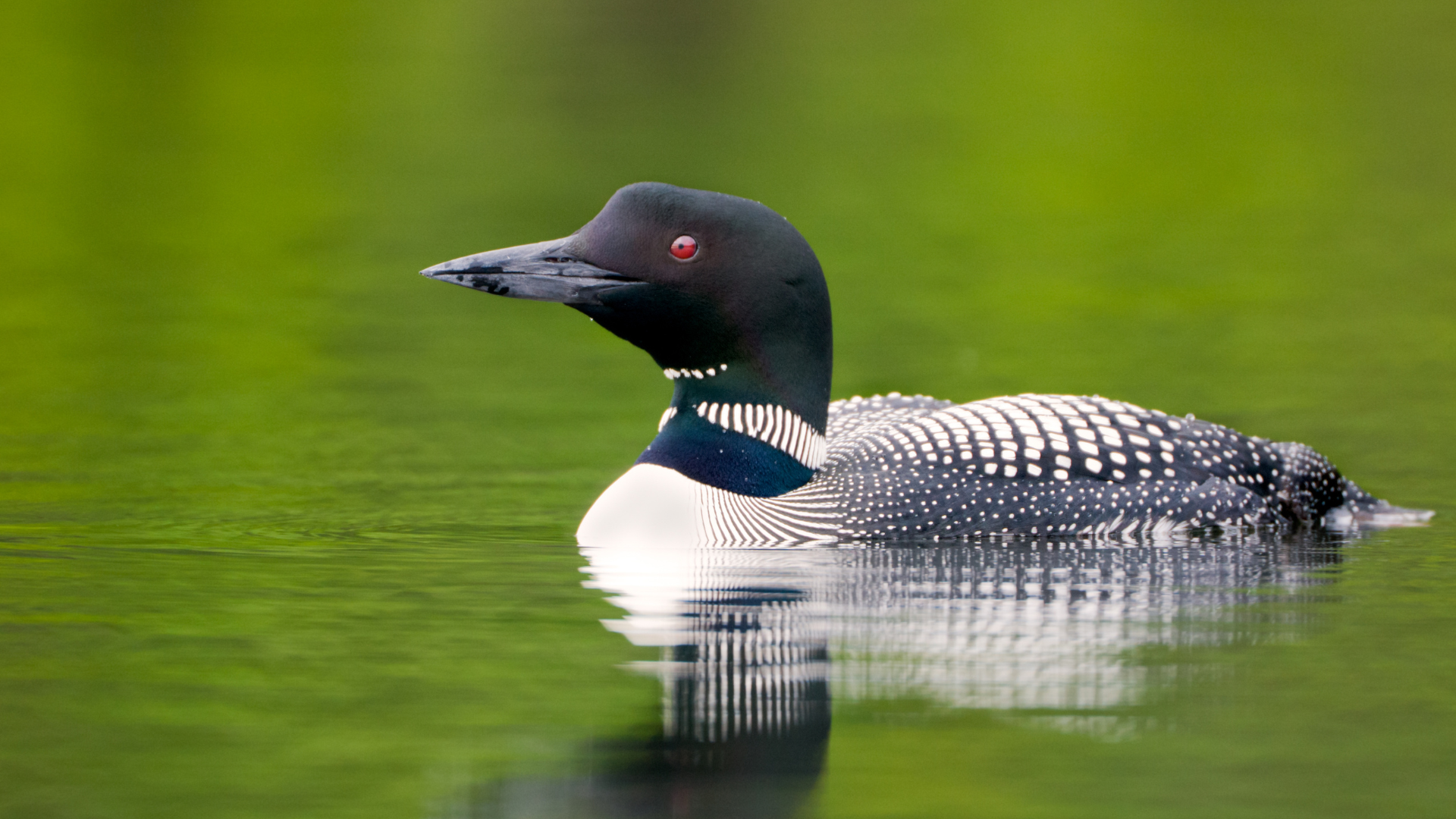
In breeding plumage, the common loon is unmistakable. Adults display a glossy black head, brilliant red eyes, a bold black-and-white checkered back, and a white-striped black necklace across the throat. The body sits low in the water with the bill pointed slightly upward, giving the bird a distinctive silhouette even at a distance. Legs are positioned far back on the body, an adaptation for powerful underwater propulsion that makes loons nearly helpless on land but extraordinarily agile beneath the surface.
In winter, the picture changes significantly. Adults molt into a much plainer gray-brown and white plumage, losing the striking checkerboard pattern. The red eyes fade to a duller reddish-brown. Birds in this transitional state can cause confusion, particularly along coastlines where multiple loon species winter together.
Common Loon vs. Pacific Loon
Birders on the Atlantic and Pacific coasts regularly encounter the challenge of distinguishing common loons from Pacific loons in winter plumage. The Pacific loon is smaller, with a cleaner, sharper demarcation between the dark cap and pale cheek, and lacks the dark half-collar that common loons typically show in winter. In breeding plumage, the Pacific loon's head is a smooth gray rather than the glossy black of the common loon. Bill size is also useful: the common loon has a heavier, straighter bill compared to the slightly thinner bill of the Pacific loon. In mixed flocks on winter ocean bays, body size and head shape remain the most reliable separation cues.
Breeding Habits and Nesting
Common loons are strongly tied to large, clear, fish-rich lakes for breeding. In Canada, they nest across a vast range from British Columbia to Newfoundland, with Quebec's lake-studded landscape providing some of the highest breeding densities on the continent. Pairs are highly territorial, defending lake territories of 40 to 200 hectares against rival loons through vocal displays and direct confrontation.
Nests are placed directly at the water's edge, often on small islands, floating mats of vegetation, or sheltered shoreline points. This placement allows the incubating bird to slide into the water instantly if threatened. Both parents share incubation duties over a period of roughly 26 to 31 days. Chicks are precocial, entering the water within hours of hatching, but they rely on their parents for food and thermoregulation for several weeks. Young chicks frequently ride on a parent's back, tucked beneath the wing feathers, a behavior that serves both to conserve warmth and protect them from underwater predators like large fish and snapping turtles.
The Famous Loon Calls Explained
The common loon has four primary calls, each serving a distinct function in the bird's social and territorial life. Understanding these calls transforms a mysterious sound into a readable language.
- The Wail: A long, mournful rising-and-falling note often heard at dusk and dawn. Wails are contact calls used between mates and family members to maintain connection across large lakes.
- The Yodel: An extended, complex male-only call used to defend territory against rival males. The yodel is one of the loudest bird calls in North America and can carry several kilometers across open water. Notably, individual males have unique yodel patterns, meaning experienced observers can identify specific birds by their calls alone.
- The Tremolo: Often described as a laughing call, the tremolo is an alarm call given when loons feel threatened, whether by a predator, a passing boat, or an encroaching rival. It is the call most commonly heard when loons are disturbed by human activity.
- The Hoot: A soft, short call used for close-range communication between family members, especially between parents and chicks.
Diving Behavior and Feeding
Common loons are pursuit divers of exceptional ability. They can dive to depths of over 60 meters, though most foraging dives in productive lake environments take place in the upper 6 to 9 meters of the water column. Dive duration averages around 40 to 60 seconds, but birds have been recorded remaining submerged for over three minutes. Underwater, loons use powerful kicks from their large feet and partly folded wings to accelerate after fish with remarkable speed and maneuverability.
Fish form the overwhelming bulk of the common loon diet. Yellow perch, sunfish, suckers, and various minnow species are common prey. Loons swallow most fish headfirst while still underwater. They also consume crayfish, frogs, and occasionally aquatic invertebrates, particularly when feeding chicks in the early days after hatching.
Loon Diving Depth and Technique
Loons transition from surface swimming to diving with a barely perceptible forward lunge, slipping under the water with very little splash. This efficiency is partly due to the density of their bones, which are denser than those of most flying birds and reduce buoyancy. Before diving, loons sometimes compress their feathers to expel air, further reducing the energy required to descend. This physiological suite of adaptations makes them among the most capable avian divers in freshwater environments.
Migration and Winter Habitat
Common loons are migratory, departing their breeding lakes in autumn before ice-up and traveling to coastal wintering grounds along the Atlantic, Gulf, and Pacific coasts. Some birds winter on large inland lakes and reservoirs, particularly in the southern United States. The migration often occurs at night and at high altitude, and loons undertaking long overwater crossings sometimes land on wet roads or parking lots after mistaking reflective pavement for water, an event that can prove fatal without intervention.
On their wintering grounds, common loons shift almost entirely to a marine fish diet and lose their breeding plumage entirely by early winter. They are generally solitary or loosely grouped during winter, lacking the territorial behavior of the breeding season. Return migration to breeding lakes typically occurs in April and May, with birds often landing on frozen or partially frozen lakes and waiting for ice-out before establishing territories.
Frequently Asked Questions
What does a common loon call sound like?
The common loon has four distinct calls. The wail is a long, haunting sound used for contact between mates. The yodel is a complex, loud territorial call produced only by males. The tremolo, often described as laughing, is an alarm call. The hoot is a short, soft sound used for close-range family communication. The wail and yodel are most often heard on breeding lakes at dawn and dusk.
How do I tell a common loon from a Pacific loon?
In breeding plumage, the common loon has a black head, red eyes, and a bold checkered back, while the Pacific loon has a gray head. In winter, look for the common loon's heavier bill and the faint dark half-collar on the neck. Pacific loons tend to show a cleaner cap-to-cheek contrast. Body size helps too: common loons are substantially larger.
Where do loons nest in Canada?
Common loons breed on large, clear lakes across Canada from British Columbia to Newfoundland. They require lakes with good fish stocks, clear water for underwater hunting, and undisturbed shorelines for nesting. Quebec, Ontario, and the northern boreal lake districts support particularly high breeding densities. Nests are placed right at the water's edge on islands or sheltered shoreline points.
How deep can loons dive?
Common loons can dive to depths exceeding 60 meters, though most foraging dives occur within the top 6 to 9 meters of the water column where fish are most accessible. Dive duration typically ranges from 40 to 60 seconds, with maximum recorded dives exceeding three minutes.
Where is the best place to see loons in Canada?
Quebec's Laurentian lakes and Gatineau Park, Ontario's Algonquin Provincial Park, and the lake-rich interior of British Columbia and Manitoba all offer excellent common loon viewing during the breeding season from May through August. Arriving at dawn or dusk on a calm day maximizes your chances of hearing the full yodel and wail sequences that make loon encounters so memorable.
A Voice That Defines the Northern Wilderness
The common loon is an ecological indicator, a behaviorally complex bird, and for many people, the sound that represents wild Canada more completely than any other. Understanding its calls, its diving mastery, its lake-nesting life, and its coastal winters turns every sighting from a pleasant encounter into a genuinely informed one. The next time that tremolo floats across the water toward you, you will know exactly what it means.
The allure of off-the-beaten-path travel
Lorem ipsum dolor sit amet, consectetur adipiscing elit ut aliquam, purus sit amet luctus venenatis, lectus magna fringilla urna, porttitor rhoncus dolor purus non enim praesent elementum facilisis leo, vel fringilla est ullamcorper eget nulla facilisi etiam dignissim diam quis enim lobortis scelerisque fermentum dui faucibus in ornare quam viverra orci sagittis eu volutpat odio facilisis mauris sit amet massa vitae tortor.

Unveiling the charm of lesser-known Destinations
Orci sagittis eu volutpat odio facilisis mauris sit amet massa vitae tortor condimentum lacinia quis vel eros donec ac odio tempor orci dapibus ultrices in iaculis nunc sed augue lacus.
- Lorem ipsum dolor sit amet consectetur facilisi etiam dignissim diam quis enim
- Mauris aliquet faucibus iaculis dui vitae ullamco sit amet luctus
- Posuere enim mi pharetra neque proin dic rhoncus dolor purus non enim
- Dui faucibus in ornare posuere enim mi pharetra neque proin dicit
Finding solitude in hidden gem locations
Lorem ipsum dolor sit amet, consectetur adipiscing elit ut aliquam, purus sit amet luctus venenatis, lectus magna fringilla urna, porttitor rhoncus dolor purus non enim praesent elementum facilisis leo, vel fringilla est ullamcorper eget nulla facilisi etiam dignissim diam quis enim lobortis scelerisque fermentum dui faucibus in ornare quam viverra orci sagittis eu volutpat odio facilisis mauris sit amet massa vitae tortor condimentum lacinia quis vel eros donec ac odio tempor orci dapibus ultrices.
The thrill of discovering untouched natural beauty
Dolor sit amet, consectetur adipiscing elit ut aliquam, purus sit amet luctus venenatis, lectus magna fringilla urna, porttitor rhoncus dolor purus non enim praesent elementum facilisis leo, vel fringilla est ullamcorper eget nulla.
- Lorem ipsum dolor sit amet consectetur tempor orci dapibus ultrices
- Mauris aliquet faucibus iaculis dui vitae ullamco elementum facilisis
- Posuere enim mi pharetra neque proin dic fermentum dui faucibus in ornare
- Purus sit amet luctus posuere enim mi pharetra neque proin dic
“Ut enim ad minim veniam, quis nostrud exercitation ullamco laboris nisi ut aliquip ex ea commodo consequat uis aute irure dolor in reprehenderit in voluptate velit”
Exploring cultural marvels off the tourist radar
Donsectetur adipiscing elit ut aliquam, purus sit amet luctus venenatis, lectus magna fringilla urna, porttitor rhoncus dolor purus non enim praesent elementum facilisis leo, vel fringilla est ullamcorper eget nulla facilisi etiam dignissim diam quis enim lobortis scelerisque fermentum dui faucibus in ornare quam viverra orci sagittis eu volutpat odio facilisis mauris sit amet massa vitae tortor condimentum lacinia quis vel eros donec ac odio tempor orci dapibus ultrices in iaculis nunc sed.