
Giant Petrels of Puerto Natales: Where and How to Spot Them
Where and how to find Southern Giant Petrels in Puerto Natales, Chile. The Costanera hotspot, fishery outflow feeding, wind conditions for close encounters.
The Giants That Fly Over Your Head
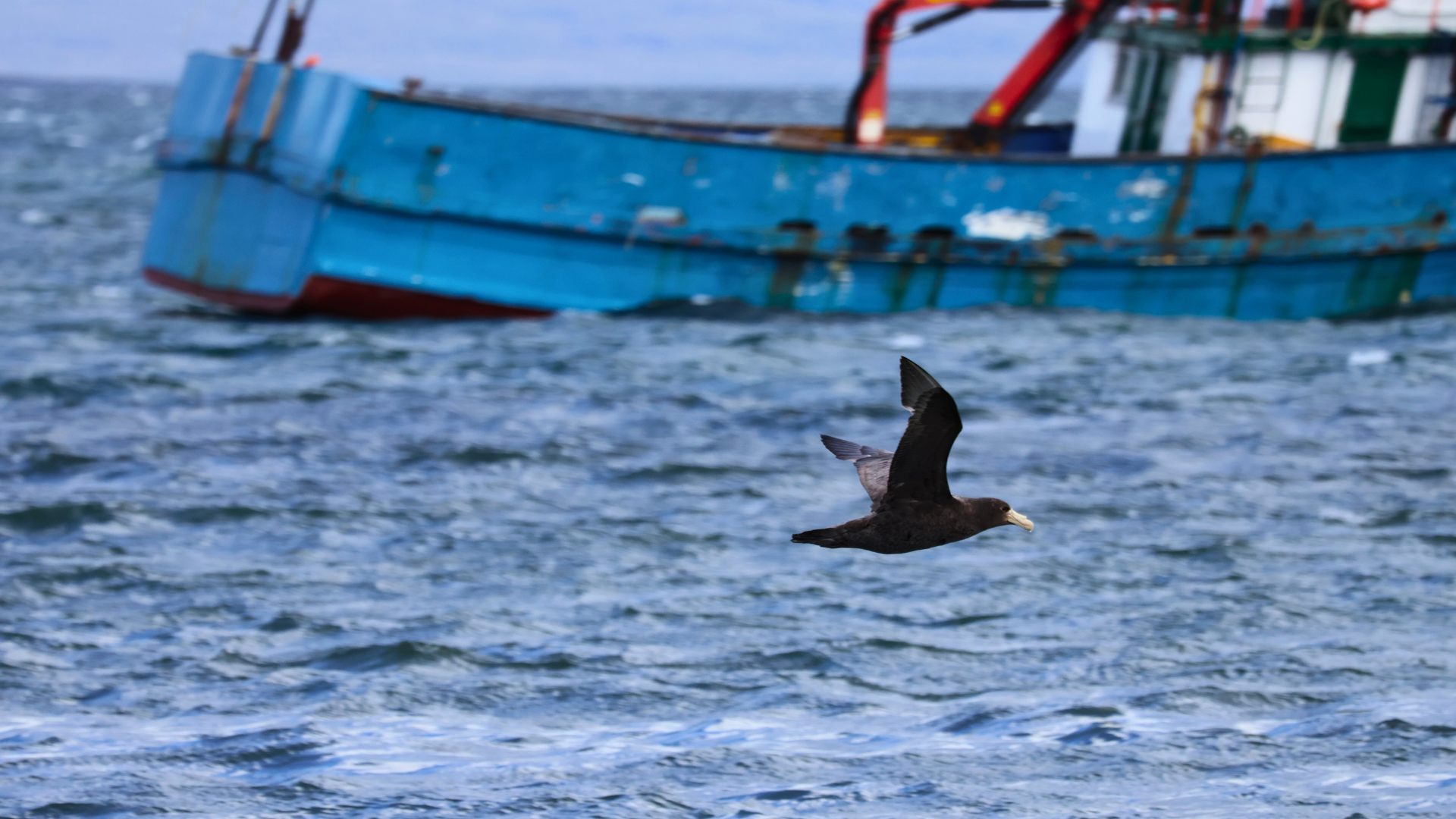
Puerto Natales, the small port town in Chile's Magallanes Region, is world-famous as the gateway to Torres del Paine. But for birders, the town itself deserves its own pilgrimage. The Última Esperanza Sound (Last Hope Sound) is one of the most accessible places on Earth to observe both species of Giant Petrel at genuinely jaw-dropping close range. Less than a metre overhead. A wingspan wider than you are tall, locked rigid against a Patagonian gale, the bird barely flicking a feather as it passes.
Both Southern Giant Petrel (Macronectes giganteus) and Northern Giant Petrel (Macronectes halli) are present in and around Puerto Natales year-round. The Southern Giant Petrel dominates. It is the default bird every time something enormous flaps or soars over the channel. But Northern Giant Petrels do occur, and it is worth checking every individual carefully. The two are best separated by bill tip colour: greenish on the Southern, pinkish red on the Northern. In the close conditions Puerto Natales offers, you will have plenty of opportunity to confirm it.
The Best Spot: La Costanera and the Fishery Outflow
The entire waterfront promenade (the Costanera) runs along the Última Esperanza Sound and is productive from end to end. Giant Petrels forage and soar the full length of the channel, and on any given morning you can simply stand at the shore and watch them work the grey water. But one location stands above all others.
Near the southern section of the Costanera, a fishery processing plant discharges fish processing residue directly into the sound. That outflow plume is a consistent, reliable magnet for feeding Giant Petrels. Stand in front of the plant and watch: birds come in to feed actively, often just metres from the bank. On my visits this was the single best place for extended, close, behavioural observation. Petrels feeding, squabbling, landing on the water, taking off again. It is extraordinary.
eBird hotspots to check and log your sightings:
- Puerto Natales: La Costanera (the main waterfront strip, excellent throughout)
- Magallanes Region hotspots on eBird (for planning a wider day of birding around the sound)
The Wind Is the Key
This is the single most useful piece of local knowledge: watch the wind direction. When strong westerlies push in off the channels (which in Patagonia is not infrequent) Giant Petrels come dramatically closer to shore. They use the gusts rolling off the hillsides and buildings to soar right along the waterfront, and you will have birds passing overhead at head height or lower. On those blustery days when other visitors retreat indoors, head straight to the Costanera. Petrels passing within a single metre is not unusual. It is one of the most visceral wildlife experiences you will have anywhere.
On calmer days the birds are still very visible out in the channel: feeding, loafing, flying. Wind simply tips the experience into something truly remarkable.
The Supporting Cast: Gulls of the Sound
While the Giant Petrels are the headline act, the Última Esperanza Sound has a rich supporting cast worth your attention. Three gull species are regularly encountered along the waterfront and are often associating with the petrels at the fishery outflow.
Kelp Gull (Larus dominicanus) is the large, abundant background gull present everywhere along the Costanera. Conspicuous and easy. Dolphin Gull (Leucophaeus scoresbii) is the one to get excited about: a striking bird with vivid red bill and legs, very distinctive once seen, and reliably present along the waterfront. And Brown-hooded Gull (Chroicocephalus maculipennis, known in French as Mouette de Patagonie) is the abundant small gull of the shore, present in good numbers and easy to study at close range.
Practical Notes
Getting there: Puerto Natales is a 3 hour bus ride north of Punta Arenas, or reachable by seasonal ferry. The Costanera is walkable from anywhere in town. Simply head to the waterfront and follow it south.
When to go: Giant Petrels are present year-round. Summer (November through March) brings longer days and more active conditions. Winter visits can be excellent too: fewer people, more dramatic weather, and as noted, wind is your friend here.
Log everything: Please submit your observations to eBird. The Magallanes region has strong coverage but every checklist adds to our understanding of how these birds use the Chilean channels seasonally.
The allure of off-the-beaten-path travel
Lorem ipsum dolor sit amet, consectetur adipiscing elit ut aliquam, purus sit amet luctus venenatis, lectus magna fringilla urna, porttitor rhoncus dolor purus non enim praesent elementum facilisis leo, vel fringilla est ullamcorper eget nulla facilisi etiam dignissim diam quis enim lobortis scelerisque fermentum dui faucibus in ornare quam viverra orci sagittis eu volutpat odio facilisis mauris sit amet massa vitae tortor.
Unveiling the charm of lesser-known Destinations
Orci sagittis eu volutpat odio facilisis mauris sit amet massa vitae tortor condimentum lacinia quis vel eros donec ac odio tempor orci dapibus ultrices in iaculis nunc sed augue lacus.
- Lorem ipsum dolor sit amet consectetur facilisi etiam dignissim diam quis enim
- Mauris aliquet faucibus iaculis dui vitae ullamco sit amet luctus
- Posuere enim mi pharetra neque proin dic rhoncus dolor purus non enim
- Dui faucibus in ornare posuere enim mi pharetra neque proin dicit
Finding solitude in hidden gem locations
Lorem ipsum dolor sit amet, consectetur adipiscing elit ut aliquam, purus sit amet luctus venenatis, lectus magna fringilla urna, porttitor rhoncus dolor purus non enim praesent elementum facilisis leo, vel fringilla est ullamcorper eget nulla facilisi etiam dignissim diam quis enim lobortis scelerisque fermentum dui faucibus in ornare quam viverra orci sagittis eu volutpat odio facilisis mauris sit amet massa vitae tortor condimentum lacinia quis vel eros donec ac odio tempor orci dapibus ultrices.
The thrill of discovering untouched natural beauty
Dolor sit amet, consectetur adipiscing elit ut aliquam, purus sit amet luctus venenatis, lectus magna fringilla urna, porttitor rhoncus dolor purus non enim praesent elementum facilisis leo, vel fringilla est ullamcorper eget nulla.
- Lorem ipsum dolor sit amet consectetur tempor orci dapibus ultrices
- Mauris aliquet faucibus iaculis dui vitae ullamco elementum facilisis
- Posuere enim mi pharetra neque proin dic fermentum dui faucibus in ornare
- Purus sit amet luctus posuere enim mi pharetra neque proin dic
“Ut enim ad minim veniam, quis nostrud exercitation ullamco laboris nisi ut aliquip ex ea commodo consequat uis aute irure dolor in reprehenderit in voluptate velit”
Exploring cultural marvels off the tourist radar
Donsectetur adipiscing elit ut aliquam, purus sit amet luctus venenatis, lectus magna fringilla urna, porttitor rhoncus dolor purus non enim praesent elementum facilisis leo, vel fringilla est ullamcorper eget nulla facilisi etiam dignissim diam quis enim lobortis scelerisque fermentum dui faucibus in ornare quam viverra orci sagittis eu volutpat odio facilisis mauris sit amet massa vitae tortor condimentum lacinia quis vel eros donec ac odio tempor orci dapibus ultrices in iaculis nunc sed.