
Magee Marsh Spring Migration Guide 2026: Biggest Week and Beyond
Magee Marsh is the best warbler watching site in North America. Here's the 2026 guide.
There is a place in northwest Ohio where, for roughly ten days each May, the boardwalk through a small patch of lakeshore woodland becomes arguably the best warbler watching spot on the continent. Birds that have been flying north from Central America and South America pile up at the southern edge of Lake Erie, reluctant to cross open water without the right winds, and concentrate into a narrow strip of forest between the marsh and the lake. The boardwalk that runs through that forest puts you among them.
During the peak of migration it is not unusual to have 26 or more species of warblers at eye level during the course of a day's birding. At eye level. Not in the canopy, not heard in the distance. Warblers on branches at shoulder height, feeding with the focused urgency of birds that have been flying for days and need food immediately. Blackburnian Warblers. Cerulean Warblers. Prothonotary Warblers glowing orange from three feet away. This is what Magee Marsh is, and why birders plan pilgrimages to it years in advance.
This guide covers everything you need to know to make your 2026 visit count, whether you are coming for the festival or birding independently.
The 2026 Dates
The Biggest Week in American Birding runs from May 8 to 17, 2026. This is the festival organized and hosted by the Black Swamp Bird Observatory, with guided field trips, presentations, workshops, and social events throughout, based at Maumee Bay Lodge and Conference Center.
The festival dates bracket what is historically the peak warbler migration window for northwest Ohio. Early in the festival, the first wave of later-season warblers is arriving. By mid-festival, you should expect to see at least 20 warbler species every day, along with masses of thrushes, vireos, flycatchers, orioles, and other migrants in the woods, plus shorebirds and other species in more open areas.
Why Magee Marsh Works: The Geography
The southern edge of Lake Erie acts as a barrier that the birds are reluctant to cross during migration. The birds tend to pile up in the woodlots surrounded by marshland on the lake's southern edge to rest and refuel before crossing the lake. The timing of their arrival is early enough in the spring that the trees have not leafed out, there are no bugs, and the birds are incredibly low and accessible.
The habitat itself is a narrow forested beach ridge, and that thin band of trees carries an outsized load. Roughly 150 species of migrating songbirds use it to rest and refuel, among them 36 warbler species, before they continue across the lake.
The leaf-out timing is the variable that makes Magee unpredictable but spectacular. Early May in northwest Ohio is the transition between bare branches and full foliage. When these birds arrive, they are so tired from their trip to that point that they hunt for insects among the new spring foliage along the boardwalk even when it is filled with people only a few feet away. So instead of the more typical experience of trying to dimly view tiny warblers way up in a tree, birders here have a close-up view.
Do You Need to Register for the Festival?
You do not have to register for the Biggest Week to go birding and have a wonderful time in the area. Most of the best birding sites are public wildlife areas and parks where visitation and birding is free.
This is the most important practical fact for independent visitors: the boardwalk at Magee Marsh is free and open to the public every day during daylight hours. No registration. No badge. No reservation. You drive to the parking lot, walk to the boardwalk entrance, and go.
The programs, field trips, and evening receptions require pre-registration. The guided Magee Marsh Boardwalk bird walks do not require specific registration for each walk, but you do need to be registered for the festival to participate. For first-time independent visitors, the most productive approach is often to bird the boardwalk at dawn before the guided walks begin, stay through mid-morning when bird activity is highest, and use the middle of the day for Ottawa National Wildlife Refuge and Howard Marsh.
The Boardwalk: How to Use It
The boardwalk itself is short, a loop through about 7 acres of woods on the beach ridge, with Lake Erie on one side and marsh on the other. That small footprint is the whole point. Northbound migrants drop into this compact patch of trees to wait out the lake crossing, and on the right morning it can be thick with birds.
Magee has essentially two main areas to bird: firstly the very well designed and positioned boardwalk, and secondly the Estuary Trail. The boardwalk passes through both more mature stands and larger stands of trees, and as a result usually delivers more, both in species and numbers. The Estuary Trail however, is not to be underestimated and has had its share of great birds and high numbers, and with far less traffic than the boardwalk it is an always inviting option.
On many mornings the best birding is not deep in the woods but around their margins, along the tree line that borders the parking lot, especially early while the interior boardwalk is still quiet and especially after a night of south winds. This is the insider tip that experienced Magee visitors learn quickly: the parking lot edge of the forest, where birds land first after arriving overnight, is often the most active zone at first light before the boardwalk fills with people. Stand at the treeline on the parking lot's south edge with the rising sun behind you and watch what is moving in the outer canopy.
The west tower is an elevated viewing platform ringed by willows. Because birds move through in waves, it swings between crowded and empty, but at the height of migration it can hand you eye level looks at canopy species you would otherwise only glimpse from below.
Mornings and afternoons are better for most songbirds, though if there is a buildup overnight it can be pumping all day. Being out by 8 AM is recommended, with the middle of the day as a good time to visit the festival programs or the nearby Ottawa NWR.
Understanding a Good Day Versus a Slow Day
Ideally, you hope for south winds to help the birds arrive followed by a little bit of north winds to hold them in the area for a few days. When north winds keep many warblers stuck south of the marsh, the week can start relatively slow. When the right wind sequence arrives, the boardwalk is overwhelming.
The Magee experience is weather-dependent in a specific way. South winds load birds into the area overnight. North winds then ground them at the lake, concentrating them in the beach ridge woodland for days. The best Magee mornings follow a sequence: a big south-wind migration night that piles birds into the area, followed by a light north wind or calm conditions that hold them there while they refuel.
Check BirdCast the evening before each day of your visit. A high-intensity migration night feeding into the Magee area, followed by a shift to northerly flow, means the next morning will be exceptional. For the full weather-reading system, see our guide on how to read weather radar for bird migration.
The Species You Can Expect
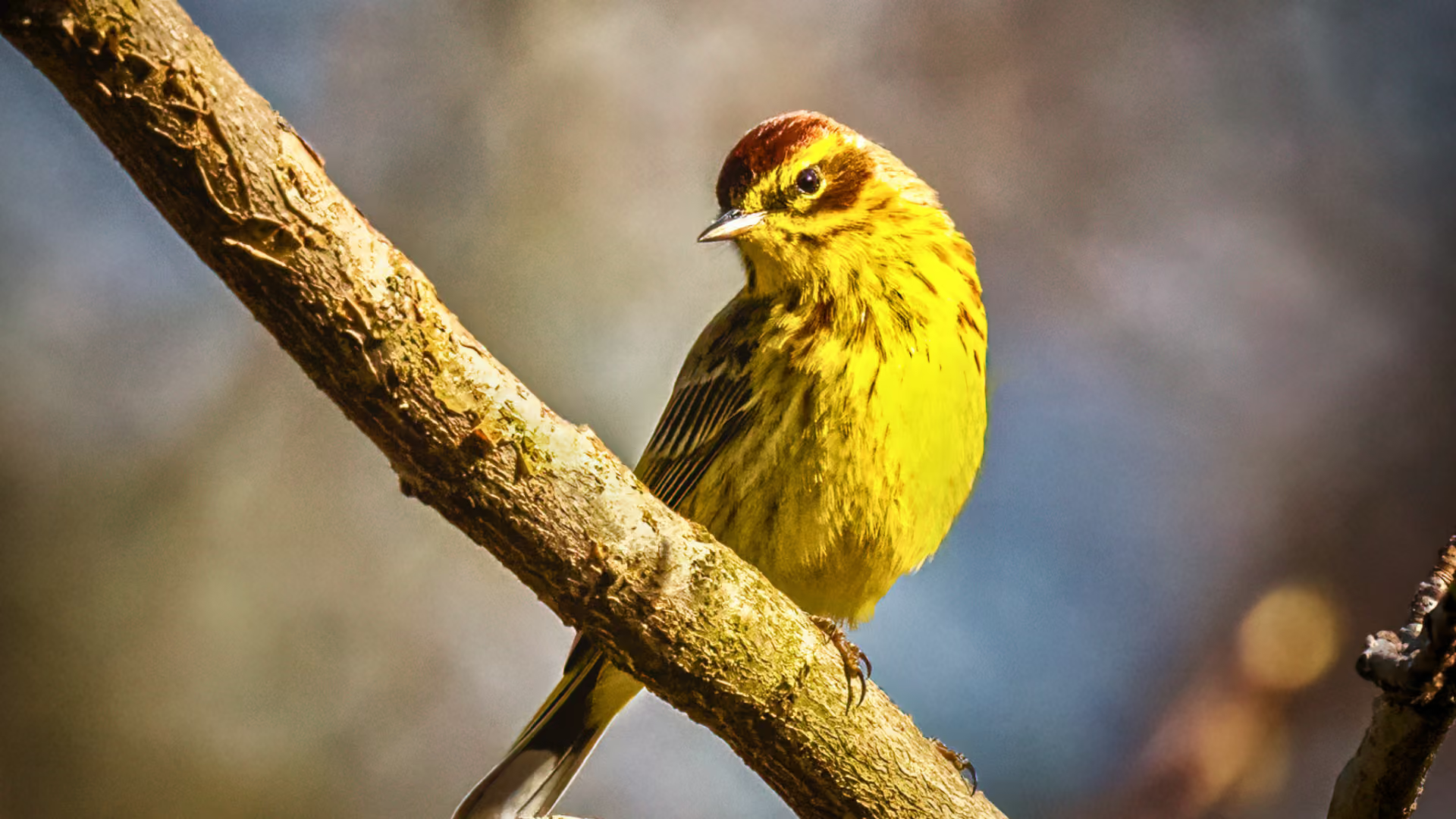
An active birder spending full days birding is likely to see: American Redstart (Setophaga ruticilla), Black-and-white Warbler (Mniotilta varia), Blackburnian Warbler (Setophaga fusca), Blackpoll Warbler (Setophaga striata), Black-throated Blue Warbler (Setophaga caerulescens), Black-throated Green Warbler (Setophaga virens), Blue-winged Warbler (Vermivora cyanoptera), Canada Warbler (Cardellina canadensis), Cape May Warbler (Setophaga tigrina), Cerulean Warbler (Setophaga cerulea), Chestnut-sided Warbler (Setophaga pensylvanica), Common Yellowthroat (Geothlypis trichas), Golden-winged Warbler (Vermivora chrysoptera), Hooded Warbler (Setophaga citrina), Magnolia Warbler (Setophaga magnolia), Mourning Warbler (Geothlypis philadelphia), Nashville Warbler (Leiothlypis ruficapilla), Northern Parula (Setophaga americana), Northern Waterthrush (Parkesia noveboracensis), Ovenbird (Seiurus aurocapilla), Palm Warbler (Setophaga palmarum), Pine Warbler (Setophaga pinus), Prothonotary Warbler (Protonotaria citrea), Tennessee Warbler (Leiothlypis peregrina), Wilson's Warbler (Cardellina pusilla), Yellow Warbler (Setophaga petechia), and Yellow-rumped Warbler (Setophaga coronata). Several others such as Yellow-throated Warbler (Setophaga dominica) and Worm-eating Warbler (Helmitheros vermivorum) are possible.
Over a full ten days, a birder working the boardwalk along with Ottawa, Howard Marsh, and the surrounding wetlands can build a long trip list, with warblers as the headline and dozens of other migrants filling it out. Beyond the warblers, the area produces Scarlet Tanager (Piranga olivacea), Rose-breasted Grosbeak (Pheucticus ludovicianus), Baltimore Oriole (Icterus galbula), multiple thrush species, vireos, flycatchers, and shorebirds in the adjacent wetlands.
Howard Marsh: The Sleeper Site
Howard Marsh is the site that most first-time visitors underestimate. Located west of Magee, it is a restored wetland that produces spectacular shorebird concentrations in early May, along with Yellow-headed Blackbirds (Xanthocephalus xanthocephalus), herons, egrets, and sometimes extraordinary concentrations of waterfowl. While everyone is on the Magee boardwalk, the birder at Howard Marsh may be looking at Dunlin flocks, White-rumped Sandpipers, and a distant Whimbrel without another person in sight.
Build Howard Marsh into your mid-day schedule, when the Magee boardwalk is at its most crowded and the wetland species are most active in the open water.
Ottawa National Wildlife Refuge: The Necessary Companion
Right next door to Magee, Ottawa National Wildlife Refuge covers more than 5,000 acres of managed wetland, woodland, and prairie, and it holds birds worth chasing on close to any day of the year. Start at the Visitors' Center, then drive the auto tour route, which threads through some of the best parts of the refuge for shorebirds, bitterns, Yellow-headed Blackbirds, and more.
Trumpeter Swans (Cygnus buccinator) were reintroduced here in the late 1990s and now nest on the refuge. Some birds show a rusty orange wash on the head and neck, picked up from the iron in the shallow water where they feed, but this staining is occasional and variable, and it is not a dependable way to tell the species apart. Tundra Swans (Cygnus columbianus) and Mute Swans (Cygnus olor) can end up with the same stain. The reliable marks are structural. On a Trumpeter the bill is entirely black and meets the forehead in a straight line, with no yellow in front of the eye, while a Tundra usually shows a small yellow spot on the lores and a more rounded border where the bill joins the face. The Trumpeter is also the larger of the two, with a longer neck and a heavier bill. Blue-winged Teal, both Lesser and Greater Yellowlegs, and Wood Duck are reliable here, along with Bald Eagle.
Crowd Management Strategy
With so many birders on site at once, almost nothing here goes unnoticed. A bird that turns up is usually spotted within minutes, and word travels fast down the boardwalk. That density is both the challenge and the advantage of a heavily attended festival site. The challenge: popular sections of the boardwalk can be crowded enough to make independent observation difficult. The advantage: with hundreds of eyes on the boardwalk at the same time, every rarity is found quickly and the location is passed along by word of mouth almost immediately.
For crowd management, the practical strategies are:
Go early. The boardwalk at first light, before 7 AM, is quieter and the birds are most active. Arrive at dawn, spend the first hour at the parking lot tree line, then enter the boardwalk before the guided walks begin.
Try the east end. Early morning on the less busy east end of the boardwalk is consistently more productive for independent birders. Most guided walks enter from the west. The east entrance accesses the same birds with a fraction of the crowd density.
Use the Estuary Trail. The Crane Creek Estuary Trail, accessible from the boardwalk's west end, extends into Ottawa NWR and offers excellent warbler habitat with far less traffic. On a slow boardwalk morning, the Estuary Trail may be more productive.
Consider late April. The days in late April, prior to the festival, are filled with the earlier migrants, which are not normally around when the festival begins. If your schedule allows, visiting the final days of April gives you access to early migrants, a quieter boardwalk, and the genuine possibility of better birds on strong migration nights.
Practical Logistics
Getting there: Magee Marsh Wildlife Area is located at 13229 West State Route 2, Oak Harbor, Ohio. Do not stop on Route 2 itself. It is never safe to stop your car on OH-2 in this area. State and local police ticket drivers pulled over to the side of this highway.
Hours: The Wildlife Area is open during daylight hours. The Bird Center is open all year Monday through Friday from 8 AM until 5 PM. During March through November the Bird Center is also open on Saturdays and Sundays from 11 AM until 5 PM, with special birding hours for the months of April and May, opening at 8 AM on Saturdays.
Accommodation: Maumee Bay Lodge is festival headquarters and the most convenient base, but it books out a year in advance. Port Clinton, Sandusky, and Toledo all offer alternative accommodation within 30 to 45 minutes. Book early regardless.
Equipment: While most birds on the boardwalk will be at eye level, sometimes a few inches from your face, binoculars are extremely helpful for seeing fine details and birds far away. A spotting scope is less useful on the boardwalk than a quality pair of binoculars. For the open water and shorebird areas at Ottawa NWR and Howard Marsh, a scope is invaluable.
Accessibility: The boardwalks at Magee Marsh Wildlife Area and Ottawa National Wildlife Refuge are both wheelchair accessible.
The Short Version
The Biggest Week in American Birding runs May 8 to 17, 2026 at Maumee Bay Lodge, northwest Ohio. The Magee Marsh boardwalk is free and open every day at dawn. Arrive before 7 AM for the quietest and most active window. Use the east end for smaller crowds. Add Ottawa NWR and Howard Marsh for shorebirds and waterfowl. Check BirdCast the night before for migration intensity. South winds followed by north winds equals the best boardwalk morning of your year. On a strong day the boardwalk alone can deliver dozens of species, warblers thick among them. Plan accordingly.