
Peregrine Falcon Speed and Nests: The World's Fastest Bird in Your City
Learn about peregrine falcon dive speed, urban nesting, DDT recovery, and prey. A guide to the world's fastest bird and its conservation comeback.
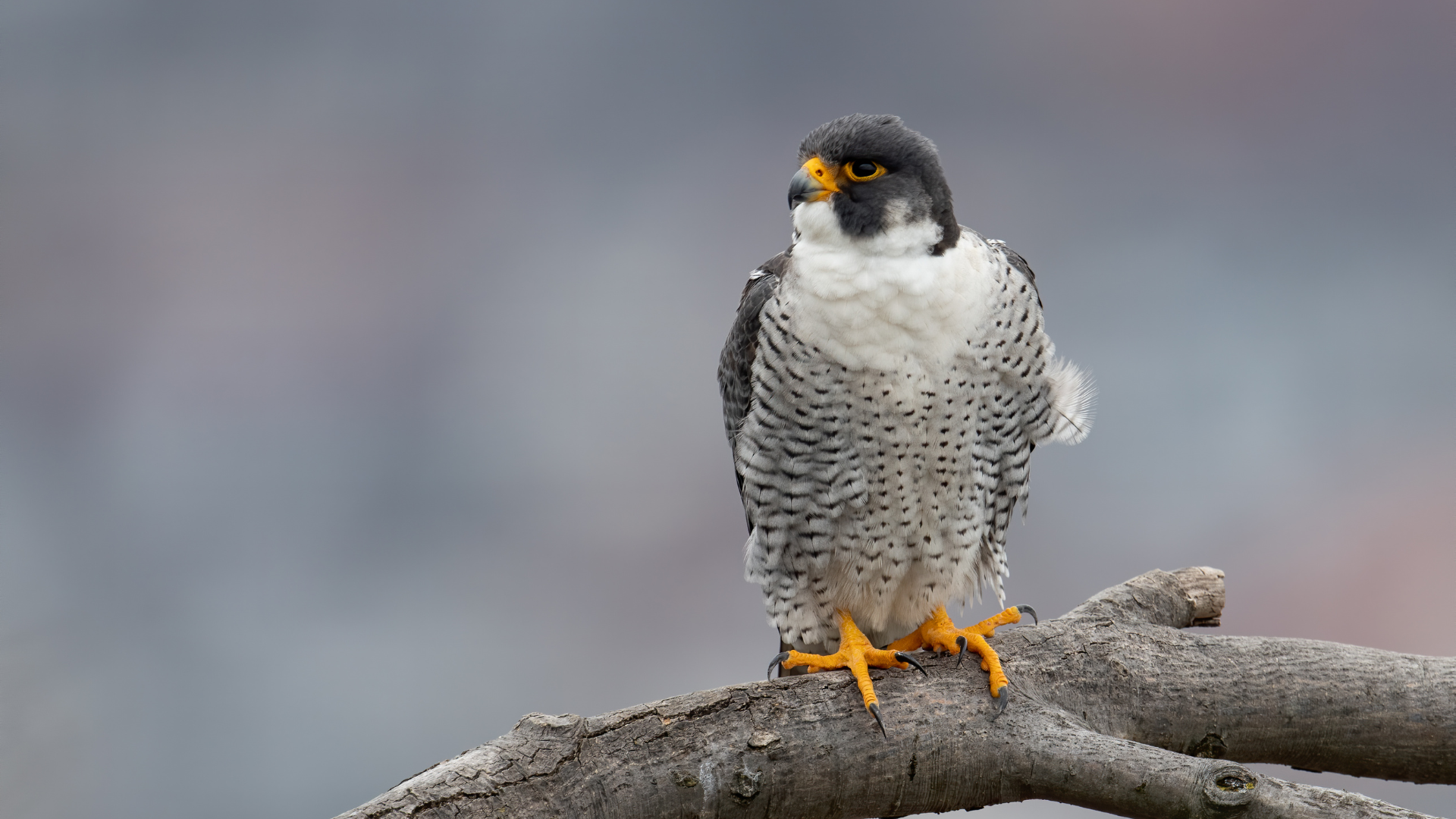
The peregrine falcon holds a record that no other animal on Earth can touch. In a full hunting stoop, this medium-sized falcon reaches speeds exceeding 380 kilometers per hour, making it the fastest animal ever recorded. That alone would be enough to make it one of the most compelling birds in the world. But the peregrine falcon's story is also one of catastrophic decline, dramatic conservation recovery, and remarkable urban adaptation, a story that now plays out on the sides of office towers in Montreal, Toronto, and cities across North America.
This guide covers peregrine falcon speed and dive mechanics, nesting behavior from remote sea cliffs to downtown skyscrapers, hunting techniques and prey selection, and the conservation history that brought this bird back from the edge of extinction in North America.
Peregrine Falcon Speed: The Science of the Stoop
The peregrine falcon achieves its extraordinary speed through a combination of evolved aerodynamics and exceptional muscle power. In level flight, peregrines cruise at 65 to 90 kilometers per hour, no faster than many large birds. The stoop changes everything. When a peregrine folds its wings into a teardrop shape and drops toward prey from altitude, the laws of physics amplify gravity-assisted acceleration into speeds that exceed 380 kilometers per hour in verified measurements. The fastest recorded stoop in scientific conditions reached 389 kilometers per hour, achieved during research conducted by Ken Franklin in California.
Dive Mechanics: How Peregrines Hit That Speed
Several anatomical features make the peregrine stoop possible. A bony tubercle inside each nostril deflects the airflow entering the nasal passage during the dive, preventing the air pressure from rupturing the lungs, a problem that would ground any other bird attempting similar speeds. The eyes are equipped with a nictitating membrane that sweeps across every second to clear debris during the dive while maintaining vision. The keel and flight muscles are proportionally massive, providing the sustained power needed to pull out of the stoop without damage. On impact, the peregrine either strikes prey with a half-open fist of talons, delivering a blow that kills or stuns instantly, or grasps the target in a full talon strike. The speed of the contact is sufficient to decapitate large birds in midair.
Peregrine Falcon Nesting Sites
Peregrines are cliff nesters by evolutionary heritage, scraping a shallow depression called an eyrie into a ledge on a steep rock face with an unobstructed view of surrounding terrain. In the wild, they favor sea cliffs, canyon walls, and river gorge escarpments. The same qualities that make a cliff ledge ideal (height, commanding view, sheer drop) are replicated perfectly by the upper floors of a tall building, and peregrines made this connection decades before their urban populations became common.
Today, urban nesting peregrines are established in nearly every major city in Canada and the United States with sufficient building height and prey populations. Montreal, Toronto, Ottawa, Quebec City, Vancouver, Calgary, and dozens of American cities now host multiple nesting pairs. Purpose-built nest boxes installed on building ledges, bridge towers, and power station structures have accelerated the colonization of urban environments and allow wildlife biologists to monitor breeding success and band chicks annually.
Urban Peregrine Examples: Canada's City Falcons
Montreal's peregrine population, centered on the bridges and downtown core, is one of the most well-documented urban falcon populations in North America. The Sun Life Building in central Montreal hosted one of the earliest urban nesting pairs in the country, and the tradition continues with active eyries on bridge towers over the St. Lawrence River. Toronto has hosted resident peregrine pairs on the Sheraton Centre, the Etobicoke nest box network, and Bay Street office towers. Ottawa's population nests on the Macdonald-Cartier Bridge and several federal government buildings in the downtown core. These populations are monitored annually by provincial wildlife agencies and citizen science networks, producing detailed records of nesting success, chick survival, and individual bird movements through satellite tracking.
Prey and Hunting Behavior
Peregrines are specialists on birds taken in aerial pursuit, and in urban environments their primary prey species shifts to reflect what is most abundant: pigeons, starlings, house sparrows, and various urban-adapted songbirds. In coastal and wetland habitats, shorebirds, ducks, gulls, and terns are heavily targeted. In rural settings, the prey list expands to include snipe, meadowlarks, and other open-country birds. Bats are also taken regularly, particularly at dusk when both predator and prey are most active.
The hunting strategy varies by habitat and prey type. In urban settings, a peregrine may launch from its building perch at a pigeon flock passing at roof height, executing a horizontal tail-chase as often as a full stoop. In open country over wetlands, the classic high-altitude stoop is more commonly employed. Peregrines frequently hunt from a soaring thermal, gaining altitude before selecting and committing to a target below.
Conservation History: From Collapse to Recovery
The peregrine falcon's decline in the mid-twentieth century stands as one of the most severe raptor population crashes ever documented in North America. By the early 1970s, the eastern peregrine population was functionally extinct as a breeding bird, eliminated by the accumulation of DDT and related organochlorine pesticides in its prey base. DDT caused eggshell thinning so severe that incubating adults crushed their own eggs under normal body weight. Population surveys in the late 1960s found almost no active eyries in the eastern United States.
The recovery program, driven by The Peregrine Fund, Cornell University, and Environment Canada, involved captive breeding and hacking, the release of captive-raised young at cliffs and urban sites across the continent. Between 1974 and the late 1990s, thousands of peregrines were released across North America. DDT was banned in the United States in 1972 and in Canada in stages through the 1970s and 1980s. The combination of pesticide removal and intensive reintroduction produced one of the most successful wildlife recoveries in conservation history. The peregrine was removed from the US Endangered Species List in 1999 and from Canadian threatened status in 2017, with populations now at or above historical levels across most of the continent.
Peregrine Falcon vs. Prairie Falcon
In the open grasslands and arid western regions of Canada and the United States, the prairie falcon occupies a similar niche to the peregrine, nesting on cliffs and hunting birds and mammals in aerial pursuit. The two species are occasionally confused in the field. The peregrine is identified by its distinctive dark helmet, bold mustache mark, and uniformly barred pale underparts. The prairie falcon is browner overall with a narrower mustache mark, a pale supercilium, and most distinctively, black axillaries (armpits) visible in flight. Habitat provides additional context: prairie falcons strongly prefer dry, open grassland and desert canyon country and are rarely found in the moist coastal and urban settings that peregrines favor.
Frequently Asked Questions
How fast does a peregrine falcon dive?
Peregrine falcons have been scientifically recorded reaching speeds of 389 kilometers per hour in a full hunting stoop, making them the fastest animals ever measured. In level flight they travel at 65 to 90 kilometers per hour. The extreme stoop speed is achieved through gravity-assisted descent in a folded-wing teardrop posture, combined with aerodynamic adaptations including nostril tubercles that manage air pressure at high velocity.
Do peregrine falcons nest in cities?
Yes. Urban nesting is now a defining feature of recovered peregrine populations across North America. Tall buildings, bridges, and power station stacks replicate the cliff ledge nesting sites peregrines evolved for. Montreal, Toronto, Ottawa, Vancouver, and Calgary all host multiple urban breeding pairs, monitored annually through nest box programs and banding operations run by wildlife agencies and volunteer networks.
What is the peregrine falcon's recovery story?
Peregrine falcons were functionally eliminated from eastern North America by the early 1970s due to DDT-caused eggshell thinning. Recovery began with the banning of DDT in North America during the 1970s and an intensive captive-breeding and release program led by The Peregrine Fund. By 1999 the species was removed from the US Endangered Species List, and it was delisted from Canadian threatened status in 2017, representing one of the great success stories of North American wildlife conservation.
Peregrine falcon vs. prairie falcon: how do I tell them apart?
The peregrine has a dark helmet, bold mustache mark, and uniformly barred pale underparts. The prairie falcon is browner with a narrow mustache, pale eyebrow, and most importantly black armpits visible in flight. Habitat is a strong cue: peregrines are found in coastal, urban, and moist environments, while prairie falcons prefer dry grasslands and desert canyon country.
The Fastest Animal on Earth, Nesting on Your Office Tower
The peregrine falcon's combination of physical extremity and conservation drama makes it one of the most compelling species in North American ornithology. A bird that dives faster than a racing car, was nearly lost within living memory, and now raises chicks on downtown Montreal bridges is a story worth knowing from every angle. Learning to look up when pigeons scatter suddenly from a building ledge is the first step toward one of the most electrifying experiences urban birding has to offer.
The allure of off-the-beaten-path travel
Lorem ipsum dolor sit amet, consectetur adipiscing elit ut aliquam, purus sit amet luctus venenatis, lectus magna fringilla urna, porttitor rhoncus dolor purus non enim praesent elementum facilisis leo, vel fringilla est ullamcorper eget nulla facilisi etiam dignissim diam quis enim lobortis scelerisque fermentum dui faucibus in ornare quam viverra orci sagittis eu volutpat odio facilisis mauris sit amet massa vitae tortor.
Unveiling the charm of lesser-known Destinations
Orci sagittis eu volutpat odio facilisis mauris sit amet massa vitae tortor condimentum lacinia quis vel eros donec ac odio tempor orci dapibus ultrices in iaculis nunc sed augue lacus.
- Lorem ipsum dolor sit amet consectetur facilisi etiam dignissim diam quis enim
- Mauris aliquet faucibus iaculis dui vitae ullamco sit amet luctus
- Posuere enim mi pharetra neque proin dic rhoncus dolor purus non enim
- Dui faucibus in ornare posuere enim mi pharetra neque proin dicit
Finding solitude in hidden gem locations
Lorem ipsum dolor sit amet, consectetur adipiscing elit ut aliquam, purus sit amet luctus venenatis, lectus magna fringilla urna, porttitor rhoncus dolor purus non enim praesent elementum facilisis leo, vel fringilla est ullamcorper eget nulla facilisi etiam dignissim diam quis enim lobortis scelerisque fermentum dui faucibus in ornare quam viverra orci sagittis eu volutpat odio facilisis mauris sit amet massa vitae tortor condimentum lacinia quis vel eros donec ac odio tempor orci dapibus ultrices.
The thrill of discovering untouched natural beauty
Dolor sit amet, consectetur adipiscing elit ut aliquam, purus sit amet luctus venenatis, lectus magna fringilla urna, porttitor rhoncus dolor purus non enim praesent elementum facilisis leo, vel fringilla est ullamcorper eget nulla.
- Lorem ipsum dolor sit amet consectetur tempor orci dapibus ultrices
- Mauris aliquet faucibus iaculis dui vitae ullamco elementum facilisis
- Posuere enim mi pharetra neque proin dic fermentum dui faucibus in ornare
- Purus sit amet luctus posuere enim mi pharetra neque proin dic
“Ut enim ad minim veniam, quis nostrud exercitation ullamco laboris nisi ut aliquip ex ea commodo consequat uis aute irure dolor in reprehenderit in voluptate velit”
Exploring cultural marvels off the tourist radar
Donsectetur adipiscing elit ut aliquam, purus sit amet luctus venenatis, lectus magna fringilla urna, porttitor rhoncus dolor purus non enim praesent elementum facilisis leo, vel fringilla est ullamcorper eget nulla facilisi etiam dignissim diam quis enim lobortis scelerisque fermentum dui faucibus in ornare quam viverra orci sagittis eu volutpat odio facilisis mauris sit amet massa vitae tortor condimentum lacinia quis vel eros donec ac odio tempor orci dapibus ultrices in iaculis nunc sed.