
Sandhill Crane Migration Dance: Flyways, Courtship, and Where to Watch
Learn about sandhill crane migration, the courtship dance, how to tell them from whooping cranes, and the best places to watch the Platte River staging.
Few wildlife spectacles in North America match the scale and drama of sandhill crane migration. Each spring, up to 600,000 sandhill cranes converge on a 120-kilometer stretch of the Platte River in Nebraska, filling the sky with vast, calling flocks and turning river sandbars white with roosting birds. But the migration spectacle is only part of the story. Before these birds continue north to their breeding wetlands, they perform one of the most elaborate and beautiful courtship rituals in the avian world: the sandhill crane dance.
Understanding sandhill crane behavior, from migration timing and flyway routes to the mechanics and meaning of the courtship dance, transforms what might otherwise be a simple wildlife observation into a genuinely informed experience. This guide covers identification, the biology of the crane dance, migration routes including those passing through Canada, and the best viewing locations and timing for witnessing this spectacle yourself.
Identifying the Sandhill Crane
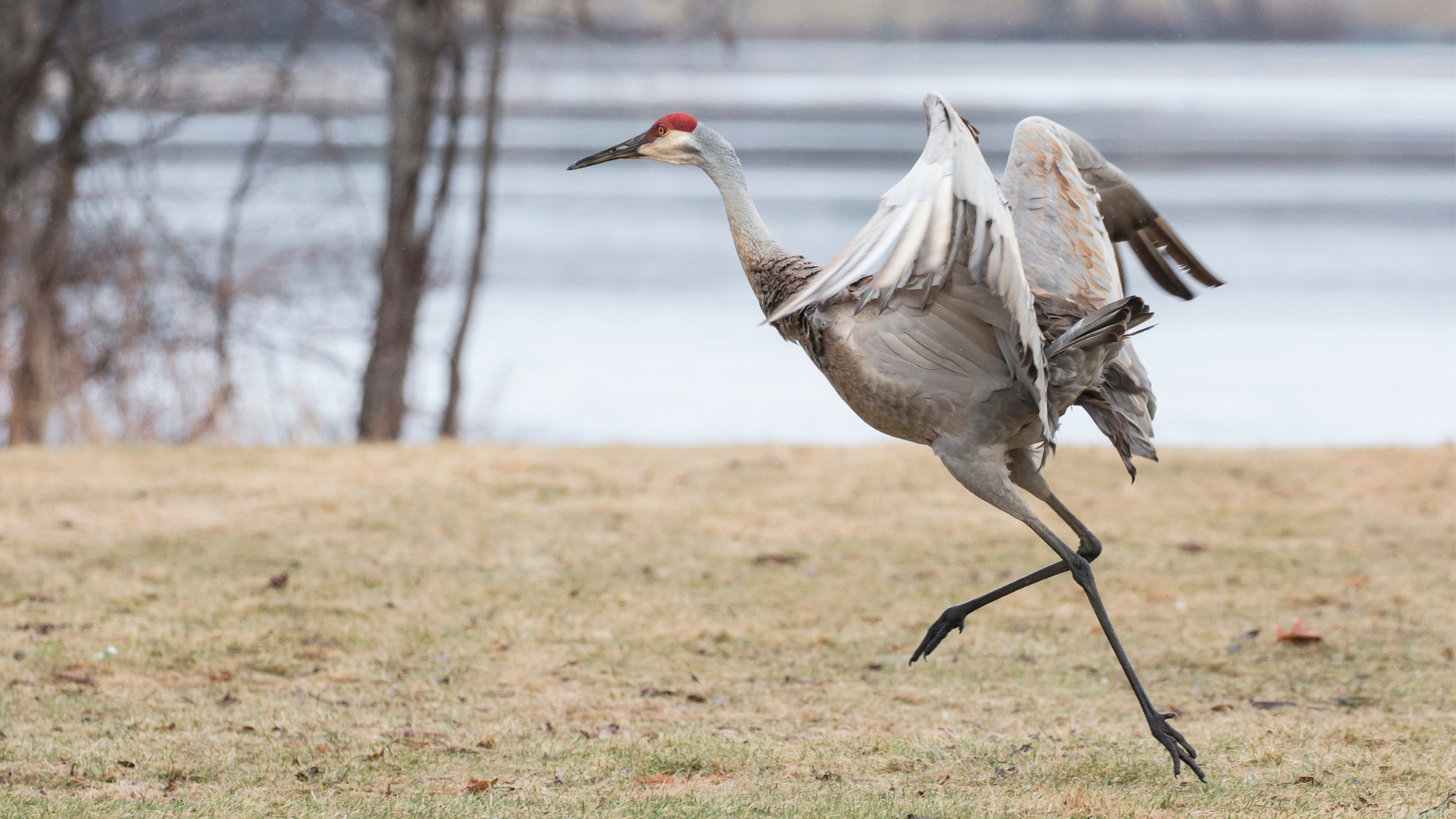
The sandhill crane is a large, long-legged wading bird standing up to 120 centimeters tall with a wingspan reaching 185 to 200 centimeters. Adults are predominantly gray, sometimes tinged with rust-brown from preening in iron-rich mud, with a distinctive bare red crown patch on the forehead and a white cheek. The bill is long and straight, the neck is held extended in flight, and the legs trail behind the tail in a distinctive silhouette that separates cranes from herons, which fold their necks in flight. In mixed flocks and open wetland landscapes, the loud, resonant, rolling garoo-a-a-a calls of sandhill cranes carry for several kilometers and are often the first indication of the bird's presence.
Sandhill Crane vs. Whooping Crane
The whooping crane is the rarest bird in North America, and distinguishing it from the sandhill crane is important for any birder in flyway states and provinces. The adult whooping crane is pure white with black wingtips and a red and black face, standing noticeably taller than the sandhill crane. Immature whooping cranes are mottled cinnamon-brown and white, which can cause brief confusion with a large sandhill crane, but size, wing pattern, and the clean white body of adults are definitive. During the Platte River staging period and in Texas wintering areas, the two species sometimes occur in close proximity, making direct size comparison possible. The whooping crane is substantially taller and heavier, and the white plumage is visible at considerable distance even in poor light.
The Courtship Dance: Biology and Meaning
The sandhill crane dance is performed by birds of all ages throughout the year, but it reaches its greatest intensity during the late winter and spring migration period when pair bonds are consolidated and breeding motivation is at its peak. The dance involves a sequence of behaviors including deep bowing with wings spread, jumping vertically into the air to heights of up to two meters, head pumping, wing stretching, and the throwing of sticks, grass stems, or other objects into the air. These elements are combined in varying sequences and can involve two birds mirroring each other's movements, creating the synchronized spectacle that attracts so much attention on the Platte River sandbars each March.
The function of the dance is complex. It is most commonly described as a courtship display, and it does serve to strengthen and test pair bonds between established mates. But sandhill cranes also dance in non-courtship contexts: juveniles dance, unpaired birds dance, and groups of birds sometimes erupt into communal dancing that appears social rather than strictly sexual. Current research suggests the dance may serve multiple functions simultaneously, including stress reduction, social bonding beyond the pair, and communication of individual condition and fitness. Pairs that dance together more frequently show higher breeding success, suggesting that dance quality and coordination genuinely reflects the strength of the pair bond.
Migration Routes and Flyways
Sandhill cranes in North America use four primary migration flyways: the Central, Mississippi, Pacific, and Atlantic flyways. The Central Flyway is home to the greatest concentrations, where the mid-continent population, numbering over 500,000 birds, funnels through the central Great Plains on its way between Gulf Coast wintering grounds and boreal and arctic breeding territories.
In Canada, sandhill cranes breeding across the boreal forest of northern Ontario, Manitoba, Saskatchewan, Alberta, and British Columbia undertake long migrations between their southern wintering areas and northern nesting sites. The Platte River staging concentration in central Nebraska is the critical link in this chain for the mid-continent population: birds arrive from late February onward, spend three to five weeks fueling on waste corn in surrounding agricultural fields, then continue north in wave after wave throughout April and into May. Flyover routes pass through the Prairie provinces in April and early May, where migrating flocks can be observed from virtually any open landscape with a clear sky view.
Breeding Wetlands and Summer Range
Sandhill cranes breed across a vast range of wetland and boreal habitats from the Great Lakes states northward through Canada to the Arctic coast and west to Alaska and Siberia. Breeding territories center on shallow wetlands, marshes, sedge meadows, and boreal bogs where nests are built on mounds of vegetation at the water's edge or in shallow water itself. Clutches typically contain two eggs, and both parents share incubation and chick-rearing. The single chick that usually survives to fledging (sibling competition is intense in early life) remains with its parents through the first autumn migration and first winter, traveling as a family group until the following spring.
Where and When to Watch Sandhill Crane Migration
The Platte River in south-central Nebraska, particularly the stretch between Kearney and Grand Island, offers the most concentrated and reliable sandhill crane viewing in the world. Peak staging occurs from late February through late March, with the maximum numbers typically present in mid-March. During this period, several hundred thousand cranes roost on shallow river sandbars at night and disperse into surrounding cornfields to feed during the day. The most spectacular moments are the dawn departure from the river, when massive flocks lift off simultaneously in the predawn light, and the evening return, when wave after wave of cranes spiral down onto the sandbars as light fades.
For Canadian observers, the Prairie provinces offer excellent opportunities to watch migrating flocks passing overhead or descending to rest and feed in agricultural fields during April. Specific areas around Last Mountain Lake in Saskatchewan and Oak Hammock Marsh in Manitoba are among the most reliable Canadian viewing sites during spring migration.
Nebraska Migration Timing and Viewing Tips
If you are planning a trip to the Platte River, timing is everything. The peak window of maximum crane concentration runs from approximately March 10 to March 25 in most years, though this varies with weather and the pace of the spring migration. Arrive well before sunrise to position yourself on or near the river for the dawn departure, and return to the same location in the hour before sunset for the evening roost flight. Blinds maintained by the Crane Trust and Audubon Society's Rowe Sanctuary along the Platte provide the best close-range views. Binoculars and spotting scopes are useful but often unnecessary when flocks number in the thousands overhead.
Frequently Asked Questions
What is the purpose of the sandhill crane dance?
The sandhill crane dance serves multiple functions. It strengthens and consolidates pair bonds between mates and is most intense during the breeding season. But cranes of all ages and social situations dance, and research suggests the behavior also reduces social tension, communicates individual fitness, and reinforces group cohesion. Pairs that dance more coordinatedly show higher breeding success, indicating the dance genuinely reflects and strengthens the pair bond.
Sandhill crane vs. whooping crane: how do I tell them apart?
Adult whooping cranes are pure white with black wingtips and stand noticeably taller than the gray sandhill crane. Immature whooping cranes are mottled brown and white but still larger and paler than a sandhill crane. In mixed groups, direct size comparison is the most reliable field mark, with the whooping crane substantially taller and heavier than its more common relative.
When and where is the best place to watch sandhill crane migration in Nebraska?
The Platte River between Kearney and Grand Island in south-central Nebraska is the prime destination. Peak viewing runs from approximately March 10 to March 25, with the maximum concentration typically in mid-March. Dawn departures from river roosts and evening returns offer the most dramatic viewing. Blinds operated by the Crane Trust and Audubon's Rowe Sanctuary provide excellent close-range access.
What sounds do sandhill cranes make?
The sandhill crane's primary call is a loud, rolling, resonant garoo-a-a-a that carries several kilometers and is unlike any other bird sound in North America. In flight, family groups and pairs maintain constant vocal contact. During courtship, the unison call, performed by a pair in synchronized duet with precise timing, is an important bonding display. The calls are produced by an elongated trachea that coils within the sternum, giving the sound its distinctive resonance and carrying power.
A Migration Spectacle Worth Traveling For
The sandhill crane migration is one of the great wildlife events on the planet, available to anyone willing to be on a Nebraska riverbank in mid-March or a Saskatchewan field in April. Understanding the biology of the dance, the mechanics of the flyway, and the remarkable distance these birds travel between Gulf Coast wintering grounds and Arctic breeding sites makes every crane encounter, whether a single bird lifting from a wetland or 10,000 cranes turning in the sunrise sky, something genuinely extraordinary.
The allure of off-the-beaten-path travel
Lorem ipsum dolor sit amet, consectetur adipiscing elit ut aliquam, purus sit amet luctus venenatis, lectus magna fringilla urna, porttitor rhoncus dolor purus non enim praesent elementum facilisis leo, vel fringilla est ullamcorper eget nulla facilisi etiam dignissim diam quis enim lobortis scelerisque fermentum dui faucibus in ornare quam viverra orci sagittis eu volutpat odio facilisis mauris sit amet massa vitae tortor.
Unveiling the charm of lesser-known Destinations
Orci sagittis eu volutpat odio facilisis mauris sit amet massa vitae tortor condimentum lacinia quis vel eros donec ac odio tempor orci dapibus ultrices in iaculis nunc sed augue lacus.
- Lorem ipsum dolor sit amet consectetur facilisi etiam dignissim diam quis enim
- Mauris aliquet faucibus iaculis dui vitae ullamco sit amet luctus
- Posuere enim mi pharetra neque proin dic rhoncus dolor purus non enim
- Dui faucibus in ornare posuere enim mi pharetra neque proin dicit
Finding solitude in hidden gem locations
Lorem ipsum dolor sit amet, consectetur adipiscing elit ut aliquam, purus sit amet luctus venenatis, lectus magna fringilla urna, porttitor rhoncus dolor purus non enim praesent elementum facilisis leo, vel fringilla est ullamcorper eget nulla facilisi etiam dignissim diam quis enim lobortis scelerisque fermentum dui faucibus in ornare quam viverra orci sagittis eu volutpat odio facilisis mauris sit amet massa vitae tortor condimentum lacinia quis vel eros donec ac odio tempor orci dapibus ultrices.
The thrill of discovering untouched natural beauty
Dolor sit amet, consectetur adipiscing elit ut aliquam, purus sit amet luctus venenatis, lectus magna fringilla urna, porttitor rhoncus dolor purus non enim praesent elementum facilisis leo, vel fringilla est ullamcorper eget nulla.
- Lorem ipsum dolor sit amet consectetur tempor orci dapibus ultrices
- Mauris aliquet faucibus iaculis dui vitae ullamco elementum facilisis
- Posuere enim mi pharetra neque proin dic fermentum dui faucibus in ornare
- Purus sit amet luctus posuere enim mi pharetra neque proin dic
“Ut enim ad minim veniam, quis nostrud exercitation ullamco laboris nisi ut aliquip ex ea commodo consequat uis aute irure dolor in reprehenderit in voluptate velit”
Exploring cultural marvels off the tourist radar
Donsectetur adipiscing elit ut aliquam, purus sit amet luctus venenatis, lectus magna fringilla urna, porttitor rhoncus dolor purus non enim praesent elementum facilisis leo, vel fringilla est ullamcorper eget nulla facilisi etiam dignissim diam quis enim lobortis scelerisque fermentum dui faucibus in ornare quam viverra orci sagittis eu volutpat odio facilisis mauris sit amet massa vitae tortor condimentum lacinia quis vel eros donec ac odio tempor orci dapibus ultrices in iaculis nunc sed.