
Dawn Chorus Listening Guide: How to Experience and Identify Morning Birdsong
Experience the dawn chorus with tips on timing, best locations, species layering, and tools like Merlin and BirdNET for North American birders.

There is a moment just before sunrise, in the still blue dark of early morning, when the first bird voice breaks the silence. Within minutes, dozens of species layer their songs into a complex acoustic tapestry that reaches peak intensity at sunrise and then slowly subsides as the morning warms. This is the dawn chorus, and for many birders it is the single most overwhelming and beautiful experience the natural world offers. It is also, with the right preparation, one of the most productive identification sessions you can have.
This guide explains the science behind why birds sing at dawn, the best times and places to experience the chorus in North America, how to begin pulling individual species voices from the mix, and how to use recordings and apps to document and review what you hear.
What Is the Dawn Chorus?
The dawn chorus is the intense burst of bird song that occurs in the period from roughly thirty minutes before sunrise to about an hour after, peaking at or just before the sun clears the horizon. It is most dramatic during the spring and early summer breeding season from April through June in most of temperate North America, when male songbirds are establishing territories and attracting mates. The chorus involves not just songbirds but also owls wrapping up their night activity, woodpeckers drumming, and waterfowl calling on nearby water.
The Science of Why Birds Sing at Dawn
Several interrelated hypotheses explain the concentration of song at dawn. The acoustic environment hypothesis notes that sound travels farther and with less distortion in the cool, still, thermally stable air of early morning than at any other time of day. Sound transmission quality begins to degrade as thermal convection currents develop after sunrise, making early morning the optimal broadcast window for territorial signals.
The honest signaling hypothesis, supported by significant research, proposes that a male bird singing at high intensity at first light signals that he successfully survived the night, which is the period of peak predation risk. A male in poor condition would not be able to sustain vigorous singing immediately after a full night exposed to predators. Females are therefore able to assess male quality by monitoring the timing and intensity of dawn singing. Studies have found correlations between individual male singing effort at dawn and reproductive success, supporting this interpretation.
- Pre-dawn twitter: some species begin before full darkness, roughly 60-90 minutes before sunrise
- Peak chorus: at or just before sunrise, maximum number of species singing simultaneously
- Post-dawn fade: intensity decreases as the morning warms and territorial conflicts are resolved
- Second peak: a quieter secondary chorus sometimes occurs in the late afternoon, especially in spring
Best Times and Spots to Hear the Dawn Chorus
Peak chorus season in eastern and central North America runs from late April through late May, coinciding with peak warbler migration and the arrival of most Neotropical migrants on their breeding grounds. In the Pacific Northwest the window is similar but extends slightly later due to spring arrival timing. In southern regions the chorus begins earlier, sometimes in March, while boreal species in Canada and the northern tier may not reach full chorus until June.
Choose locations with habitat diversity to maximize the species count in a single session. Forest edges, where woodland birds and open-country birds overlap, are particularly productive. Wetland edges add rails, frogs that can confuse the ear, and marsh birds to the mix. Suburban parks with mature trees and shrubby understory often produce surprisingly rich dawn choruses that are easy to access. Arrive at your chosen spot in full darkness, before any birds have begun singing, so you can hear the progression from the first voice to full chorus without missing the early singers.
- Arrive 30-45 minutes before sunrise to be in position before singing begins
- Target forest edges, wetland margins, and shrubby park habitats
- Peak season: late April through late May for most of temperate North America
- Dress warmly: standing still for an hour before sunrise is colder than moving during a normal birding walk
- Check eBird bar charts for your location to know which species are currently present
Identification Tips for the Dawn Chorus
Identifying birds during the dawn chorus is challenging even for experienced birders because multiple species sing simultaneously and acoustic conditions can make familiar songs sound unfamiliar at high volume or at unusual distances. A few strategies make the process more manageable.
Layering Songs: Separating Voices from the Mix
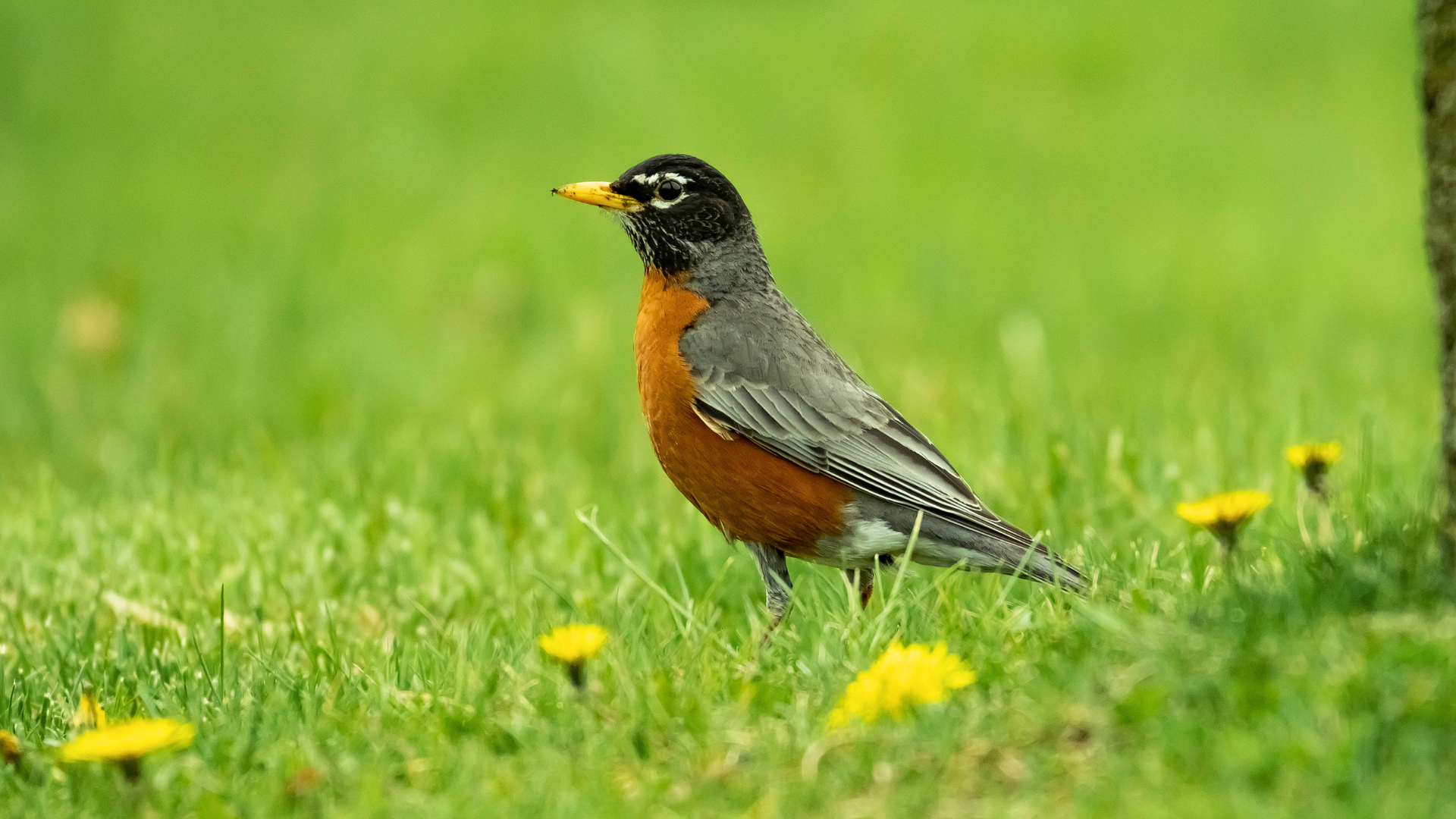
Think of the chorus as a series of acoustic layers, each occupying a slightly different frequency range or habitat zone. Robins and thrushes tend to produce rich flute-like songs in the mid-frequency range. Warblers occupy higher frequencies with thin, buzzy, or sibilant notes. Great Crested Flycatchers add loud emphatic calls from the mid-canopy. Sparrows sing from low shrubs or the ground. Rails produce grunting or whinny calls from the marsh edge. Consciously directing your attention to one frequency range or one habitat layer at a time separates the overlapping voices into more manageable streams.
Start each session by identifying two or three anchor species, birds whose songs you know confidently, and use them as reference points. If you can clearly hear an American Robin and a Black-capped Chickadee, those become anchors against which unfamiliar voices can be evaluated for relative pitch, tempo, and habitat position. Build outward from your anchors rather than trying to decode the full chorus simultaneously.
- Identify two to three confident anchor species to use as reference points
- Focus on one acoustic layer at a time: high-frequency warblers, mid-range thrushes, low sparrows
- Note which direction an unfamiliar song comes from and scan that habitat quadrant
- Use Merlin Sound ID running on your phone to help label voices while you listen and observe
Recording and Reviewing the Dawn Chorus
Recording the dawn chorus with a phone or a dedicated recorder allows post-session review that dramatically accelerates learning. Many songs that blur past in real time can be identified calmly at home from a recording. Free apps like Voice Memos on iPhone produce recordings clear enough for identification purposes when held away from wind noise. Dedicated field recorders produce much cleaner results for serious documentation.
After a recording session, run the audio through BirdNET, the Cornell Lab identification tool, which analyzes recordings and returns species probability lists with time stamps. Combine BirdNET analysis with your own listening and the Xeno-canto reference library to build a confirmed species list from each session. Reviewing recordings in the evening after a dawn session while memory is still fresh creates a powerful learning loop that transfers to faster in-field recognition on subsequent outings.
Frequently Asked Questions
What is the dawn chorus?
The dawn chorus is the concentrated burst of bird song that occurs in the period from roughly 30 minutes before sunrise to about an hour after, peaking at or just before sunrise. It is most intense during the spring breeding season and involves male songbirds advertising territory and fitness through sustained singing in the optimal acoustic conditions of early morning.
Why do birds sing specifically at dawn?
Sound travels farther and with less distortion in the cool still air of early morning than at any other time of day. Research also supports the idea that vigorous dawn singing signals to potential mates that a male survived the night successfully, making early morning song an honest indicator of health and fitness. Both factors make dawn the most productive singing window for territorial males.
When is the best time to hear the dawn chorus in North America?
Late April through late May is the peak chorus season for most of temperate North America, coinciding with the arrival of Neotropical migrants and the peak of territorial singing by resident species. Arrive at your chosen location 30 to 45 minutes before local sunrise to hear the full progression from the first voices to peak intensity at sunrise.
How do I begin to identify individual species during the dawn chorus?
Start by picking out two or three anchor species whose songs you already know confidently, and use them as frequency and tempo reference points. Then direct your attention to one acoustic layer at a time rather than trying to decode the full chorus. Use Merlin Sound ID running passively on your phone to help label unfamiliar voices while you observe. Record the session for post-sunset review with BirdNET to build your confirmed species list.
An Experience Worth Waking Up For
The dawn chorus is one of those birding experiences that stays with you long after the last note fades. The combination of cool morning air, building light, and an accelerating crescendo of song from dozens of species simultaneously is genuinely unlike anything else in natural history observation. Once you have stood in a spring forest edge at first light with Merlin running and a warm flask in your hand, the alarm clock stops feeling like an obstacle and starts feeling like an invitation. Go early, dress warmly, and let the birds do the rest.
The allure of off-the-beaten-path travel
Lorem ipsum dolor sit amet, consectetur adipiscing elit ut aliquam, purus sit amet luctus venenatis, lectus magna fringilla urna, porttitor rhoncus dolor purus non enim praesent elementum facilisis leo, vel fringilla est ullamcorper eget nulla facilisi etiam dignissim diam quis enim lobortis scelerisque fermentum dui faucibus in ornare quam viverra orci sagittis eu volutpat odio facilisis mauris sit amet massa vitae tortor.

Unveiling the charm of lesser-known Destinations
Orci sagittis eu volutpat odio facilisis mauris sit amet massa vitae tortor condimentum lacinia quis vel eros donec ac odio tempor orci dapibus ultrices in iaculis nunc sed augue lacus.
- Lorem ipsum dolor sit amet consectetur facilisi etiam dignissim diam quis enim
- Mauris aliquet faucibus iaculis dui vitae ullamco sit amet luctus
- Posuere enim mi pharetra neque proin dic rhoncus dolor purus non enim
- Dui faucibus in ornare posuere enim mi pharetra neque proin dicit
Finding solitude in hidden gem locations
Lorem ipsum dolor sit amet, consectetur adipiscing elit ut aliquam, purus sit amet luctus venenatis, lectus magna fringilla urna, porttitor rhoncus dolor purus non enim praesent elementum facilisis leo, vel fringilla est ullamcorper eget nulla facilisi etiam dignissim diam quis enim lobortis scelerisque fermentum dui faucibus in ornare quam viverra orci sagittis eu volutpat odio facilisis mauris sit amet massa vitae tortor condimentum lacinia quis vel eros donec ac odio tempor orci dapibus ultrices.
The thrill of discovering untouched natural beauty
Dolor sit amet, consectetur adipiscing elit ut aliquam, purus sit amet luctus venenatis, lectus magna fringilla urna, porttitor rhoncus dolor purus non enim praesent elementum facilisis leo, vel fringilla est ullamcorper eget nulla.
- Lorem ipsum dolor sit amet consectetur tempor orci dapibus ultrices
- Mauris aliquet faucibus iaculis dui vitae ullamco elementum facilisis
- Posuere enim mi pharetra neque proin dic fermentum dui faucibus in ornare
- Purus sit amet luctus posuere enim mi pharetra neque proin dic
“Ut enim ad minim veniam, quis nostrud exercitation ullamco laboris nisi ut aliquip ex ea commodo consequat uis aute irure dolor in reprehenderit in voluptate velit”
Exploring cultural marvels off the tourist radar
Donsectetur adipiscing elit ut aliquam, purus sit amet luctus venenatis, lectus magna fringilla urna, porttitor rhoncus dolor purus non enim praesent elementum facilisis leo, vel fringilla est ullamcorper eget nulla facilisi etiam dignissim diam quis enim lobortis scelerisque fermentum dui faucibus in ornare quam viverra orci sagittis eu volutpat odio facilisis mauris sit amet massa vitae tortor condimentum lacinia quis vel eros donec ac odio tempor orci dapibus ultrices in iaculis nunc sed.