
How to Identify Birds by Sound: A Beginner's Guide
Learn to identify birds by sound with this beginner's guide covering bird songs vs calls, key sound qualities, Merlin Sound ID, and ear-training strategies.
You hear it before you see it: a clear flute-like song drifting from deep inside a leafy canopy, or a sharp metallic chip note from the thicket beside the trail. Learning to identify birds by sound opens up a completely different dimension of birding. Experienced birders often identify the majority of species in a woodland by ear alone, without ever getting a clear visual. For beginners, ear birding can feel overwhelming, but it becomes manageable quickly once you understand how bird vocalizations are structured and how modern tools can accelerate your learning.
This guide covers the fundamental differences between songs and calls, the key sound qualities to listen for, the best apps and tools for sound identification, and practical strategies for building your ear in the field.
Song vs. Call: Understanding the Difference
One of the most important distinctions in bird sound identification is the difference between a song and a call. Songs are typically complex, extended vocalizations used primarily by males to advertise territory and attract mates. They tend to be species-specific and consistent enough to serve as reliable identification markers. Calls are shorter, simpler vocalizations used for functions like contact, alarm, and coordination within flocks.
The same bird species may have a song you learn immediately and a call note that stumps you for years. The Ovenbird's loud teacher teacher teacher song is distinctive and easy to place once heard. Its sharp metallic chip call, on the other hand, resembles dozens of other warblers and sparrows. Knowing that you are hearing a call versus a song adjusts your expectations appropriately and prevents misidentification.
Why This Distinction Matters for Beginners
Beginners often focus on songs because they are easier to find in recordings and field guides. But calls make up the majority of sounds you will hear in the field, especially during fall migration and winter when singing is minimal. Training your ear on both types from the start will make you a more complete birder across all seasons.
- Songs: complex, melodic, longer duration, mostly spring and summer
- Calls: short, functional, heard year-round, often similar across species
- Alarm calls: sharp and scolding, often shared across multiple species
- Flight calls: given during migration at night or at dawn, species-specific and learnable
Key Sound Qualities to Listen For
When a bird vocalizes, resist the urge to immediately reach for your phone. Instead, train yourself to consciously register a few key sound properties before the moment passes. These qualities form the raw material for identification and for retaining sounds in memory.
Pitch, Rhythm, and Tempo
Pitch refers to how high or low the sound is on the musical scale. Some species like the Golden-crowned Kinglet produce extremely high-frequency sounds near the upper edge of human hearing, often inaudible to older birders. Others like the American Bittern produce low booming sounds that carry across a marsh. Getting a quick read on pitch level helps narrow the family group immediately.
Rhythm and tempo describe how notes are arranged in time. Is the song a single sustained tone? A rapid series of identical notes? An ascending whistle followed by a descending phrase? The White-throated Sparrow sings a mournful series of clear whistles often described as Oh sweet Canada Canada Canada, a memorable rhythm that carries well through forest. Flickers produce long rolling calls with consistent tempo that telegraph their presence from a distance.
- Pitch: high, mid-range, or low compared to other nearby sounds
- Tempo: fast rapid-fire notes versus slow spaced phrases
- Tone quality: flute-like, buzzy, harsh, metallic, or nasal
- Pattern: repeated phrases, varied phrases, ascending, or descending structure
Apps and Tools for Bird Sound Identification
Technology has transformed ear birding for beginners. Two apps stand out above all others for North American birders looking to identify birds by sound in real time.
Merlin Sound ID
Merlin Bird ID from the Cornell Lab of Ornithology includes a Sound ID feature that listens through your phone's microphone and identifies bird species in real time. It covers over 2,000 species including comprehensive coverage of the United States and Canada, and it works offline once species packs are downloaded. The app displays a scrolling spectrogram as it listens, highlighting each species as it detects their calls or songs. This visual reinforcement helps connect the sound you are hearing to the species name on screen, accelerating the learning process significantly.
Merlin is powered by eBird data, meaning its detection accuracy reflects real-world occurrence patterns for your location and date. It will not flag a tropical species in a Canadian boreal forest in February. This location and date intelligence makes the identifications highly reliable and removes a major source of confusion for beginners.
BirdNET
BirdNET, developed by the Cornell Lab and Chemnitz University, offers a complementary approach. You can record a sound clip and submit it for analysis, receiving a species probability list with confidence scores. BirdNET is particularly useful for reviewing recordings made in the field when you could not check your phone in the moment.
- Merlin Sound ID: real-time, location-aware, offline capable, spectrogram display
- BirdNET: recording analysis, confidence scores, useful for post-field review
- Xeno-canto: community-contributed recordings from around the world for reference listening
- eBird: bar charts show which species are present in your location by date
Learning Strategies: Building Your Ear Without Apps
Apps are a powerful crutch for beginners but the goal is to develop independent listening skills. Several strategies help you internalize bird sounds so that field recognition becomes automatic.
Mnemonics and Phrase Associations
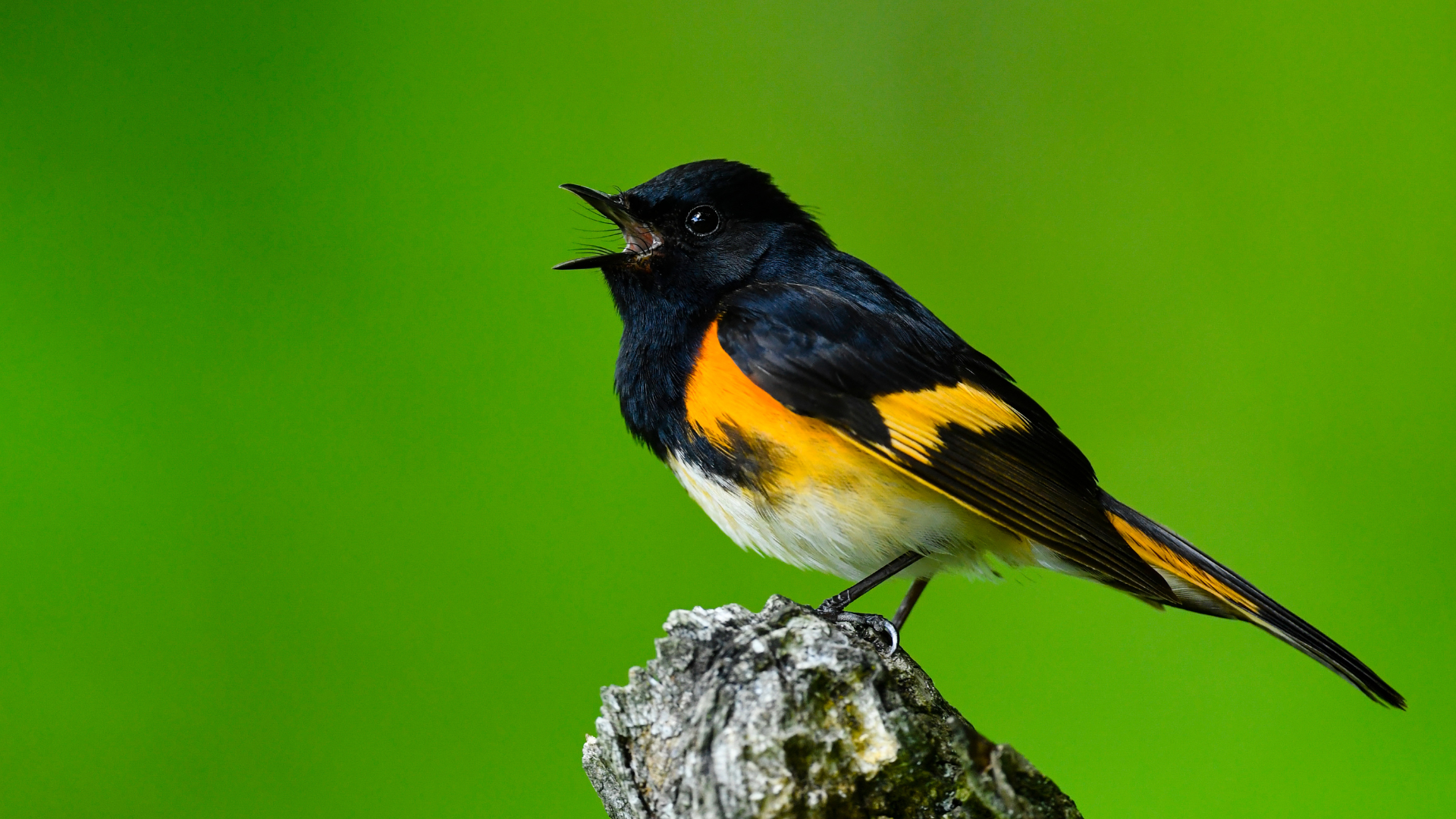
Attaching a memorable phrase to a bird's song is one of the oldest and most effective learning techniques in ornithology. The Eastern Wood-Pewee is said to sing pee-a-wee in a plaintive two-note pattern. The Barred Owl calls Who cooks for you, who cooks for you-all. The American Redstart's song has been described as a high thin series ending with a downward inflection. These verbal hooks give your memory a hook to hang the sound on and make recall faster in the field.
Write your own mnemonic phrases based on what the sound reminds you of personally. Memory research consistently shows that self-generated associations are more durable than borrowed ones. If the Red-eyed Vireo's endless repeated phrases remind you of someone reading a grocery list, note that. It will stick better than any printed description.
Focused Listening Sessions
Rather than trying to learn all local bird sounds at once, pick two or three target species before each outing. Review their recordings on Xeno-canto or the Merlin app the evening before. Then in the field, focus specifically on detecting those sounds among everything else you hear. This targeted approach builds a reliable repertoire faster than passive exposure to random recordings.
- Start with five to ten common resident species in your area
- Practice distinguishing confusing pairs like Downy versus Hairy Woodpecker drums
- Learn alarm calls of chickadees and nuthatches as they often alert you to nearby owls or hawks
- Listen at multiple distances to understand how songs degrade with distance
Why Birds Sing at Dawn
The dawn chorus is the peak vocal period of the day for most songbirds, occurring in the half-hour before and after sunrise during spring and summer. Birds sing at dawn for several interconnected reasons. Sound carries farther in the cool still air of early morning than later in the day when thermal turbulence scatters acoustics. Males use this window to reinforce territorial boundaries and advertise fitness to females. Research suggests that song rate at dawn is also used by females to assess male quality, since a male singing vigorously at first light signals that he survived the night successfully.
For birders, the dawn chorus is the single best daily opportunity to practice sound identification. Species that fall silent by mid-morning are fully vocal at first light. The layered complexity of multiple species singing simultaneously is challenging but incredibly rewarding once you begin to pull individual voices from the mix.
Frequently Asked Questions
What is the difference between a bird song and a call?
Songs are typically complex, longer vocalizations used mainly for territory and mate attraction, heard most often in spring and summer. Calls are shorter and functional, used year-round for contact, alarm, and flock coordination. The same species may have both, and learning to distinguish them improves identification accuracy across seasons.
How does Merlin identify bird sounds?
Merlin Sound ID uses machine learning trained on a large library of recordings combined with eBird occurrence data for your location and date. It listens through your phone's microphone, generates a real-time spectrogram, and highlights species as it detects them. It covers over 2,000 species and works offline after downloading regional packs.
What is the best app for bird sound identification?
Merlin Bird ID from the Cornell Lab is widely considered the best free app for North American birders. Its real-time Sound ID feature, offline capability, and eBird-backed accuracy make it the top choice for beginners and experienced birders alike. BirdNET is a strong complement for analyzing recorded clips after the fact.
Why do birds sing at dawn?
Dawn singing coincides with optimal acoustic conditions when cool still air carries sound farther with less distortion. Males use this window to reinforce territory and advertise fitness. Research suggests that vigorous dawn singing signals overnight survival to potential mates, making it a meaningful honest signal of male quality.
How can I learn bird songs without relying on apps?
Focus on a small set of target species before each outing and review their recordings the night before. Create your own mnemonic phrases to anchor sounds in memory. Practice separating individual voices during the dawn chorus. Over time, repeated field exposure builds automatic recognition that becomes independent of technology.
Your Ears Are Your Best Birding Tool
Learning to identify birds by sound is one of the most rewarding skills in birding. It dramatically increases the number of species you detect on any outing and opens up entire categories of birds, like nocturnal migrants, skulking marsh species, and canopy singers, that visual birding alone cannot reach. Start with a handful of common local species, use Merlin as a tutor rather than a crutch, and let every walk become a listening exercise. Within a single season you will be surprised how many birds announce themselves before you ever raise your binoculars.
The allure of off-the-beaten-path travel
Lorem ipsum dolor sit amet, consectetur adipiscing elit ut aliquam, purus sit amet luctus venenatis, lectus magna fringilla urna, porttitor rhoncus dolor purus non enim praesent elementum facilisis leo, vel fringilla est ullamcorper eget nulla facilisi etiam dignissim diam quis enim lobortis scelerisque fermentum dui faucibus in ornare quam viverra orci sagittis eu volutpat odio facilisis mauris sit amet massa vitae tortor.

Unveiling the charm of lesser-known Destinations
Orci sagittis eu volutpat odio facilisis mauris sit amet massa vitae tortor condimentum lacinia quis vel eros donec ac odio tempor orci dapibus ultrices in iaculis nunc sed augue lacus.
- Lorem ipsum dolor sit amet consectetur facilisi etiam dignissim diam quis enim
- Mauris aliquet faucibus iaculis dui vitae ullamco sit amet luctus
- Posuere enim mi pharetra neque proin dic rhoncus dolor purus non enim
- Dui faucibus in ornare posuere enim mi pharetra neque proin dicit
Finding solitude in hidden gem locations
Lorem ipsum dolor sit amet, consectetur adipiscing elit ut aliquam, purus sit amet luctus venenatis, lectus magna fringilla urna, porttitor rhoncus dolor purus non enim praesent elementum facilisis leo, vel fringilla est ullamcorper eget nulla facilisi etiam dignissim diam quis enim lobortis scelerisque fermentum dui faucibus in ornare quam viverra orci sagittis eu volutpat odio facilisis mauris sit amet massa vitae tortor condimentum lacinia quis vel eros donec ac odio tempor orci dapibus ultrices.
The thrill of discovering untouched natural beauty
Dolor sit amet, consectetur adipiscing elit ut aliquam, purus sit amet luctus venenatis, lectus magna fringilla urna, porttitor rhoncus dolor purus non enim praesent elementum facilisis leo, vel fringilla est ullamcorper eget nulla.
- Lorem ipsum dolor sit amet consectetur tempor orci dapibus ultrices
- Mauris aliquet faucibus iaculis dui vitae ullamco elementum facilisis
- Posuere enim mi pharetra neque proin dic fermentum dui faucibus in ornare
- Purus sit amet luctus posuere enim mi pharetra neque proin dic
“Ut enim ad minim veniam, quis nostrud exercitation ullamco laboris nisi ut aliquip ex ea commodo consequat uis aute irure dolor in reprehenderit in voluptate velit”
Exploring cultural marvels off the tourist radar
Donsectetur adipiscing elit ut aliquam, purus sit amet luctus venenatis, lectus magna fringilla urna, porttitor rhoncus dolor purus non enim praesent elementum facilisis leo, vel fringilla est ullamcorper eget nulla facilisi etiam dignissim diam quis enim lobortis scelerisque fermentum dui faucibus in ornare quam viverra orci sagittis eu volutpat odio facilisis mauris sit amet massa vitae tortor condimentum lacinia quis vel eros donec ac odio tempor orci dapibus ultrices in iaculis nunc sed.