
The Hooded Grebe: Patagonia's Most Endangered Bird
The complete story of the Hooded Grebe — its discovery, catastrophic collapse, the threats driving it toward extinction, and the 2025 captive breeding breakthrough.
There are birds you see on a Patagonia trip without trying. Condors overhead, penguins underfoot, Lesser Rheas crossing the road. And then there is the Hooded Grebe. To see one is special in a way that goes beyond rarity. It requires a journey to one of the most remote plateaus in Argentine Patagonia, at exactly the right time of year, with the knowledge that every individual bird you are looking at represents a species that came within a fraction of disappearing entirely. Standing at the edge of a Santa Cruz plateau lake watching a Hooded Grebe perform its extraordinary courtship dance is an encounter with the precarity of biodiversity, a reminder that the natural world we assume will always be there is, in some cases, barely still here at all.
This is the story of the Hooded Grebe: how it was discovered, why it collapsed, what is being done, and what the 2025 captive breeding breakthrough means for its future.
A Bird Discovered and Nearly Lost Within One Human Lifetime
The Hooded Grebe (Podiceps gallardoi) was not known to science until 1974, when ornithologist Maurice Rumboll encountered an unknown grebe on a remote basaltic plateau lake in Santa Cruz province, Argentine Patagonia. The species was formally described that same year. Within a decade of its discovery, surveys estimated the global population at around 5,000 individuals. By the mid 2000s that figure had collapsed to under 1,000. Current estimates place the population below 800 birds, representing a decline of 80 to 95 percent in less than 40 years.
The speed and scale of that collapse is extraordinary even by the grim standards of global bird conservation. A species went from unknown to critically endangered within a single human lifetime. The IUCN now lists the Hooded Grebe as Critically Endangered, the highest threat category before extinction in the wild.
What the Hooded Grebe Looks Like
The Hooded Grebe is a medium-sized grebe with an unmistakable breeding plumage: a black cap, white face, and a rich rufous patch on the forecrown that gives the species its common name. The neck is white below the rufous patch and the body is dark grey-brown above and white below. The red iris is visible at close range. In non-breeding plumage the colours are reduced and the bird becomes a more subdued grey and white, requiring careful observation to identify with certainty.
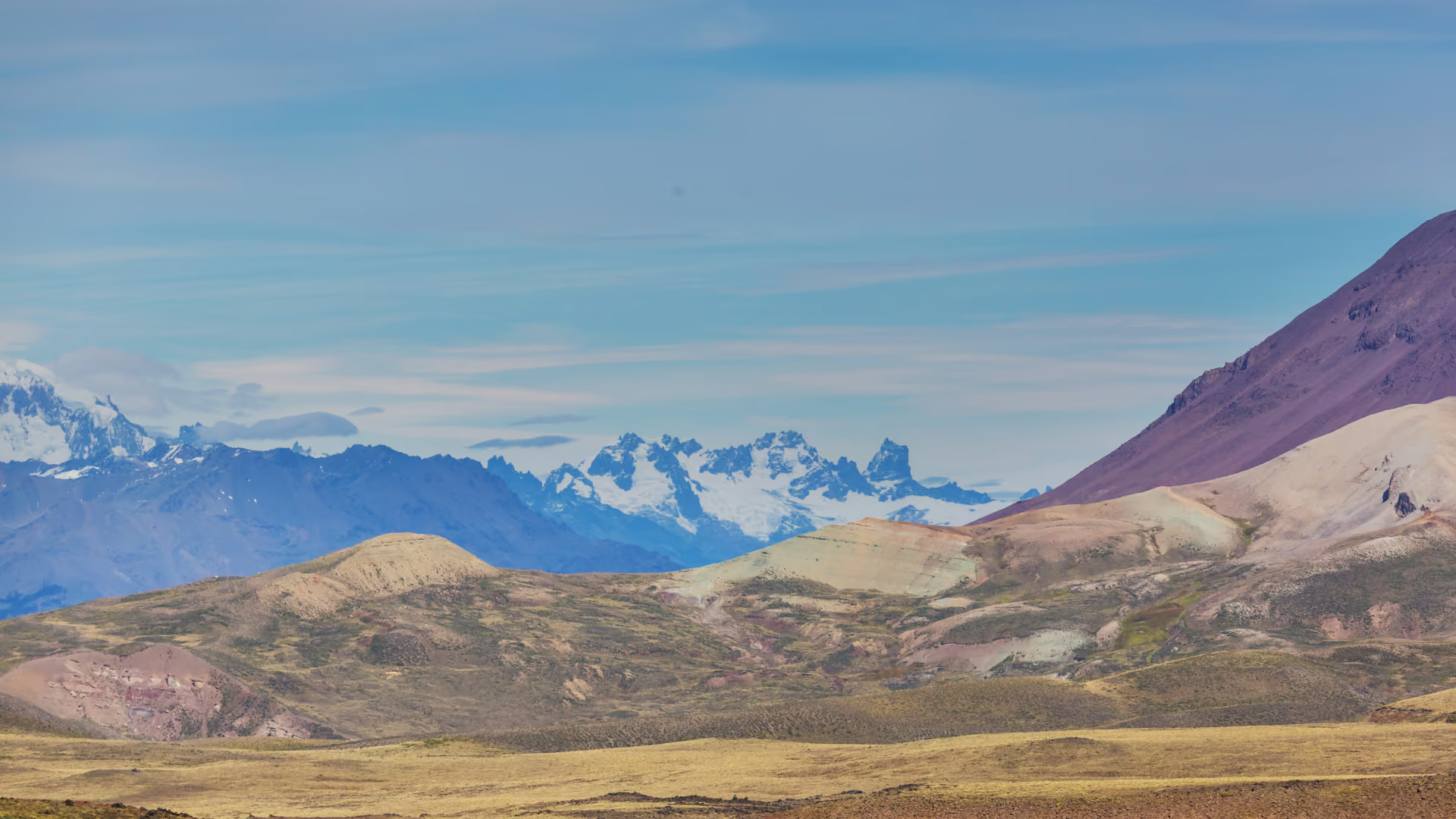
The species breeds only on the basaltic plateau lakes of Santa Cruz province interior, at elevations between 600 and 1,500 meters above sea level. It winters on the coast of Argentine Patagonia, primarily around the Santa Cruz and Chubut coastlines, where it can occasionally be seen from shore during the austral winter months.
The Breeding Biology: Elaborate, Fragile, and Extraordinary
The Hooded Grebe is a colonial breeder, nesting in small floating colonies of 2 to 15 pairs on lakes dominated by the aquatic plant Myriophyllum quitense. The nest is a floating platform of aquatic vegetation anchored to submerged plant material. Colonies form only on lakes with specific conditions: abundant Myriophyllum, the right water chemistry, and freedom from certain predators.
The courtship display is one of the most spectacular of any bird in the southern hemisphere. Pairs perform an elaborate synchronised ritual involving head shaking, wing spreading, diving and resurfacing, and the extraordinary rush display in which both birds rise simultaneously from the water and run side by side across the surface in perfect coordination. Observing this display at a breeding lake is one of the finest wildlife experiences available in Patagonia for those willing to make the journey.
The breeding season is short. The birds arrive at the plateau lakes in October and November, form colonies, and attempt to raise a single chick per pair before departing in March. The entire annual cycle is compressed into a narrow window, which means any single failure eliminates an entire year's reproductive effort for an affected colony.
The Threats: A Convergence of Catastrophes
The Hooded Grebe's population collapse is not the result of a single cause. It is the convergence of multiple threats, each severe enough on its own, acting simultaneously on a species with almost no capacity to absorb additional pressure.
American Mink
The American Mink was introduced to Argentine Patagonia for the fur trade in the mid-twentieth century and has since established wild populations throughout the Santa Cruz river systems and lake networks. Mink are exceptional swimmers and a single mink visiting a colony can destroy all nests and kill all chicks in a single night. Studies have documented mink predation as one of the primary drivers of nest failure at Hooded Grebe colonies. Mink control programmes in the Santa Cruz plateau, led by Aves Argentinas and Wildlife Conservation Society Argentina, have demonstrated that systematic mink removal around breeding lakes can substantially improve nesting success.
Kelp Gull Predation
Kelp Gulls have dramatically increased in number throughout Argentine Patagonia over recent decades. On the plateau lakes, Kelp Gulls have learned to exploit Hooded Grebe colonies by snatching eggs and chicks during disturbance events. A single flushing event caused by a low-flying aircraft or a human approaching too closely can trigger a simultaneous Kelp Gull raid across an entire colony. Conservation protocols at breeding lakes now include strict observer distance guidelines specifically because of this vulnerability.
Climate Change and Lake Drying
The basaltic plateau lakes of Santa Cruz are shallow and highly sensitive to changes in precipitation and evaporation. Climate change has driven measurable reductions in water level across many of the lakes in the breeding range, reducing the area of Myriophyllum habitat available for nesting. Lakes that formerly held colonies have dried entirely in recent decades.
Rainbow Trout Introduction
Introduced Rainbow Trout have been stocked in Santa Cruz lakes for recreational fishing and have established populations in several plateau water bodies. Trout prey directly on the invertebrates that Hooded Grebes depend on for food during the breeding season. Lakes with established trout populations show lower breeding success than trout-free lakes.
The Conservation Response
The primary organisations working on the species are Aves Argentinas, Wildlife Conservation Society Argentina, and the provincial government of Santa Cruz, with support from BirdLife International and international conservation partners. The conservation programme has three main components: mink control at and around breeding lakes, Kelp Gull deterrence during the nesting season, and habitat protection through formal designation of the most important breeding lakes as protected areas.
The 2025 Captive Breeding Breakthrough
For the first time in the species' recorded history, Hooded Grebes bred in captivity at a facility in Argentina were successfully raised to independence and released at a protected breeding lake in Santa Cruz in 2025. The significance of this breakthrough cannot be overstated. For a species with fewer than 800 wild individuals and almost no buffer against catastrophic breeding failure, having a captive population that can supplement wild numbers in poor breeding years is the difference between a species with options and one in terminal decline. It does not solve the mink problem. It does not reverse climate change. But it removes the worst-case scenario from the table and gives the wild population time for the other conservation measures to take effect.
Where and How to See the Hooded Grebe
The breeding lakes are located on the remote basaltic plateau of interior Santa Cruz province, accessible only by long dirt road from Gobernador Gregores or from the Ruta 40 corridor. Most birders who target the species organise a dedicated trip of at least four to five days during the October to March breeding season. Perito Moreno National Park in western Santa Cruz is one of the most accessible breeding sites, with rangers who can advise on current colony locations and access protocols.
For birders visiting Patagonia on a broader trip, the coastal wintering sites between Puerto San Julian and Comodoro Rivadavia offer a more accessible alternative from April through September. As we explain in our Best Time to Go Birding in Patagonia guide, the austral summer window aligns with both breeding season access and the broader peak of Patagonian birding activity. For the full list of Patagonia's most sought species, see our 20 Best Birds to See in Patagonia.
Why Seeing One Matters
The Hooded Grebe was discovered in 1974 and within fifty years was nearly gone. Going to see one is special in a way that is difficult to articulate to someone who has not stood at one of those remote lakes. It is not just a tick on a list. It is a moment of understanding the precarity of biodiversity, a direct encounter with the reality that the natural world is not permanent, that species that have existed for thousands of years can disappear within decades, and that the distance between still here and gone is often smaller than we want to believe.
If you go to Patagonia and you have the time and the inclination to make the journey to the Santa Cruz plateau, go. Take the long dirt road. Find the lake. Wait at the correct distance. Watch the courtship display if you are fortunate enough to be there when the birds are performing. Understand what you are looking at. Then tell someone else about it. That is what conservation looks like from the ground.