
The 20 Best Birds to See in Patagonia (And Exactly Where to Find Each One)
The 20 best birds to see in Patagonia with honest difficulty ratings, exact locations, and the species that most visitors walk straight past.
We have seen condors on the ground and 51 of them streaming past on a ridge. We have stood inside a penguin colony while King Penguins walked past our feet. But the moment that felt most purely like birding happened on the trail back from Laguna de los Tres, somewhere around kilometre 7, after a sunrise on Fitz Roy that had already made the whole trip worthwhile. A cluster of White-crested Elaenias, Thorn-tailed Rayaditos, and sierra finches erupted in mobbing alarm calls in a small lenga beech. We stopped, found the centre of the chaos, and there it was: an Austral Pygmy-Owl, tiny and unimpressed, sitting perfectly still while every small bird in the forest told it to leave. Nobody else on the trail noticed. That is what birding in Patagonia does to you. It gives you a layer of the place that most people walk straight past.
This list covers the 20 birds we think every visitor to Patagonia should know, seek out, and understand. Some are unmissable on any trip. Others require patience, timing, and a willingness to stop the car one more time. All of them are worth it. Each entry includes where to find the species, the best timing, and an honest difficulty rating so you can plan your time realistically.
How to Use This List
Difficulty ratings: Easy means you will see it on almost any visit with minimal effort. Moderate means you need the right site and the right time of day. Hard means you need to know what you are doing, where to look, and ideally what it sounds like. These ratings assume a December or January visit. As we explain in our Best Time to Go Birding in Patagonia guide, December is the optimal month for species activity across the region.
1. Andean Condor / Difficulty: Easy
The largest flying bird in the Western Hemisphere and the undisputed icon of Patagonian skies. With a wingspan exceeding 3 meters, a condor in flight is an experience that recalibrates your sense of scale permanently. We have watched them soaring above every major site from Torres del Paine to El Chalten, but the most extraordinary encounter was a bird on the ground near the road between Puerto Natales and the park, close enough to understand that the wingspan you admire from below becomes a body of genuine, extraordinary mass.
Where: Cerro Dorotea near Puerto Natales. Torres del Paine steppe road and Mirador del Condor. Fitz Roy valley road near El Chalten. Olga Teresa Ranch near Punta Arenas.
Best time: Late afternoon. December through February.
Read our complete guide: The Andean Condor in Patagonia
2. Magellanic Penguin / Difficulty: Easy
The penguin of Patagonia. Breeding colonies up to one million birds strong on the Argentine coast, smaller and more intimate colonies on the Chilean side, and the extraordinary multi-species experience of Isla Martillo near Ushuaia. There is no single correct way to experience Magellanic Penguins in Patagonia. There are four genuinely different options, each with its own character.
Where: Isla Martillo near Ushuaia. Punta Tombo in Chubut. Isla Magdalena in the Strait of Magellan. Seno Otway near Punta Arenas.
Best time: December for eggs and early chicks. February for large nearly-fledged chicks.
Read our complete guide: Magellanic Penguin Colony Guide
3. Lesser Rhea / Difficulty: Easy
The largest bird in the Americas that cannot fly, and one of the defining sights of the Patagonian steppe. In December the males lead enormous broods of chicks across the road, young birds running alongside adults with an energy that makes them impossible not to stop for. The male incubates eggs from multiple females and takes sole responsibility for the chicks from hatching. Understanding that changes what you are watching completely.
Where: Torres del Paine steppe road. The corridor from Puerto Natales to the park. Argentine Ruta 40. Open steppe throughout Patagonia on both sides of the border.
Best time: December and January for family groups. Present year-round.
4. Magellanic Woodpecker / Difficulty: Moderate
The largest woodpecker in South America and one of the most spectacular birds in the Nothofagus forests of southern Patagonia. The male's entirely red head is unmistakable when seen, but the forest absorbs its calls and the bird moves constantly through the canopy. Learn the call and the loud resonant drumming before you go. The Ascencio Valley near Base de las Torres in Torres del Paine and the Nothofagus forests around El Chalten and Ushuaia are the most accessible sites.
Where: Ascencio Valley, Torres del Paine. Tierra del Fuego National Park near Ushuaia. El Chalten valley forest edges. Carretera Austral forest sectors.
Best time: Year-round resident. Most active in early morning.
5. Chilean Flamingo / Difficulty: Easy
Tall, pink, and filtering algae from saline lakes across the Patagonian landscape, the Chilean Flamingo is one of those birds that looks like it belongs somewhere else entirely and then becomes completely expected. Laguna Nimez in El Calafate gives you flamingos at close range against a glacier backdrop. Laguna Amarga in Torres del Paine adds condors overhead and Black-necked Swans on the water.
Where: Laguna Nimez, El Calafate. Laguna Amarga, Torres del Paine. Salt lakes throughout Santa Cruz province. Seno Otway area near Punta Arenas.
Best time: Year-round at main sites. December through January for maximum numbers.
6. Austral Pygmy-Owl / Difficulty: Hard
The smallest owl in Patagonia and the one that rewards genuine birding skill most directly. You will almost never find one by looking. You find one by listening to the mobbing alarm calls of small forest birds telling you exactly where it is sitting. White-crested Elaenias, Thorn-tailed Rayaditos, sierra finches, and Rufous-collared Sparrows all mob this tiny predator vocally and relentlessly. When the forest erupts in that specific agitated chorus, stop and find the centre of it. That is where the owl is.
We found ours at kilometre 7 on the Laguna de los Tres trail near El Chalten, heading back from a Fitz Roy sunrise, reading exactly that alarm call pattern. Nobody else on the trail knew what had just happened.
Where: Nothofagus forest anywhere in Patagonia. El Chalten forest edges. Ascencio Valley. Tierra del Fuego National Park.
Best time: Dawn and dusk. Listen for mobbing behaviour at any time of day.
7. Torrent Duck / Difficulty: Moderate
One of the most specialised birds in the world, adapted to fast-moving Andean rivers so completely that it seems to belong to a different physical reality. The male's striking black and white striped head is visible from a distance, but finding one requires knowing which rivers to check and where the fast white-water sections are. The Rio Ascencio in Torres del Paine is one of the most accessible sites.
Where: Rio Ascencio, Torres del Paine. Fast rivers on the Carretera Austral. Rio de las Vueltas near El Chalten.
Best time: Year-round resident. Morning and late afternoon most productive.
8. Black-chested Buzzard-Eagle / Difficulty: Easy
Patagonia's most powerful raptor and one of its most reliably seen. The adult's bold black chest band against clean white underparts makes identification straightforward at distance. Soaring on thermals above the steppe, perched on rocky outcrops, or hunting guanaco pastures from fence posts, this bird is present throughout the region. Laguna Amarga in Torres del Paine is one of the most reliable sites for extended close views.
Where: Throughout Patagonia on both sides. Laguna Amarga and the Torres del Paine steppe road particularly reliable.
Best time: Year-round. Most visible on thermal days between late morning and late afternoon.
9. Gentoo Penguin / Difficulty: Moderate
Found at only one accessible mainland site in all of South America, the growing Gentoo colony on Isla Martillo near Ushuaia is one of the most compelling reasons to make the Harberton crossing. The bright orange bill and the relaxed, curious demeanour of Gentoo Penguins make them immediately distinguishable from the Magellanic birds nesting alongside them. In December the Gentoos are on nests in the open grassland areas of the island.
Where: Isla Martillo, Ushuaia only. Book the Piratours concession well in advance.
Best time: December and January for breeding activity.
Read our full colony comparison: Magellanic Penguin Colony Guide
10. Kelp Goose / Difficulty: Easy
One of the most visually striking birds on Patagonia's coastline. The sexual dimorphism is extreme: the male is pure white, the female dark brown with bold white wing markings. They feed on kelp and algae on rocky shores at low tide and are almost completely sedentary, making them easy to observe at leisure once located.
Where: Any rocky coastal shoreline in southern Patagonia. Beagle Channel near Ushuaia. Strait of Magellan coastline.
Best time: Year-round resident.
11. Upland Goose / Difficulty: Easy
The most abundant large bird on the Patagonian steppe and one of the first species you will see on any visit. Males are white-headed with a finely barred grey body. Females are richly barred brown. They graze short grass in pairs and family groups throughout the steppe and are present at virtually every open site in the region.
Where: Everywhere on the steppe. Torres del Paine, El Calafate, the Puerto Natales road corridor, Peninsula Valdes interior.
Best time: Year-round. December brings goslings.
12. Southern Giant Petrel / Difficulty: Easy near coasts
The vulture of the Southern Ocean and one of the most impressive seabirds in the region. With a wingspan approaching 2 meters, it dominates the scavenging community at penguin colonies, seal haul-outs, and whale carcasses along the Patagonian coast. At Peninsula Valdes and Punta Tombo it is a constant presence. On the Beagle Channel near Ushuaia it soars past the boat at eye level.
Where: Beagle Channel near Ushuaia. Peninsula Valdes coastal sites. Punta Tombo. Any boat crossing in the Strait of Magellan.
Best time: Year-round. Most visible at coastal wildlife aggregations.
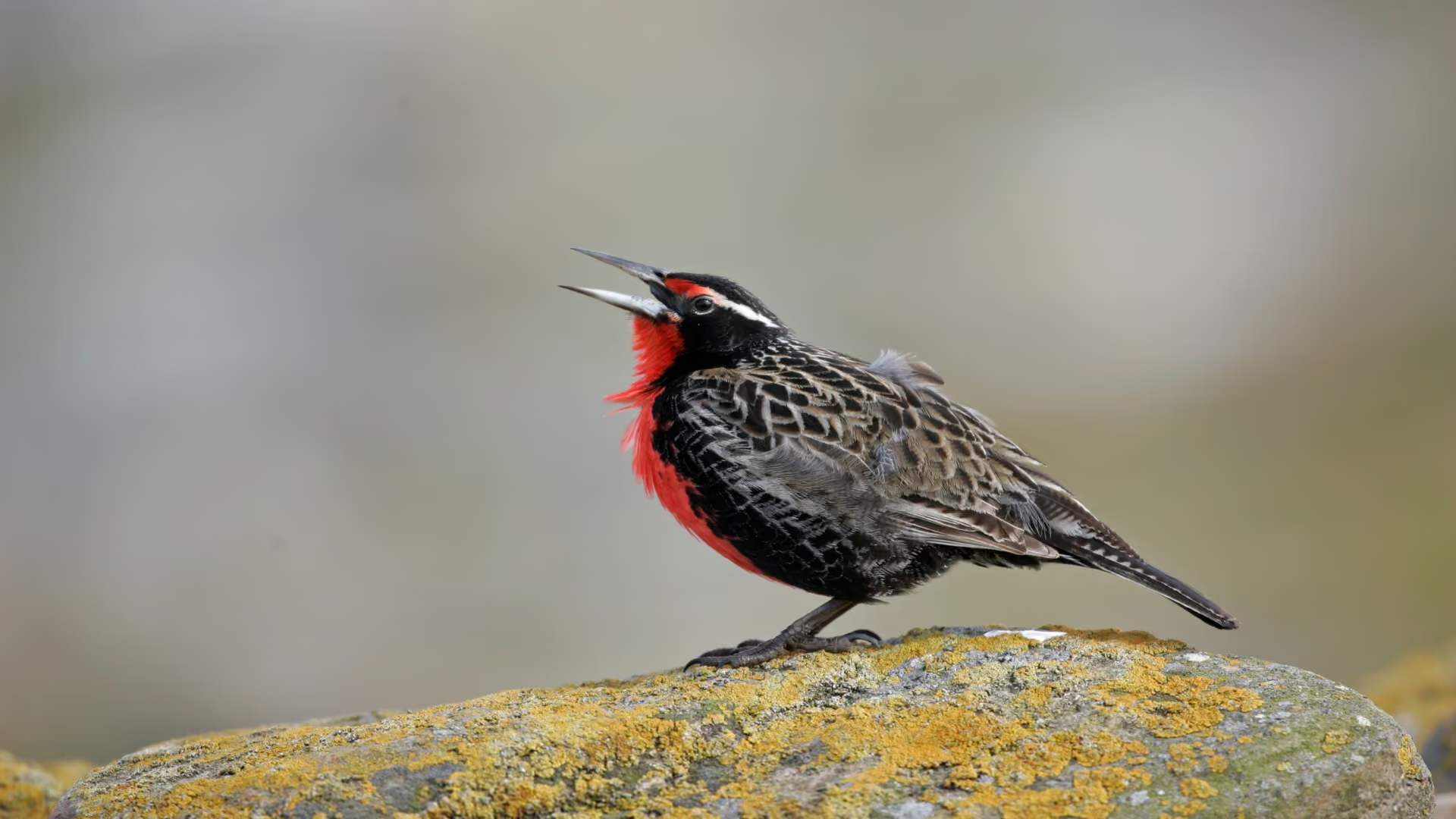
13. Long-tailed Meadowlark / Difficulty: Easy
The red-breasted jewel of the Patagonian grasslands. The male's deep crimson breast is startling against the brown steppe landscape, and he sings from prominent fence posts and bush tops throughout the breeding season. Easy to find, hard to stop watching.
Where: Open grassland and steppe throughout Patagonia. Fence lines on the Torres del Paine steppe road. Argentine Ruta 40 corridor.
Best time: October through February for full breeding plumage and song.
14. Dolphin Gull / Difficulty: Easy near coast
The most beautiful gull in Patagonia. The adult's vivid red bill and red orbital ring against a pale grey body make it immediately separable from every other gull in the region. A reliable waterfront bird in Ushuaia, a constant presence on the Beagle Channel, and common at all major coastal wildlife sites.
Where: Ushuaia waterfront. Beagle Channel any boat trip. Peninsula Valdes coastal sites. Punta Arenas waterfront.
Best time: Year-round.
15. Thorn-tailed Rayadito / Difficulty: Easy in forest
The most charming small bird in Patagonia's Nothofagus forests. Rayaditos move in small active flocks through the forest canopy, foraging along bark surfaces with a sideways acrobatic style. They are fearless around humans and frequently approach within a few meters. Often found alongside the very alarm call flocks that lead you to an Austral Pygmy-Owl.
Where: Any Nothofagus forest in southern Patagonia. Ascencio Valley, Torres del Paine. El Chalten forest edges. Tierra del Fuego National Park.
Best time: Year-round resident.
16. White-throated Caracara / Difficulty: Moderate
The most sought-after of Patagonia's four caracara species and a genuinely localised bird that requires specific sites and effort to find. The bold black and white plumage and the bare red facial skin are unmistakable once seen. It favours the western and southern sectors of Chilean Patagonia, particularly areas with Nothofagus forest adjacent to open steppe.
Where: Torres del Paine western steppe sectors. Carretera Austral southern sections. Tierra del Fuego forest edges.
Best time: Year-round resident. Most visible in open areas during midday.
17. Black-necked Swan / Difficulty: Easy
The most elegant waterbird in Patagonia and one of the most visually striking swans in the world. The pure white body contrasted with the jet black neck and the red knob at the base of the bill make this bird impossible to misidentify. Laguna Nimez in El Calafate and Laguna Amarga in Torres del Paine are the most reliable sites for close views.
Where: Laguna Nimez, El Calafate. Laguna Amarga, Torres del Paine. Wetlands and lakes throughout Patagonia.
Best time: Year-round. December and January for cygnets.
18. Fire-eyed Diucon / Difficulty: Easy in forest edges
A bird that stops people in their tracks not because it is rare but because it looks extraordinary. The deep crimson iris glows in the right light like a coal, and the bird sits openly on exposed perches at forest edges with the calm confidence of a species that has no natural fear. A Patagonian endemic found throughout the Nothofagus zone on both sides of the border.
Where: Forest edges throughout southern Patagonia. El Chalten, Torres del Paine forest margins, Carretera Austral, Tierra del Fuego.
Best time: Year-round resident.
19. Correndera Pipit / Difficulty: Easy
The bird that is always underfoot on the Patagonian steppe and the one that reveals, when you study it closely, just how rich the apparently bare grassland actually is. In December the Correndera Pipit is in full breeding song, running along the ground with its bill full of insects for a nest hidden meters away. Learning to find the nest by watching the adult's flight lines is one of the quiet pleasures of steppe birding.
Where: Open grassland and steppe throughout Patagonia. Everywhere from Torres del Paine to Peninsula Valdes.
Best time: October through February for breeding behaviour and song.
20. Austral Parakeet / Difficulty: Easy
The world's most southerly parrot and a noisily conspicuous presence in the Nothofagus forests of southern Patagonia. Flocks move through the canopy with a chattering urgency that announces them from a distance. The green plumage with the blue flight feathers and the red underwing coverts are visible in flight as the flocks wheel between trees. In December family groups are moving through the forest in loose, noisy aggregations.
Where: Nothofagus forest throughout southern Patagonia. Torres del Paine forest sectors. El Chalten. Tierra del Fuego. Carretera Austral.
Best time: Year-round resident. Most conspicuous in December and January.
Where to Start
If you are planning your first Patagonia birding trip and want a framework that covers the most species across the most habitats, our Torres del Paine Birding Guide covers 12 of these 20 birds in a single self-drive visit. Add the Magellanic Penguin Colony Guide for the penguin experience, the Peninsula Valdes Birding Guide for the Atlantic coast circuit, and the Andean Condor guide for the bird that defines the region more than any other.
The Austral Pygmy-Owl will find you when you are ready for it. Keep your ears open on every forest trail.