
Point Pelee Birding in May 2026: What to Expect and How to Prepare
Point Pelee birding in May 2026: Festival of Birds, tram tips, Carolinian species.
Point Pelee is a place that every serious North American birder knows about, even if they have not yet been. The southernmost tip of mainland Canada, a narrow peninsula jutting 20 kilometers into Lake Erie, at the same latitude as Rome, Barcelona, and northern California. A piece of the continent that sits further south than any other Canadian land, warm enough to support forest communities that exist nowhere else in the country, and perfectly positioned to intercept every migrant moving north across the lake.
During the spring migration, in the first three weeks of May, birders can spot between 75 and 150 species in one day. Birders have spotted more than 40 warbler species in one day. These numbers are not outlier events. They are what a good May morning at Point Pelee can produce for a prepared birder who arrives before dawn and works the site systematically.
This guide covers the 2026 festival dates, the geography that makes the site work, how to use the tram system, what to expect on a good day versus a slow one, and the satellite sites that most visitors leave on the table.
The 2026 Festival of Birds
The Friends of Point Pelee and Point Pelee National Park invite you to celebrate spring migration at the 2026 Festival of Birds from May 1 to May 18.
The festival includes morning hikes that leave from the Visitor Centre and focus on songbirds, afternoon north-end hikes beginning at the Northwest Beach parking lot, and twilight hikes exploring the DeLaurier Trail with the chance to view the courtship display of the American Woodcock (Scolopax minor).
As with Magee Marsh, the festival programming requires registration, but the park itself and its birding are accessible to all visitors who pay the park entrance fee. The tram system, included in the entrance fee, runs from April through October and is the key to accessing the Tip efficiently.
Why Point Pelee Works: The Geography and the Carolinian Forest
Most songbirds are nocturnal migrants. When they find themselves over Lake Erie near sunrise, they look for the nearest point of land to rest and refuel after flying up to 200 kilometres in a night. Since the Point Pelee peninsula extends 20 kilometres into Lake Erie, it is often the first point of land they see, and the Tip is often buzzing with birds in the early morning.
The mechanism is identical to Magee Marsh but in reverse: Magee catches birds reluctant to cross the lake going north, Point Pelee catches birds that have already made the crossing and are landing at the first available habitat. The result at both sites is the same: an extraordinary concentration of migrants in a small, accessible area. The difference is in what the habitat itself contains.
Point Pelee sits in an ecological region called the Carolinian zone, also known as the eastern deciduous forest, and boasts five ecosystems: a Lake Erie and sand spit savannah, marsh, swamp forest, dry forest and beach. Designated by UNESCO as a Wetland of International Significance, Point Pelee covers 4,000 acres, mostly marshland. Other habitats include Carolinian forest, swamp forest, cedar savannah, ponds, dry forest and overgrown fields.
The Carolinian forest distinction is what separates Point Pelee from every other birding site in Canada. This is the northernmost extent of a forest community that extends south through Ohio and Indiana, and it supports breeding species that exist nowhere else in the country. The park's landscape of marsh, forest, fields, and beaches is a lush Carolinian oasis which produces a complexity of life that is unequalled, even in Canada's larger national parks.
Species that breed at or near Point Pelee but rarely or never breed elsewhere in Canada include Acadian Flycatcher (Empidonax virescens), Louisiana Waterthrush (Parkesia motacilla), Yellow-breasted Chat (Icteria virens), and Carolina Wren (Thryothorus ludovicianus). For a birder from Quebec, seeing these species in Canada at all is a Point Pelee exclusive.
The Tram to the Tip: Using It Strategically
Starting at 6 AM, park shuttles, included in the Point Pelee entrance fee from April through October, transport birders from the visitor center to the Tip.
Each day, catch the first tram in the morning. This tram leaves the Visitor Centre at 6:00 AM, but fills up beforehand. Generally arrive at the tram pick-up area, ready to birdwatch for the morning, at 5:45 AM.
The strategic approach is not to take the tram to the Tip and then take it back. The approach is to take the tram to the Tip, spend 30 to 45 minutes at the southernmost point where first-light arrivals are most concentrated, and then walk the trail back north toward the Visitor Centre through the forest. This walk, which takes 45 minutes to two hours depending on how slowly you move, passes through the best Carolinian forest habitat in the park. Birds that landed at the Tip at dawn have dispersed north into this forest by 7 AM, and walking south-to-north through it puts you moving against the birds' dispersal direction, maximizing encounters per meter of trail.
The Tip itself at first light is one of the most dramatic experiences in North American birding. Within twenty minutes of stepping off the trolley, it is possible to identify a dozen or more new kinds of warblers and vireos, birds that some visitors have only seen as field guide photos and illustrations over the years.
What to Expect on a Good Day vs. a Slow Day
The first three weeks of May are the best time to see warblers, vireos, tanagers and orioles. Of the 53 regularly occurring warbler species in North America, 41 have been found at Point Pelee.
A good day at Point Pelee requires the same two-stage weather sequence that produces the best mornings at Magee Marsh: a southerly wind overnight that loads migrants over Lake Erie, followed by a shift to northerly or calm conditions that grounds them at the Tip as they make landfall. Fallouts or groundings of songbirds occur when a warm weather front advancing from the south or southeast meets a cold weather front moving in from the north or northwest. Birds will descend when the two fronts meet at ground level, or when the birds flying on a warm front override a cold front.
On a genuine fallout morning at the Tip, the experience is overwhelming in the most literal sense. Warblers on the ground, on the beach, in the low shrubs, on the sand itself. Birds that should be in the canopy are at ankle height, too exhausted and hungry to maintain their normal wariness. A fallout at the Tip of Point Pelee is, by the accounts of birders who have experienced it, one of the most intense concentration events in North American ornithology.
On a slow day, the Tip may be quiet and the forest trails may feel like any other eastern woodland in early May. This is when the satellite sites become essential.
Check BirdCast the evening before for migration intensity over Lake Erie. A high-intensity migration night following southerly flow, particularly from the Ohio shore, is the setup for an extraordinary Tip morning. For the full weather-reading system, see our guide on how to read weather radar for bird migration.
The Playback Prohibition: Ethics at Point Pelee
While the use of recordings is acceptable in some locations, it is not suitable in heavily birded areas like Point Pelee. Use of recordings in the park is prohibited.
This is one of the strongest and most explicit positions taken by any North American park on the question of playback ethics, and it deserves support rather than workaround. The reason is simple: at peak migration, hundreds of birders are present simultaneously in a small area. If even a fraction used playback, the cumulative disturbance to exhausted migrants would be significant. The park's ban is not arbitrary. It reflects a genuine understanding of what playback does to birds that are already physiologically stressed from migration.
The practical implication: learn your songs before you arrive. A birder at Point Pelee who can identify 20 warblers by ear without assistance has a fundamentally different experience than one who cannot. For the complete spring warbler song framework, see our guide on how to identify warblers by song in spring.
The Trails: Which to Prioritize
Point Pelee trails range from 0.5 to four kilometers in length and take 15 minutes to two hours to walk.
The Tip Trail: The primary migration concentration point. Walk north from the Tip after the first tram of the day. Prioritize at first light.
The Woodland Nature Trail: The best Carolinian forest access in the park. This is where the southern specialties breed and where warbler diversity peaks during mid-May mornings.
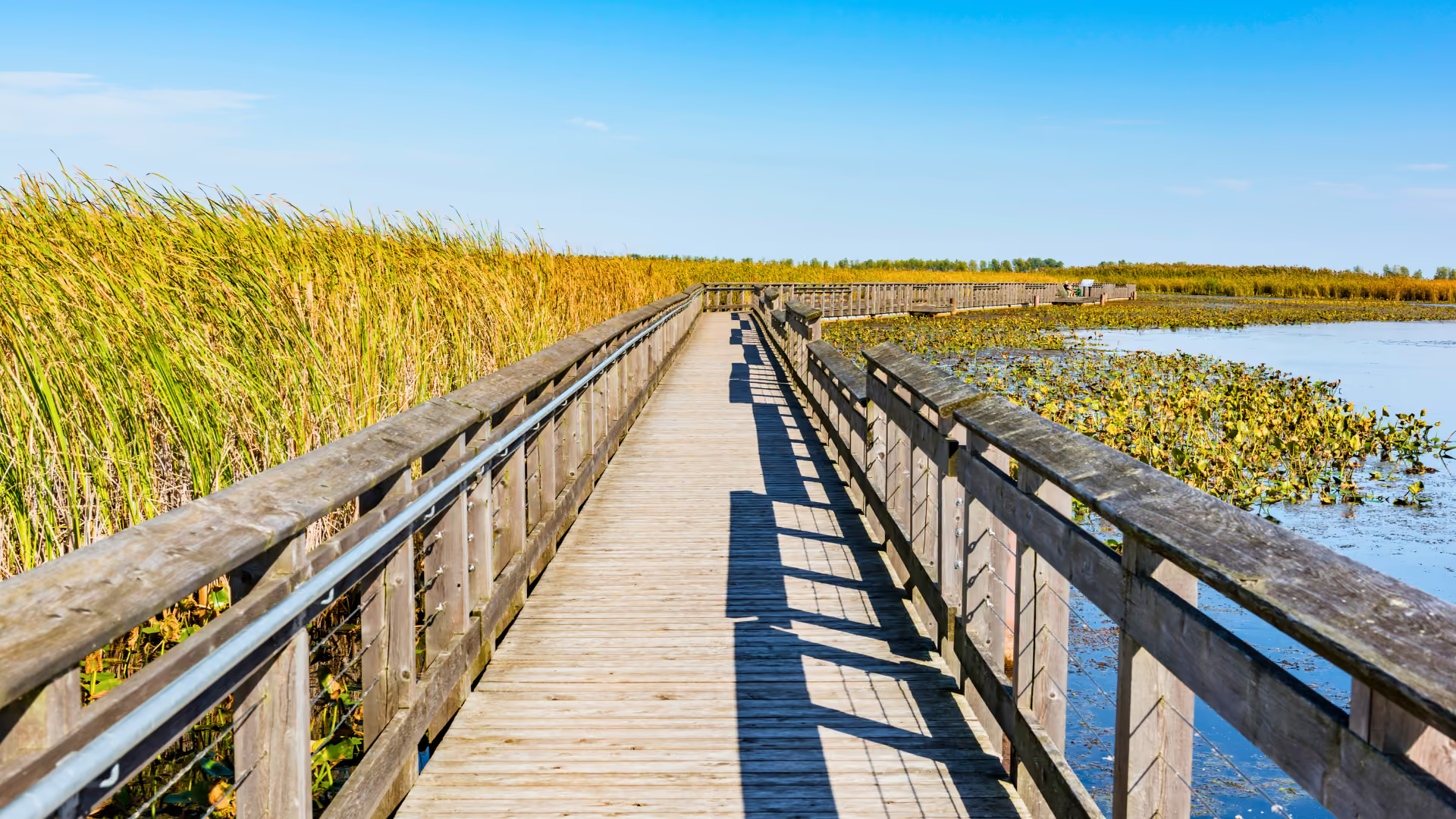
The Marsh Boardwalk: Bird watchers frequently see Red-winged Blackbirds from the Marsh Boardwalk, which has an observation tower and telescopes. The boardwalk extends into the marsh and is particularly productive for Marsh Wren (Cistothorus palustris), Common Gallinule (Gallinula galeata), Least Bittern (Ixobrychus exilis), and during migration, Virginia Rail (Rallus limicola) and Sora (Porzana carolina).
The DeLaurier Homestead Trail: Has an observation tower from where birders can view the Bald Eagle nesting platform near East Barrier Beach and Redhead Pond. Also one of the best locations for the American Woodcock twilight display in late April.
West Beach Footpath: Good for scanning Lake Erie for waterbirds, shorebirds on the beach, and migrants working the beachside shrubs.
Hillman Marsh: The Shorebird Site Nobody Should Skip
Hillman Marsh Conservation Area, located a short drive north of the park entrance on County Road 50, is the shorebird companion site that most first-time Point Pelee visitors miss entirely. It is managed by the Essex Region Conservation Authority and provides precisely the shallow water habitat that shorebirds need: flooded impoundments with exposed mudflats, minimal disturbance, and a scope-friendly viewing structure.
Experienced guides visiting the area regularly include Hillman Marsh in the afternoon schedule after morning birding at the Tip. During early to mid-May, Hillman Marsh can hold Dunlin (Calidris alpina), Semipalmated Sandpiper (Calidris pusilla), White-rumped Sandpiper (Calidris fuscicollis), dowitchers, yellowlegs, and occasional surprises including godwits and rarer shorebird species that are genuinely difficult to find anywhere in southern Ontario. The combination of Point Pelee warblers and Hillman Marsh shorebirds in a single day represents almost the full spectrum of spring migration experience available in the region.
Point Pelee vs. Magee Marsh: Do You Need Both?
If you are planning a Great Lakes spring migration trip and wondering whether both sites are worth visiting, the answer is yes, but for different reasons.
Magee Marsh delivers warblers at eye level from a boardwalk in a concentration that is unmatched anywhere. Point Pelee delivers the experience of watching birds arrive after a lake crossing, the Carolinian forest species impossible to see elsewhere in Canada, and the marsh and beach habitats that Magee's boardwalk does not offer. The two sites are 90 minutes apart by road via the Ambassador Bridge crossing at Windsor. A four to five day trip centered on the second week of May, dividing time between both sites based on daily BirdCast conditions, is the most efficient way to experience the peak of Great Lakes spring migration.
For the full Magee Marsh guide, see our companion article on Magee Marsh spring migration 2026.
Practical Logistics
Location: Point Pelee National Park, 1118 Point Pelee Drive, Leamington, Ontario. Approximately 1 hour south from Detroit, Michigan, or a 3-hour drive west of Toronto.
Entrance fee: Parks Canada day pass required. The tram to the Tip is included in the entrance fee.
Tram timing: First tram departs 6 AM from the Visitor Centre. Arrive by 5:45 AM during festival period to secure a place.
Accommodation: Leamington is the closest town. Windsor, 50 kilometers north, offers more options but adds commute time. Book well in advance: festival-period accommodation in Leamington books out months ahead.
What to bring: Binoculars, layered clothing (early May at the Tip is cold and windy), rain gear, sunscreen for beach sections, snacks and water. A spotting scope is valuable for the marsh, beach, and lake scanning but not essential on the forest trails.
Birding updates: Regular birding updates from the Point Pelee area are posted to the BIRDNEWS listserv. Provincially rare sightings are posted to the ONTBIRDS listserv. The Ontario Bird Alert Discord server provides updates from the field. The Festival of Birds website at festivalofbirds.ca maintains a daily sightings board during festival period.
The Short Version
The first three weeks of May are the best time to see warblers, vireos, tanagers and orioles at Point Pelee, with 41 warbler species recorded in the park. The 2026 Festival of Birds runs May 1 to May 18. Take the first tram at 6 AM, spend the opening hour at the Tip, walk north through the Carolinian forest. Add Hillman Marsh for shorebirds. Do not use playback. Check BirdCast the night before. A southerly wind overnight followed by calm or northerly conditions at dawn means the Tip will be extraordinary.
It is the southernmost point of mainland Canada. On a good morning in the second week of May, it is impossible to improve on.