
Torrent Duck: How to Find Patagonia's Most Specialised River Bird
How to find Torrent Duck in Patagonia. Bridge stops, river structure, best sites.
The Torrent Duck has eluded us more than once. We have stopped at the right bridges, on the right rivers, at the right time of day, and found nothing but the sound of white water. That is part of what this bird is. It lives in the most demanding habitat in Patagonia, white water that would sweep most birds off their feet instantly, and it is under no obligation to be visible. But the birders who understand the river, who know which rapid type the bird prefers, who stop at every bridge and walk every accessible bank section, find it. This guide covers exactly that.
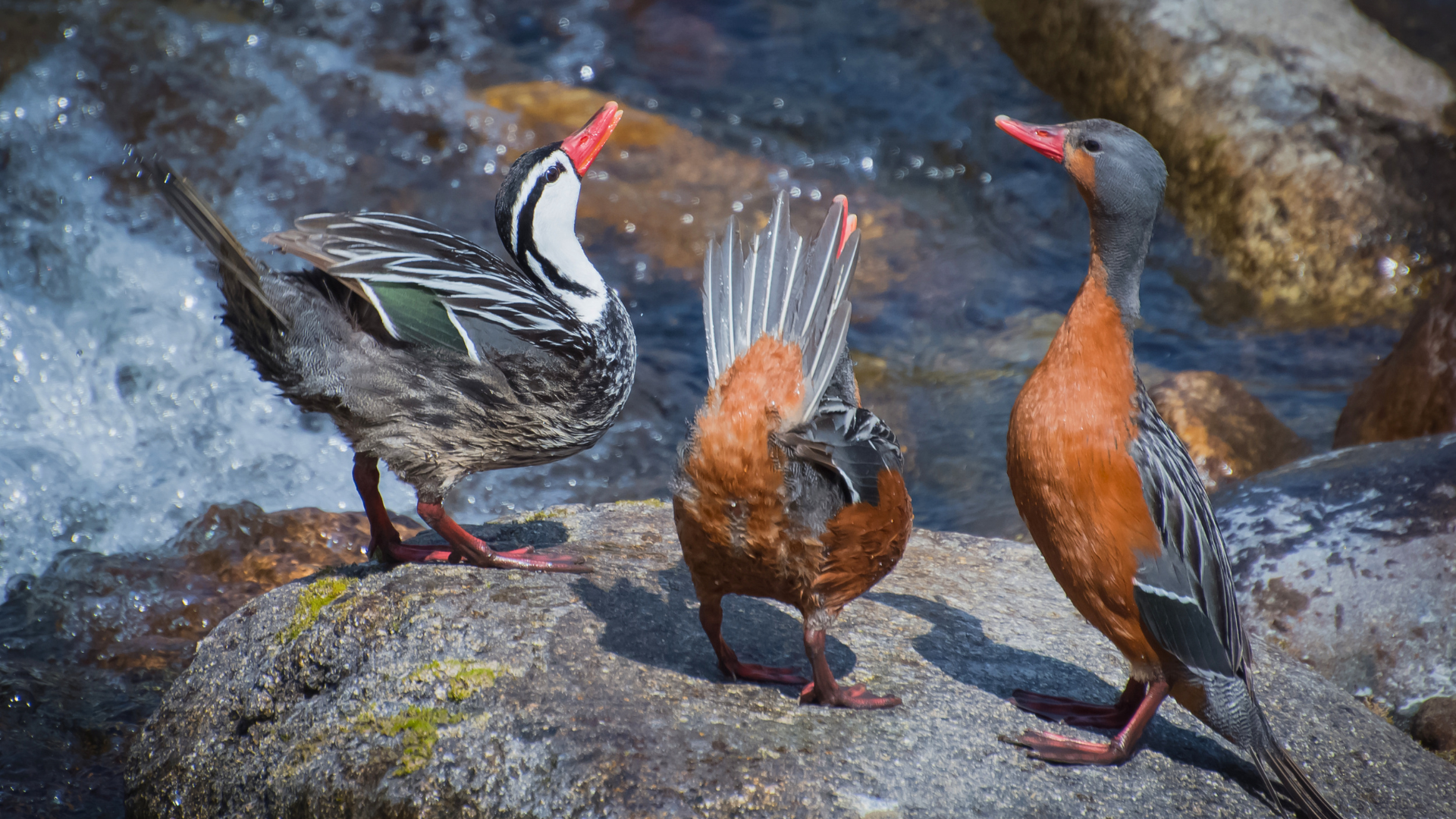
The Torrent Duck (Merganetta armata) is one of the most specialised birds in the world. It is the only member of its genus and the only duck on Earth that has evolved specifically for fast, cold, white-water Andean rivers. Its compressed body, stiffened tail, and powerful legs allow it to swim through rapids that no other waterfowl can navigate. The male's bold black and white striped head with its bright red bill makes it one of the most striking river birds in South America. The female is softer, with rusty-orange underparts and a grey head. Both are extraordinary birds in extraordinary habitat. Finding them is the challenge.
Understanding the River: What Torrent Ducks Need
The single most important step before searching any river is understanding what structure the bird requires. Torrent Ducks do not use all fast water equally. They use specific sections with specific characteristics, and once you understand what those characteristics are, unproductive searching drops dramatically.
The ideal rapid section combines fast white water with adjacent calm pools or slower eddies immediately downstream. The duck uses the rapid to access the invertebrates dislodged by turbulent water from the riverbed, then retreats to the eddy or pool to rest, preen, and feed on what the current has delivered. A river that is fast throughout with no calm sections is less productive than one that alternates between white water and pool. The transition zones between rapid and pool are where birds are most often found.
Boulder fields within the rapid are critical. Torrent Ducks use exposed midstream boulders as resting platforms between feeding bouts. A boulder ten to twenty centimetres above water level, positioned where a rapid breaks around it creating a sheltered zone, is ideal resting habitat. Scanning boulders systematically rather than scanning the water surface produces a significantly higher detection rate.
Territory structure means that productive river sections are occupied by a pair year-round. Unlike migratory ducks that aggregate at feeding sites, Torrent Ducks maintain strict linear territories along specific river sections. A pair found at a particular bridge crossing in December will be at the same bridge in July. This means that any section producing a sighting in previous eBird records is worth prioritising on any visit. Check the eBird Torrent Duck page for recent sightings at specific hotspots before any river visit.
The Bridge Stop Method
The most efficient approach to finding Torrent Duck on any Patagonian self-drive route is the bridge stop method. The principle is simple: every road bridge over a fast-flowing river is a potential Torrent Duck site, and every bridge should be stopped at and scanned systematically.
The approach at each bridge is as follows. Park off the road safely before the bridge rather than on it. Walk to the bridge railing and scan both upstream and downstream for a minimum of two minutes before moving. Look at every boulder systematically. Look at the water surface in the calmer sections immediately adjacent to rapid zones. Look at the banks where they are accessible. Then walk to the other side of the bridge and repeat. A total of four to six minutes per bridge is the minimum productive search time.
The temptation on a long self-drive route is to pull over on the bridge and scan from the vehicle window for thirty seconds before moving on. This produces almost no Torrent Duck records and many missed birds. The bird at a productive site may be resting behind a boulder or in a bank-side eddy not visible from the vehicle position. A brief walking scan changes the detection probability dramatically.
As we explain in our Self-Drive Birding in Patagonia guide, the stop-more-than-feels-necessary principle applies here more powerfully than at any other target species. Every bridge is the opportunity. Take it.
The Best Sites
Rio Ascencio, Torres del Paine is the most reliably productive and accessible Torrent Duck site in Chilean Patagonia. The river runs through the Ascencio Valley from the Base de las Torres trailhead and has several excellent rapid and pool sections within the first two kilometres of the trail. The birds are present year-round and in December the pair is often accompanied by ducklings navigating the calmer sections. Full guide at our Torres del Paine Birding Guide.
Rio de las Vueltas, El Chalten has fast-moving sections north of town that hold a resident pair. Check every bridge and boulder section on the river margin accessible from the town edge. Full guide at our El Chalten Birding Guide.
Glacier road rivers near El Calafate — the bridges over fast-running streams on the final approach to Perito Moreno Glacier hold Torrent Duck and are almost never checked by glacier visitors. Stop at every bridge over moving water on this road and apply the full bridge stop method.
Carretera Austral fast rivers — the entire length crosses dozens of fast Andean rivers with appropriate habitat. The Rio Baker between Cochrane and Villa O'Higgins is the most spectacular. Every pull-off with river access along this corridor is worth stopping for. As we cover in our Carretera Austral Birding Guide, the Rio Baker valley is one of the finest river birding corridors in South America.
Tierra del Fuego rivers near Ushuaia — the fast sections within Tierra del Fuego National Park and along Route 3 east toward Harberton hold Torrent Duck. The rivers running through the national park forest are particularly productive as the forest cover provides shelter from the wind.
Identification: Male, Female, and Juvenile
The male has a bold black and white striped head, the stripes running horizontally from bill to nape, with a bright red bill. The body is dark grey above with a strongly barred flank pattern and rusty-red on the breast. In fast water, the striped head is the most visible feature, catching the eye against the white water background.
The female has a soft grey head, white supercilium, and richly coloured rusty-orange underparts and throat. She is subtler than the male but equally distinctive once the underpart colour registers. On the river the orange breast is often visible from above as the bird feeds in shallow, fast water.
Juveniles resemble the female but with duller colouring. Family groups in December and January include small ducklings that navigate the calmer sections of the river while adults feed in the more demanding white water.
Practical Field Notes
The right rapid, not the right river. On any given river, productive searching concentrates on the rapid-to-pool transition zones and boulder fields. A kilometre of continuous white water with no calm sections or exposed boulders will not hold birds regardless of how fast or cold the water is.
Walk both banks if possible. Birds resting behind a boulder or in a bank-side eddy may not be visible from one bank. Where both banks are accessible by trail, walking both sides doubles detection probability.
Listen as well as look. The Torrent Duck has a distinctive high, piping call that carries above river noise. Familiarise yourself with it on eBird before visiting any river site. A calling bird before a sighting is a common experience at productive sites.
December is the best month for ducklings. As we explain in our Best Time to Go Birding in Patagonia guide, December breeding activity brings Torrent Duck ducklings to accessible river margins, making family groups significantly easier to observe than adults alone.
Accept the misses. The Torrent Duck is a bird that requires genuine effort and accepts no shortcuts. The birder who applies the bridge stop method consistently across every river crossing on a two-week Patagonia circuit will find it. The birder who looks from the vehicle window at speed will not. The difference is not luck. It is method. For the full list of species worth this level of effort in Patagonia, see our 20 Best Birds to See in Patagonia guide.
The allure of off-the-beaten-path travel
Lorem ipsum dolor sit amet, consectetur adipiscing elit ut aliquam, purus sit amet luctus venenatis, lectus magna fringilla urna, porttitor rhoncus dolor purus non enim praesent elementum facilisis leo, vel fringilla est ullamcorper eget nulla facilisi etiam dignissim diam quis enim lobortis scelerisque fermentum dui faucibus in ornare quam viverra orci sagittis eu volutpat odio facilisis mauris sit amet massa vitae tortor.
Unveiling the charm of lesser-known Destinations
Orci sagittis eu volutpat odio facilisis mauris sit amet massa vitae tortor condimentum lacinia quis vel eros donec ac odio tempor orci dapibus ultrices in iaculis nunc sed augue lacus.
- Lorem ipsum dolor sit amet consectetur facilisi etiam dignissim diam quis enim
- Mauris aliquet faucibus iaculis dui vitae ullamco sit amet luctus
- Posuere enim mi pharetra neque proin dic rhoncus dolor purus non enim
- Dui faucibus in ornare posuere enim mi pharetra neque proin dicit
Finding solitude in hidden gem locations
Lorem ipsum dolor sit amet, consectetur adipiscing elit ut aliquam, purus sit amet luctus venenatis, lectus magna fringilla urna, porttitor rhoncus dolor purus non enim praesent elementum facilisis leo, vel fringilla est ullamcorper eget nulla facilisi etiam dignissim diam quis enim lobortis scelerisque fermentum dui faucibus in ornare quam viverra orci sagittis eu volutpat odio facilisis mauris sit amet massa vitae tortor condimentum lacinia quis vel eros donec ac odio tempor orci dapibus ultrices.
The thrill of discovering untouched natural beauty
Dolor sit amet, consectetur adipiscing elit ut aliquam, purus sit amet luctus venenatis, lectus magna fringilla urna, porttitor rhoncus dolor purus non enim praesent elementum facilisis leo, vel fringilla est ullamcorper eget nulla.
- Lorem ipsum dolor sit amet consectetur tempor orci dapibus ultrices
- Mauris aliquet faucibus iaculis dui vitae ullamco elementum facilisis
- Posuere enim mi pharetra neque proin dic fermentum dui faucibus in ornare
- Purus sit amet luctus posuere enim mi pharetra neque proin dic
“Ut enim ad minim veniam, quis nostrud exercitation ullamco laboris nisi ut aliquip ex ea commodo consequat uis aute irure dolor in reprehenderit in voluptate velit”
Exploring cultural marvels off the tourist radar
Donsectetur adipiscing elit ut aliquam, purus sit amet luctus venenatis, lectus magna fringilla urna, porttitor rhoncus dolor purus non enim praesent elementum facilisis leo, vel fringilla est ullamcorper eget nulla facilisi etiam dignissim diam quis enim lobortis scelerisque fermentum dui faucibus in ornare quam viverra orci sagittis eu volutpat odio facilisis mauris sit amet massa vitae tortor condimentum lacinia quis vel eros donec ac odio tempor orci dapibus ultrices in iaculis nunc sed.