
American Robin Nesting Behavior in Spring: A Complete Guide
The American Robin nesting cycle runs 36 to 40 days from first egg to fledgling independence.
Look up under the eave of your patio sometime in March or April. If a female American Robin has been busy, you may find a nest so perfectly constructed that it seems almost engineered: a cup of dried grass and twigs, reinforced with a smooth interior layer of mud, lined with fine plant fibers. The nest will be there before you noticed anything unusual. Robins build quickly and quietly, and by the time most people discover a nest, it already holds eggs or chicks.
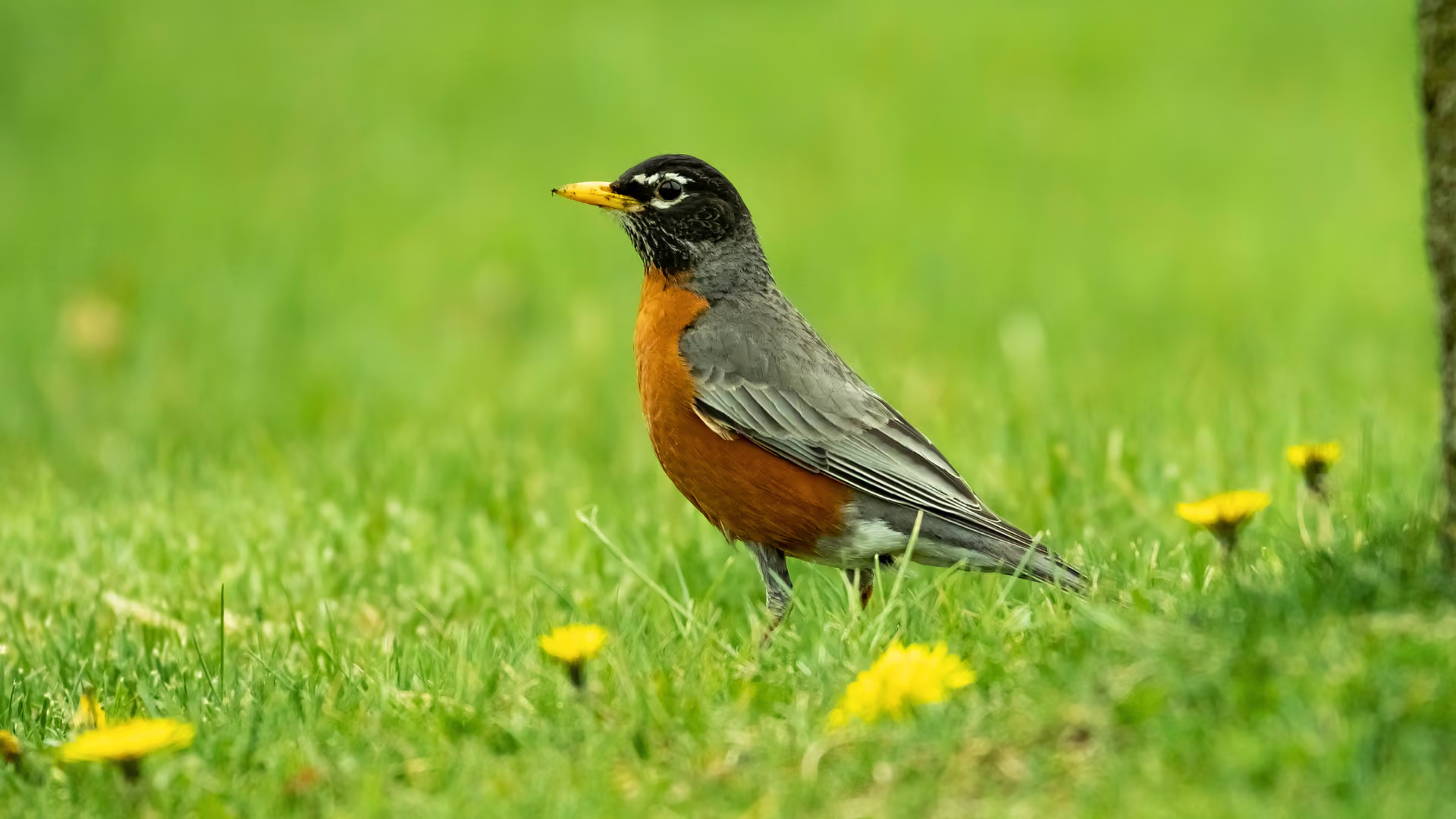
The American Robin is a very familiar bird over most of North America, running and hopping on lawns with an upright stance, often nesting on porches and windowsills. It is the bird most North Americans could identify before they knew what birding was. And yet the robin's spring nesting cycle is one of the most biologically extraordinary things happening in any suburban yard, from the chemistry of the eggs to the feeding rate of the parents to the managed handoff between adults when the second brood begins. This guide follows the complete cycle from the first song to the last fledgling on your lawn.
The American Robin nesting cycle runs about 36 to 40 days from the first egg to an independent fledgling. The female builds a mud-lined cup nest in roughly five to six days, lays a clutch of three to five blue eggs, and incubates them alone for 12 to 14 days. The nestlings then stay in the nest for about 13 days, fed by both parents, before spending a dangerous two weeks on the ground as fledglings. Most pairs raise two to three broods between April and July, with the male often feeding the first brood while the female starts the next.
The "First Robin of Spring" Is Not What You Think
Before the nest, before the eggs, there is a misunderstanding worth clearing up.
With the breakup of flocks before the nesting season, when northerners see their first robin of spring, it may be a bird that has wintered only a few miles away, not one that has just arrived from southern climates. American Robins are short-to-medium distance migrants, and a significant portion of the northern population overwinters within the same region where they will breed, sustained by fruit and berry crops rather than earthworms. They are present all winter, but they are invisible: roosting in flocks in dense woodland, eating berries, staying out of the open lawns where we expect to see them.
In the winter, robins form flocks, typically comprised of a dozen birds but sometimes reaching into the hundreds, and roost in trees throughout the season. They are active in small groups during the day, looking for berries and fruit, but will return to the ground in spring when worms are available. When it is time to nest, the birds become less social and leave the group to defend a territory.
The first robin you see on your lawn in March is the same individual that has been 500 meters away in the woodlot since November. The thaw that softens the soil and brings earthworms to the surface is what draws that bird back onto open ground, not a long migration, but a short walk from the winter roost to the breeding territory. The moment feels like an arrival because it is a behavioral shift, not a geographic one.
Nest Construction: The Mud Architecture
The female does most of the nest building with some help from the male. Site is on a horizontal branch of a tree or shrub, usually 5 to 25 feet above ground; also nests on ledges of houses, barns, bridges. Nest is a cup of grasses, twigs, and debris, worked into a solid foundation of mud, lined with fine grasses and plant fibers.
The mud layer is the structural secret. Their nests are shallow, round bowls made from twigs, dried grass, and mud, the mud being the secret to their sturdy construction. The female robin gathers wet mud in her bill and works it into the coarse outer structure by pressing and rotating her body against the interior of the cup, using her breast as a living trowel. The result, once dry, is a nest that can withstand significant wind and rain while remaining flexible enough to absorb impact rather than crack.
The nest takes roughly four to six days to complete. Robins usually return to the same general area year after year if they find it safe. In some cases, they even reuse or rebuild on top of old nests.
Site selection is deliberate. Robins choose locations that balance concealment from predators with access to open foraging ground. The patio beam, the window ledge, the crotch of a low apple tree: all of these provide the structural support and partial shelter the nest requires. Robins can build nests on porches and in rafters and may return to it every year during nesting season. They are protected under the Migratory Bird Treaty Act, so please do not move their nests, but rather consider it an opportunity to observe nature happening right on your doorstep.
Territorial Song: The Male's Spring Announcement
Robins begin regularly singing in March, when they start to look for mates. Males sing more before they are coupled, mainly to attract females and to maintain territories.
Male American Robins arrive before females on nesting grounds and defend territories by singing, sometimes by fighting. The song is the robin's most recognizable spring sound: a familiar caroling that sounds something like 'cheerily, cheer up, cheer up, cheerily, cheer up.' American robins sing frequently throughout the day, but particularly early in the morning. They most often sing from a perching spot high in a tree.
Incubation is also the period of time when male robins are most vigorous about singing. Most songbirds reach their peak of song during courtship, but with robins, they sing strongest and longest right before the eggs hatch. This is a great clue to watch for. If you hear a robin singing with unusual intensity from the same tree every morning, the eggs may be days from hatching.
The Eggs: Why They Are Blue
Usually 4 eggs, sometimes 3 to 7, pale blue or robin's-egg blue. Incubation by female, 12 to 14 days.
The blue is not pigment in the usual sense. The eggs are a beautiful blue color, which is caused by the substance biliverdin. Biliverdin is found in healthy females, and more brilliant blue eggs reflect better health.
Biliverdin is a bile pigment and antioxidant produced during the breakdown of red blood cells. Its presence in the eggshell in concentrations high enough to produce vivid color is an honest signal of the female's physiological condition. A deeply blue clutch is not just beautiful. It is an advertisement, primarily directed at the male, that the female laying those eggs is healthy and producing eggs of high quality. The intensity of the blue predicts nestling survival. The color is not decoration. It is communication.
The female lays one egg per day, usually leaving the nest to forage in the early morning before returning to lay mid-morning. She delays full incubation until the final egg is laid, ensuring that the entire clutch develops at the same rate and hatches on the same day.
Incubation: The Brood Patch and the Counting-Down Male
The female robin handles all the incubation duties, sitting on the eggs for 13 to 14 days. To transfer heat efficiently, she develops a brood patch, a bare area of skin on her belly heavily supplied with blood vessels that rests directly against the eggs.
The brood patch is not just bare skin. It is a thermally specialized organ that develops specifically for incubation, with increased blood supply that can raise surface temperature by several degrees. The female presses this patch against the eggs dozens of times per day, and the robin will rotate the eggs several times a day using her beak to ensure even heat distribution, which is critical for healthy embryo development.
The male does not incubate but is not passive. Parents are very aggressive in defense of the nest. A male robin defending a nest with eggs will dive at cats, squirrels, crows, and human observers without hesitation, swooping down very close but not making contact.
Hatching: The Egg Tooth and the Shell Removal
When the time comes, the chicks use a temporary, sharp projection on their beak called an egg tooth to break out of the shell. The parents immediately remove the broken eggshells from the nest, either eating them to recycle the calcium or carrying them far away to prevent the bright white interiors from attracting predators.
Once the eggs reach full term, all chicks usually hatch within a 24-hour period, creating a synchronized brood. Newly hatched baby robins are born blind and featherless, with closed eyes and translucent pink skin, roughly 2 inches long, weighing just 5 to 6 grams, and entirely dependent on their parents for warmth and food.
The synchronous hatching is a direct consequence of the female's delayed incubation strategy. By not beginning to incubate until the last egg is laid, all embryos develop on the same schedule and hatch within hours of each other. A brood of four chicks all at the same developmental stage is dramatically more efficient to feed than a brood where the oldest is nearly fledged while the youngest is newly hatched.
The Nestling Stage: 100 to 150 Meals Per Day
A pair of American robins feeding a hungry family deliver 100 to 150 meals a day to the nest. Each baby robin may eat its weight in insects, worms and berries in a day.
After the eggs hatch and parents are feeding nestlings, this feeding will go on all day long in a highly rhythmic fashion that can be timed almost like clockwork. The feeding visits are the most observable phase of the nesting cycle. Stand near a nest with nestlings and watch a parent land, deliver a food item, wait for the chick to swallow, collect the fecal sac, and depart, all within 15 to 30 seconds.
By Day 5, pinfeathers begin to appear. By Day 7, their eyes open, and by Day 9 to 10, they start standing in the nest and preening. Baby robins typically stay in the nest for 13 to 15 days after hatching.
The nestling growth rate is extraordinary. A chick that weighs 5 grams at hatching leaves the nest at roughly 60 grams, a twelve-fold increase in 13 to 15 days. This growth is fueled primarily by earthworms, which are high in protein and easily digestible. The robin's foraging behavior on lawns, the run-stop-tilt posture that everyone recognizes, is specifically adapted to hunting earthworms by sight. The eye tilt aligns one eye toward the ground in the optimal position for detecting the slight surface movement that betrays a worm below.
Nest Sanitation: The Fecal Sac System
The chicks produce their waste in neat, mucous-covered packages called fecal sacs. The parents remove these sacs immediately, often eating them when the chicks are very young, and carrying them away to drop elsewhere as the nestlings grow older.
The fecal sac is one of the most elegant sanitation solutions in vertebrate biology. The mucous membrane containing the waste is produced by the nestling's digestive system specifically to make the parents' sanitation task practical. A nest that accumulated fecal material would become a disease vector and an olfactory signal to predators within days. The fecal sac system keeps the nest clean throughout the nestling period with no energy cost to the parents beyond the few seconds required for each removal.
The shift from eating to carrying marks the point at which the chicks' digestive systems have developed enough that the fecal material contains less undigested nutrition and more waste compounds.
Fledgling: The Dangerous Two Weeks on the Ground
The chicks leave the nest roughly 13 days after hatching. At this stage, they are still unable to fly properly and spend several days hopping on the ground, hiding in dense vegetation.
Many people mistakenly believe fledglings are abandoned when they see them hopping on lawns. In reality, the parents are usually nearby, watching and feeding them from a distance. About two weeks after fledging, young American robins become capable of sustained flight. During those two weeks, the parents continue to deliver food while the fledgling gradually strengthens its wings through short attempts at flight.
If you find a fledgling on your lawn, the correct response is to leave it where it is and keep pets indoors. Moving it, even to what seems like a safer location, breaks the parental connection. The spotted robin chick on your lawn, apparently alone, is not orphaned. It is a fledgling in the normal state of fledglings: grounded, mobile, and being monitored by parents who are intentionally keeping a distance to avoid advertising the chick's location to predators.
The Second Brood: The Handoff
The robin averages two, and sometimes three broods, consisting of about three to five eggs each. Because the female often starts building a new nest and laying her next clutch shortly after the first brood fledges, the male usually takes sole responsibility for feeding the fledglings during their final weeks of dependency.
This managed handoff is one of the most behaviorally sophisticated aspects of robin reproduction. The female does not abandon the first brood. She leaves them with the male, whose contribution to feeding continues uninterrupted, while she begins the energetically demanding work of building a new nest and producing a new clutch. The result is two simultaneous parental operations: the male finishing the first brood, the female beginning the second.
The male may tend the fledged young while the female begins the second nesting attempt. This is why you can still find signs of nest-building and robins feeding nestlings going well into summer, and often the highest populations of fledglings are not seen until as late as August.
What to Watch For: A Season of Observation
The patio nest that appears under your eave in April is not just a decoration. It is a 36 to 40 day event that, if you pay attention, reveals something biological at every stage.
Watch the female building: the early morning trips with mud, the breast-rotation against the interior of the nest, the precise placement of fine grass lining that takes most of a week to complete.
Watch the female incubating: the stillness broken every 20 minutes by a departure to feed, the male's increasingly intense singing from the tree above, the aggressive escort of any crow or squirrel that approaches within 10 meters.
Watch the feeding visits: the almost mechanical regularity of the parental trips, the momentary gap when a fecal sac is removed, the nestlings' heads rising above the nest rim as they grow.
Watch the fledglings on the lawn: the spotted breast, the cocked head learning the worm-hunting posture, the food deliveries from a parent that lands and departs within seconds, the short practice flights between the shrubs.
The time it takes from incubating eggs, to young robins hatching, fledging, and then surviving on their own is approximately 36 to 40 days. Roughly six weeks from first egg to independent young. The most familiar bird in North America, performing one of the most extraordinary things any organism does, within arm's reach of your patio chair.
FAQ
The full American Robin nesting cycle runs about 36 to 40 days from the first egg to an independent fledgling. Within that window the female spends roughly five to six days building the nest, 12 to 14 days incubating, and about 13 days feeding nestlings, followed by two more weeks tending fledglings on the ground. Because most pairs raise two to three broods, the nesting season as a whole stretches from April into July.
No. The female American Robin does all the incubating, developing a bare brood patch on her belly to warm the eggs directly. The male does not sit on the eggs, but he is far from idle: he defends the nest aggressively and sings most intensely in the days just before the eggs hatch. Once the chicks arrive, both parents share the feeding.
American Robin eggs hatch after about 12 to 14 days of incubation. The female lays one egg per day and delays steady incubation until the last egg is laid, so the whole clutch develops together and the chicks usually hatch within the same 24 hour period. A typical clutch holds three to five sky-blue eggs.
Baby robins stay in the nest for roughly 13 days after hatching, growing from about 5 grams to around 60 grams on a diet of earthworms and soft invertebrates delivered by both parents. When they leave, they still cannot fly well and spend about two weeks on the ground as fledglings while the parents keep feeding them. A grounded, spotted young robin is normal and almost never abandoned.
American Robins usually raise two broods a season and sometimes three, each with about three to five eggs. The female often starts building the next nest while the male finishes feeding the fledglings from the previous brood, so two parental efforts can overlap. This is why you can still find active robin nests well into summer.
Robin eggs are blue because of a pigment called biliverdin that the female deposits in the shell. The intensity of the blue reflects her physiological condition and predicts nestling survival, so the color works as an honest signal, mainly directed at the male, rather than as camouflage. Healthier females tend to lay more vividly blue clutches.