
Sexual Coercion in Birds: Conflict, Anatomy, and Who Actually Wins
Courtship and female choice are only part of how birds reproduce. The other part is conflict, and the anatomy it has produced is some of the most remarkable evidence in evolutionary biology.
Most writing about bird reproduction, including much of ours, describes a system organized around female choice. Males display, females assess, and the best performer is selected. That account is accurate as far as it goes, and it is incomplete, because it assumes the interests of the two sexes are broadly aligned. Often they are not.
Where those interests diverge, evolution does not produce a compromise. It produces an argument, conducted over millions of years in behaviour and in anatomy. Sexual coercion is one outcome of that argument, and understanding it properly requires starting with the disagreement rather than with the behaviour.
What sexual conflict actually means
Sexual conflict is the term for situations where the reproductive interests of males and females do not coincide. It is not a claim about intent, and no bird is choosing to be antagonistic. It is a description of selection pressures pulling in different directions.
The asymmetry usually traces back to investment. In most birds, a female commits substantially to each breeding attempt, producing eggs and typically bearing more of the incubation, as we set out in why some male birds are deadbeat dads. Her reproductive output is limited by how many broods she can raise, so which male fertilizes her eggs matters a great deal to her. A male's output is limited mainly by how many females he can fertilize, so an additional mating is close to pure gain for him.
From that asymmetry, one prediction follows. Traits that increase a male's number of matings will be selected even when they impose costs on females, and traits that let females retain control over fertilization will be selected in response. This produces antagonistic coevolution, where each side's adaptation drives the other's counter-adaptation, and neither reaches a stable end point.
Coercion as one tactic among several
It helps to see coercion in context rather than in isolation, because it is one of several routes to the same objective.
A male may compete by display, investing in ornament and performance and leaving the decision entirely with the female, which is the lek system described in lekking birds and their dance battles. He may compete by mate-guarding, staying close to his partner during her fertile period to exclude rivals. He may compete after mating, through sperm competition, where selection favours producing more sperm rather than winning more encounters. Or he may attempt forced copulation, bypassing choice altogether.
Which tactic predominates depends on the species, and most run several at once. Coercion is not a separate category of bird behaviour so much as one strategy that appears where the conditions favour it and the anatomy permits it.
The waterfowl case, and the anatomy it produced
Most birds have no intromittent organ at all, and fertilization requires the female to evert her cloaca, which we explain in our guide to how birds mate. Cooperation is built into the mechanics. Waterfowl are the major exception, and the consequences are visible in their anatomy.
Male waterfowl have a phallus that spirals anticlockwise and everts rapidly during copulation. Across waterfowl species, its length correlates with how frequently forced copulation occurs in that species, which is already a strong indication that the structure is shaped by this specific pressure.
The female side is where the work of Patricia Brennan and colleagues changed the picture. Female waterfowl reproductive tracts are not simple tubes. They contain dead-end pouches and coils that spiral clockwise, in the opposite direction to the male structure. Species with a short phallus and no forced copulation have simple vaginas; species with a long phallus and high rates of forced copulation have highly elaborate ones. The geometry is obstructive by design.
The demonstration was elegantly direct. Researchers built glass tubes shaped like the female tract and tested whether the male phallus could evert through them. Through a straight or accommodating tube it everted normally. Through a tube with a clockwise spiral, or with a sharp bend of the kind found in a female tract, eversion stopped completely. The female anatomy is a mechanical barrier that can be opened by cooperation and not otherwise.
Who actually wins
This is the part most coverage omits, and it changes the meaning of everything above.
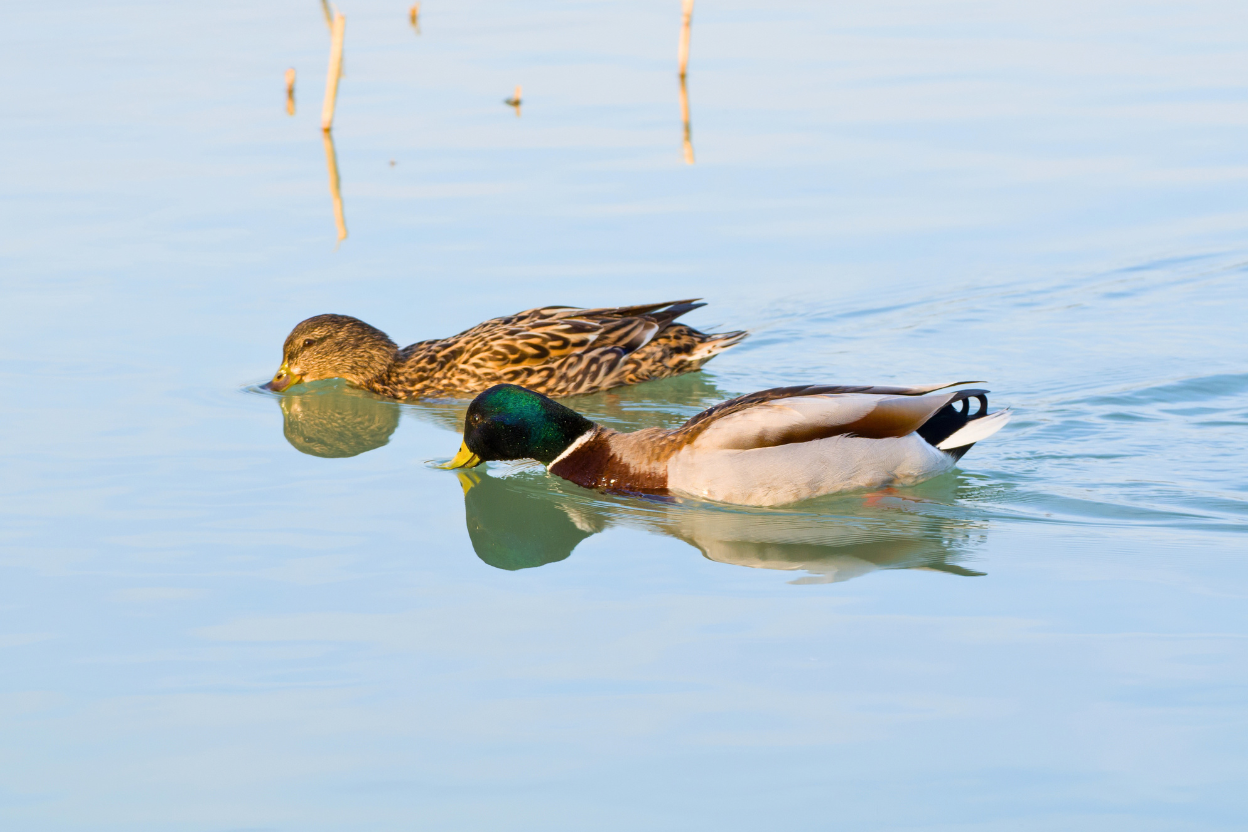
In wild Mallards, the best-studied case, forced copulations can account for 30% to 40% of all observed copulations. Genetic work on the same species shows that only around 3% of offspring result from them, with the female's own social mate fathering the overwhelming majority. The behaviour occurs frequently and succeeds rarely.
That gap is the female counter-adaptation working. Combined with the mechanics of the reproductive tract, and with what researchers call cryptic female choice, the processes occurring after copulation that influence which sperm actually fertilize eggs, female waterfowl retain control over paternity to a degree that the frequency of forced copulation would never suggest. Coercion is common. Coercion is largely unsuccessful. Both statements are true, and only reporting the first produces a false picture.
The Stitchbird, which does something no other bird does
The Stitchbird (Notiomystis cincta), known in New Zealand as the Hihi, copulates in two positions: conventionally, with the male on the female's back, and face to face. The face-to-face position is unique among birds and, in the words of the researchers who described it, appears to be a form of forced copulation.
The supporting anatomy indicates extreme sperm competition. Male testes reach around 4.2% of body mass, which is very large for a bird, males carry on the order of 1.46 billion sperm in their seminal glomera, and the cloacal protuberance is unusually enlarged. The same combination turns up in other species where males face intense sperm competition.
The paternity outcomes are correspondingly high. Studies of different populations have recorded roughly 35% to 46% of nestlings sired outside the pair bond, with extra-pair young present in around 80% of nests or more. Notably, about half of those extra-pair chicks were fathered by unpaired floater males, birds holding no territory and no partner of their own.
One qualification matters here, and leaving it out would misrepresent the species. The Hihi breeding system is genuinely variable, taking in monogamy, polyandry, polygyny and polygynandry, and alongside copulations that occur despite female resistance, female Hihi also solicit copulations with males other than their partner. Both sexes appear to run mixed reproductive strategies, and the high extra-pair paternity reflects female behaviour as well as male. This is not simply a system of males coercing and females resisting.
It is not confined to species with a phallus
Forced copulation attempts also occur in birds that lack an intromittent organ, including corvids such as jackdaws, where the ultimate drivers have been studied directly. The mechanics limit how often such attempts succeed, since without female cooperation the cloacal contact required for sperm transfer is difficult to achieve, which is itself part of the explanation for why the behaviour is less consequential in most birds than in waterfowl.
Reading this correctly
Two errors are worth avoiding, and they point in opposite directions.
The first is treating this material as sensational. Waterfowl anatomy in particular circulates online mainly as a curiosity, which obscures that it is among the clearest demonstrations of antagonistic coevolution in any vertebrate. The structures are interesting because of what they demonstrate, not because of what they are.
The second is importing human moral categories. Birds are not moral agents, forced copulation in ducks is not an ethical event, and the language of the scientific literature is deliberately clinical because the alternative imports assumptions that do not apply. What is being described is selection acting on behaviour and anatomy in a species where the interests of the sexes diverge.
What this does support is a more accurate picture of bird reproduction generally. The courtship-and-choice account is real, and it is one part of a system that also contains conflict, and reading only the courtship leaves you with an incomplete model of what you are watching.
Telling it apart in the field
Coercion is distinguishable from courtship, and the difference is usually obvious once you know what separates them. Courtship involves both birds participating, with ritualized posture, mutual display, food passing, or a female actively soliciting. Coercive attempts involve pursuit, a bird actively attempting to escape, and no ritualized element at all. In waterfowl the distinction is generally unambiguous.
Our guide to how to watch bird courtship displays covers reading pair behaviour, and for conflict that plays out between species rather than between the sexes, see brood parasitism and the cuckoo problem.