
Northern Saw-whet Owl Banding at Tadoussac: A Night With Quebec's Smallest Owl
Saw-whet owls are among the most common owls in the boreal forest and among the least seen. A banding night is the one reliable way to meet one, and it exists because researchers went out after dark and found a migration nobody knew was happening.
There is a gap in birding between how common a bird is and how often anyone sees it, and no North American species opens that gap wider than the Northern Saw-whet Owl. Partners in Flight puts the global breeding population at roughly two million. Most birders will go an entire life without finding one.
They are out there. On an October night they are passing over houses, over highways, over people asleep, in numbers that were not even suspected until the 1990s. The reason nobody knew is simple and slightly humbling: they move in the dark, silently, and nobody was standing in the right place at the right hour with a net.
A banding night is where that changes. It is the one reliable way for an ordinary person to meet this bird, held for a minute or two in a researcher's hand under a headlamp, and then let go back into the dark. This is what happens on one, why the work is done, and what three decades of it at Tadoussac has produced.
The Bird Itself
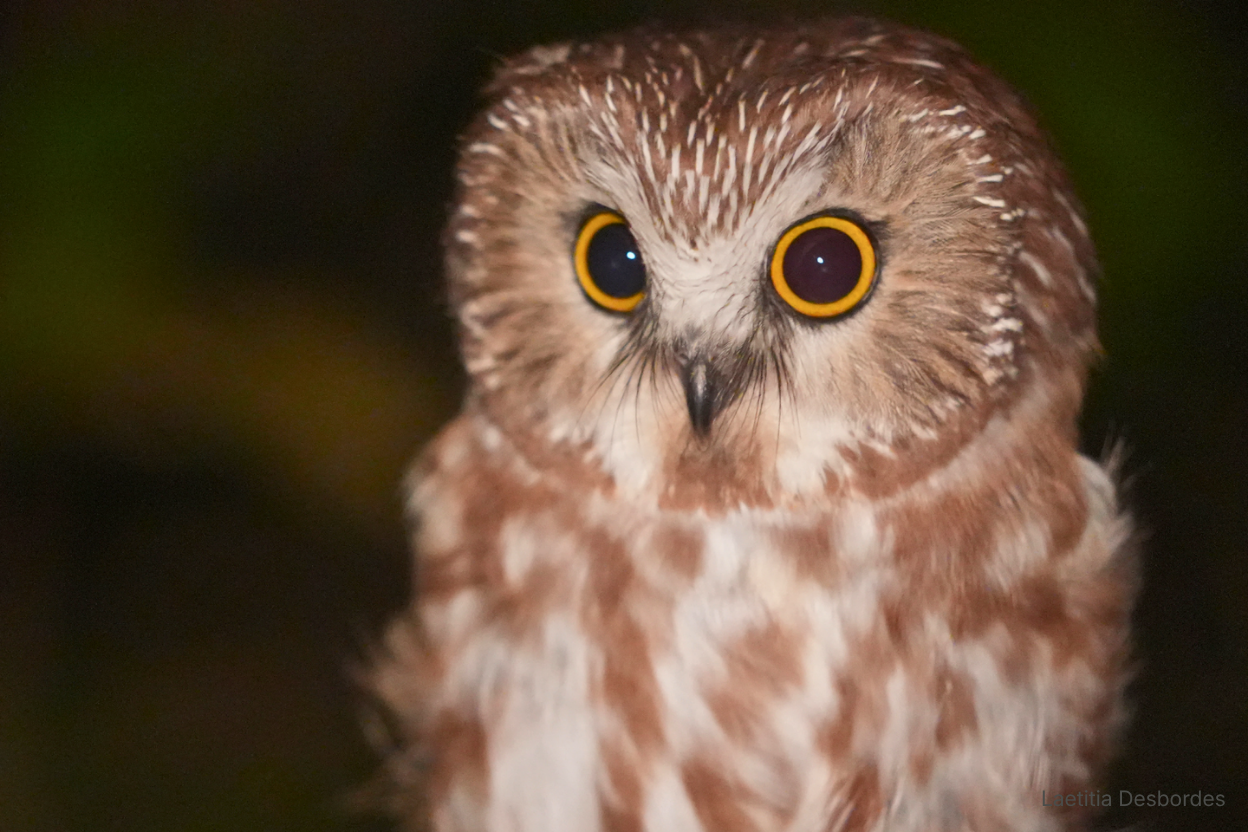
A Northern Saw-whet Owl (Aegolius acadicus) is about the size of an American Robin. It runs 18 to 21 centimetres long with a wingspan of 42 to 48 centimetres, and weighs between 65 and 151 grams. Cornell's guide puts it neatly: slightly heavier but more compact than a Hairy Woodpecker, and smaller than an Eastern Screech-Owl.
Adults are mottled brown with a whitish facial disc, a white-spotted head, fine white streaking on the crown, enormous yellow eyes, and a white V running up between them that gives the face its permanently startled look. Juveniles are strikingly different and catch people out: a rich cinnamon belly, a plain unspotted brown back, and the same white V, but none of the adult's streaking or spotting.
Females are noticeably larger than males, which is standard among owls and raptors and the reverse of the usual pattern in birds. This matters practically, because size and mass are two of the measurements a bander uses to sex a bird in the hand.
They hunt small mammals, principally deer mice and white-footed mice, with shrews and voles making up much of the rest, and they will take small birds during migration. They nest in cavities they did not make, usually old Northern Flicker or Pileated Woodpecker holes, and readily use nest boxes, laying 4 to 7 eggs with an incubation of 26 to 29 days and a nestling period of 27 to 34 days.
The Name, and the Call You Will Not Hear in Autumn
The name is usually traced to one of the bird's harsher calls, said to resemble the sound of a saw blade being whetted against a sharpening stone. The derivation is old and not perfectly documented, so treat it as the traditional explanation rather than settled fact.
The sound most people associate with the species is different: a monotonous, endlessly repeated too-too-too, given by males on a single pitch, sometimes for hours. It is a territorial and mate-attraction song, and the timing matters for anyone hoping to hear one. Males begin as early as late January, before females arrive, and continue into May.
Which means autumn is silent. The birds passing over the dunes in October are not calling, and this is exactly why a migration involving very large numbers of a vocal, well-known species went undetected for so long. Take away the song and you take away the only way most people ever detect an owl.
The Migration Nobody Knew About
For most of the twentieth century, the Northern Saw-whet Owl was widely treated as largely resident, a bird that stayed put. Nobody had strong evidence otherwise, because the evidence required standing in a boreal forest at two in the morning.
What changed it was Project Owlnet, a loose, cooperative, largely volunteer banding network that now runs more than 125 partner stations across Canada, the United States and Mexico. Once dozens of stations were operating the same protocol on the same nights, the recaptures started telling a story that no single station could have seen.
Banders in Pennsylvania began netting saw-whets already wearing bands from central Wisconsin, from the Bruce Peninsula in Ontario, and from the shores of the St. Lawrence in Quebec. The most quietly astonishing record of the kind involves a female found in a nest box in western Quebec, paired with a male that had been banded at a Project Owlnet station in Michigan. Both birds had travelled roughly 600 miles from opposite directions to meet in the same box.
The Ned Smith Center stations alone have banded more than 12,000 owls. All of it came from people choosing to be awake and outside on cold nights, for decades.
What Drives a Big Year, and Why Tadoussac Is Steadier
Across much of the continent, saw-whet captures swing hard from one autumn to the next, and the explanation is one of the more satisfying chains in boreal ecology.
A big flight is usually not a big movement of adults. It is a flood of juveniles, produced by an unusually successful breeding season. That success traces back to a population spike in small rodents, red-backed voles in particular, and those spikes follow autumns when the spruce and fir of the boreal forest produced heavy cone crops. Cones feed rodents, rodents feed owls, and the owls that result turn up in the nets a year later.
Tadoussac is a useful counterexample. The numbers caught here are relatively stable from autumn to autumn, without the boom and bust that some stations report. That steadiness is informative in its own right: it points to a consistent migratory corridor rather than a site that only fills up in irruption years, and it is part of why a long unbroken run of data from this particular dune is worth having.
It is worth noticing what does swing here. The same conifer cone crops sit behind the finch irruptions visible over the same sand by day, and those vary enormously, with a cone failure pushing crossbills and redpolls south in numbers while a good year keeps them north. One forest process, two migrations over one hill, and only one of them boom and bust. We cover the daytime half of that story in why raptors funnel through Tadoussac.
How a Banding Night Actually Works
Nets go up around sunset. These are mist nets, fine mesh strung between poles, effectively invisible in the dark, set in lines through appropriate habitat. Alongside them runs an audio lure, a recording of the male's advertising song played on a loop, which draws passing migrants down toward the net lane.
The lure is the part that surprises people, and it is worth being straightforward about it. It works because the birds are responsive to that song, and it is used under federal permit, at a research station, at fixed locations, on a defined schedule, for the purpose of collecting data. That is a categorically different activity from a birder playing owl calls in the woods, and we will come back to why.
Nets are then checked on a fixed cycle through the night, frequently enough that no bird spends long in the mesh. Extraction is done by trained hands, and at Tadoussac by volunteers working under a professional bander's supervision. Birds are carried to a mobile laboratory, where each one is fitted with a numbered aluminium band and then measured.
Sexing comes from wing chord and mass together, using the size difference between females and males, with the two measurements read against a species-specific table rather than judged by eye. Then the bird is aged, which is where the work gets genuinely clever.
Reading a Wing Under Ultraviolet Light
Owl feathers contain porphyrins, nitrogen-based pigments that fluoresce under ultraviolet light. Hold a black light close to the underside of a saw-whet's wing in a dark room and new feathers glow an intense magenta, brightest toward the base.
The useful property is that porphyrins are destroyed by sunlight. They are most abundant in fresh feathers and degrade as a feather ages and weathers, so an old feather does not glow at all, appearing chalky or yellowish white instead. Since owls replace their flight feathers in stages rather than all at once, the wing ends up carrying feathers of different ages side by side, and under UV those generations light up as visibly different bands.
The reading, from the 2011 method paper by Scott Weidensaul, Bruce Colvin, David Brinker and Steven Huy, works like this. A hatch-year bird fluoresces evenly across the whole underwing, because every feather is the same age. A second-year bird shows bright, freshly moulted outer primaries and inner secondaries contrasting against darker retained juvenile feathers. An after-second-year bird shows three distinct generations of feather at once.
What makes this so valuable is that it turns a subtle judgement into a pattern anyone can be trained to see, quickly, in the dark, in the field. Ageing data is what separates a season with many young birds from a season with simply many birds, which is the distinction that makes a long run of counts worth anything.
Three Decades of Nocturnal Work at Tadoussac
The Observatoire d'oiseaux de Tadoussac has run its owl monitoring program since 1996, which is now three decades of continuous nocturnal work. The banding season runs from early September to the end of October. Nets go up at sunset with call systems replicating each target species' song, and trained volunteers work under a professional bander.
The program's contribution to the wider network is real: recapture data for nearly 200 birds since 1996 as part of Project Owlnet, each one a data point connecting Tadoussac to somewhere else on the continent. At Tadoussac, Laetitia Desbordes is the bander in charge of the Northern Saw-whet Owl banding program.
Two other owls come to the nets. Long-eared Owl was added deliberately in 2024, and the observatory is explicit about why: data on the species is sorely lacking in northeastern North America. It is unusual and rather admirable for a station to take on extra nocturnal work specifically because a gap exists. The other is the one that will interest a visiting lister most.
The Boreal Owl Question
Boreal Owl is one of the hardest birds in North America to actually lay eyes on. It lives year-round in the spruce and fir of the northern forest, coming further south only in years when prey fails. It is almost entirely nocturnal, and it is silent for most of the year, calling mainly from mid-February to April. It roosts by day about 15 to 20 feet up, tight against a trunk in aspen, birch or conifer, and Cornell's own assessment of finding one in daylight is that it is a little like finding a needle in a haystack.
The practical consequence is that a very large share of birders who have Boreal Owl on a list have it as a voice heard on a freezing March night and never as a bird seen. A banding station is one of the few honest routes to the other kind of encounter.
Be realistic about the odds. Boreal Owl is far scarcer in the nets than saw-whet, and the overwhelming majority of nights produce none at all. Nobody should book an owl night expecting one. But it is a real possibility rather than a theoretical one, which is more than can be said for almost any other way of pursuing this species.
If you do get one, the difference is immediate. Boreal Owl is bigger and squarer-faced than a saw-whet, with a pale bill and a face framed in black. It also shows the most extreme size difference between the sexes of any North American owl, with females sometimes weighing twice what a male does.
What an Owl Night Is Like as a Visitor
During the festival week each September, the observatory opens the operation to the public at the Tadoussac dunes. Sessions run at 8pm and 10pm and last about an hour and a half, with 20 places each. One session is offered in English, so check the current schedule for which night that falls on.
This is not an evening of standing around hoping. Most banding stations that admit visitors simply let them watch. Tadoussac runs the night as a genuine interpretation session: the project is presented, the research explained, the methods walked through, and questions answered, so the time between net checks is the substance of the evening rather than dead air. You come away understanding why the work exists, whether or not a bird arrives.
Dress for it, though. You are outside in late September night air on an exposed dune, so wear far more than the daytime temperature suggests, and bring a headlamp with a red setting.
Then, sometimes, a bird arrives, and the whole thing justifies itself in about ninety seconds. The owl is smaller than you expected and heavier-eyed, and it is measured, banded and readied to go.
And then, if the bander offers it, you may be the one who lets it go. The owl sits on an open palm for a few seconds while its night vision comes back, and then it is simply gone into the dark. We are not going to pretend to be neutral about this. A saw-whet in the hand is calm to the point of serenity, weighs about as much as a deck of cards, and carries a kind of composure that is hard to describe without sounding sentimental. It is one of the birding memories we expect to keep for the rest of our lives, and if you get the chance at it, take it.
Some nights nothing comes. This is research rather than entertainment, and there is no owl held in reserve for a slow evening. It depends entirely on whether birds are moving, and a legitimate operation will tell you that upfront rather than after you have paid. Booking two nights if you can is the sensible hedge. Current dates, costs and booking are in our guide to the Côte-Nord Migratory Bird Festival, and what else the region offers is in birding in Tadoussac and the Haute-Côte-Nord.
Naming an Owl, and What It Pays For
The observatory also runs a sponsorship program, which is the most direct way we know to turn an evening's enjoyment into research funding. Photographs of owls captured at the station are posted online, sponsors take on an individual bird and name it, and the money goes straight into the movement and population research.
A sponsor receives a certificate carrying that owl's photograph along with its weight and its age. Because the bird is now in the continental banding system, a sponsor can also follow it if it is ever recaptured at another observatory.
That last part is what makes it more than a symbolic gesture. You are not adopting an abstraction. You are attached to one specific numbered bird moving somewhere across North America, with a real if modest chance of one day learning where it turned up. Current sponsorship details are on the observatory's own pages, and it is one of the better ways to support a small research program that runs on very little.
The Ethics, and Why You Should Not Do This Yourself
Everything described above happens under permit. Banders are licensed, protocols are reviewed, net-check intervals are mandatory, and the data goes into a continental dataset that supports conservation decisions. The justification for briefly handling a wild bird is that the resulting knowledge protects the population.
That framing also covers the release. A bird resting a few seconds on a visitor's palm, at the bander's discretion, at the end of a process that was happening anyway for research reasons, is a supervised moment inside a permitted operation. It is not the same thing as going out to find and handle wildlife yourself, and the distinction is the permit and the purpose rather than the gentleness of the hands.
None of that applies to a birder with a phone and a speaker. Playing owl calls in the woods to draw a bird in for a look has no research value to offset it. Repeated playback can pull a territorial bird off its hunting, provoke it into responding to a rival that does not exist, and in the wrong season and place expose it to predation. It is also unfair on everyone birding the same patch afterwards.
Learn to find owls the slow way instead. Our guides to scanning for owls in the field, hearing nocturnal migration overhead, and keeping an ethical distance from wildlife cover the methods that cost the bird nothing. If you want to see an owl in the hand, go to a banding station, where the handling is already being done for a reason.
Where the Data Goes
Every band carries a unique number, and every recapture turns two isolated observations into a line on a map. That is how the network established that saw-whets migrate at all, then how far, then along which corridors, then how the size of the flight tracks rodent cycles and cone crops in the forest to the north.
Those questions are not academic. A bird that was assumed sedentary is managed very differently from one that crosses international borders twice a year, and a species whose numbers can move with the forest is exactly the kind whose declines hide inside natural variation. Separating a real trend from a good vole year takes decades of counts done the same way.
Which is the quiet argument for standing on a cold dune at midnight, and for the thirty years of people who have. The bird you watch fly off your own hand is not a spectacle laid on for you. It is a data point that happens to be one of the most affecting things in North American birding.
FAQ
A Northern Saw-whet Owl is roughly robin-sized: 18 to 21 centimetres long, with a wingspan of 42 to 48 centimetres, weighing between 65 and 151 grams. Cornell's guide compares it to a Hairy Woodpecker, slightly heavier but more compact, and notes it is smaller than an Eastern Screech-Owl.
In the hand the impression is of a bird that weighs almost nothing. Most of the apparent bulk is feather. Females are noticeably larger than males, which is normal among owls and the reverse of the pattern in most birds.
No. Banding is carried out under federal permit by trained banders, and every part of the protocol is designed around the bird's welfare. Mist nets are checked on a short, fixed cycle so nothing stays in a net long. Handling is brief, usually a few minutes, and the aluminium band is sized to the species and adds negligible weight, comparable to a wristwatch on a person.
The evidence for this is the data itself. Banders routinely recapture the same individuals in later years, in good condition and often on the same migration route, which would not happen if the process caused meaningful harm.
Because that is when they migrate. Northern Saw-whet Owls move after dark, and a station can only catch what is actually flying. Nets go up around sunset and the work runs through the night, which is also why the entire discovery of saw-whet migration came so late: nobody was out in the right place at the right hour.
Night work also keeps the birds calm. Owls handled in darkness are far less stressed than they would be in daylight, and releasing a nocturnal bird back into the dark lets it resume its flight immediately rather than leaving it exposed.
The main autumn passage runs from roughly late September through November across the northern United States and southern Canada, with the peak typically in October. Banding stations concentrate their effort in that window.
Numbers vary enormously from year to year. Big flights are driven by a surge of juveniles, which follows a good breeding season, which in turn follows a boom in small rodents such as red-backed voles after a heavy conifer cone crop. A poor year and a peak year at the same station can differ by an order of magnitude.
Project Owlnet coordinates more than 125 partner stations across Canada, the United States and Mexico, and a good number of them run public demonstration nights during the autumn migration. Well-known examples include stations in Pennsylvania, the Great Lakes states, Ontario, and the Maritimes.
Access varies and places are always limited, because a banding station is a research operation first. Check with the individual station well ahead of the season rather than turning up, and expect any legitimate operation to cap group sizes and to say plainly that seeing an owl is never guaranteed.