
Côte-Nord Migratory Bird Festival 2026: The Complete Guide to Quebec's Best Week of Fall Migration
Quebec's North Shore hosts its sixteenth migratory bird festival from 21 to 27 September 2026. Here is what the week actually contains, what it costs, and what to book before it fills.
Some birding festivals are conferences that happen to have birds nearby. The Festival des oiseaux migrateurs de la Côte-Nord is the other kind. It is a genuine community gathering, where the activities are built so that people actually talk to each other, and where nobody is trying to sell you anything. Everyone is nice, in the plain and unremarkable way that makes a week feel good rather than impressive.
It also happens to fall in what we consider the strongest week of the entire autumn on Quebec's North Shore. The sixteenth edition of the Côte-Nord Migratory Bird Festival runs from 21 to 27 September 2026, based in Tadoussac and Les Bergeronnes with activities spread along the Haute-Côte-Nord. We will be guiding there, which is the reason this guide can tell you what a morning at the dunes is actually like rather than what a listing page says it should be.
On a good day the raptors do not stop. The estuary below produces encounters that people are still describing at dinner. And because the region is a migration funnel with several hundred sharp pairs of eyes trained on it for seven consecutive days, vagrants turn up during festival week often enough that regulars half expect one. No tourism listing mentions that, and it is one of the better reasons to come.
What follows is the practical brief, in English, that the festival's largely French materials do not give a visitor from outside Quebec: what the week contains, what it costs, what sells out, and whether it justifies the drive.
What the Festival Is, and Who Runs It
The festival is organised by the Observatoire d'oiseaux de Tadoussac, a research program of the registered charity Explos-Nature, and it was created in 2009 by the observatory's own team. That matters more than it sounds. This is not an events company renting a venue near some birds. It is a working migration research station opening its operation to the public for one week a year, and the money you spend on activities funds the monitoring.
The observatory has counted migrating raptors at the Tadoussac dunes since 1993, with standardised visual surveys running since 1996, and its programs now cover raptors, passerines, boreal songbirds, and a nocturnal owl-banding effort. The count season is long, running from 24 August to 25 November, and produces an average of about 7,000 raptors of 13 species. Festival week sits squarely inside the best of it.
The essential structural point, which most listings bury: there is no admission fee and more than 40 activities across the week, but the festival runs on an à la carte system. Some of the best things cost nothing and some are capped and paid, and several of those sell out well before September. Understanding which is which is most of the planning problem.
The Free Half of the Week
Two activities run every single day and cost nothing, and between them they would justify the trip on their own.
Passerine banding demonstrations run from 7am to noon, 21 to 27 September, at the banding station in the Tadoussac dunes. You watch birds come out of the nets, get measured, banded, and released, with researchers explaining as they go. It is also the single best thing at the festival for anyone bringing children, and the reason a lot of families come back.
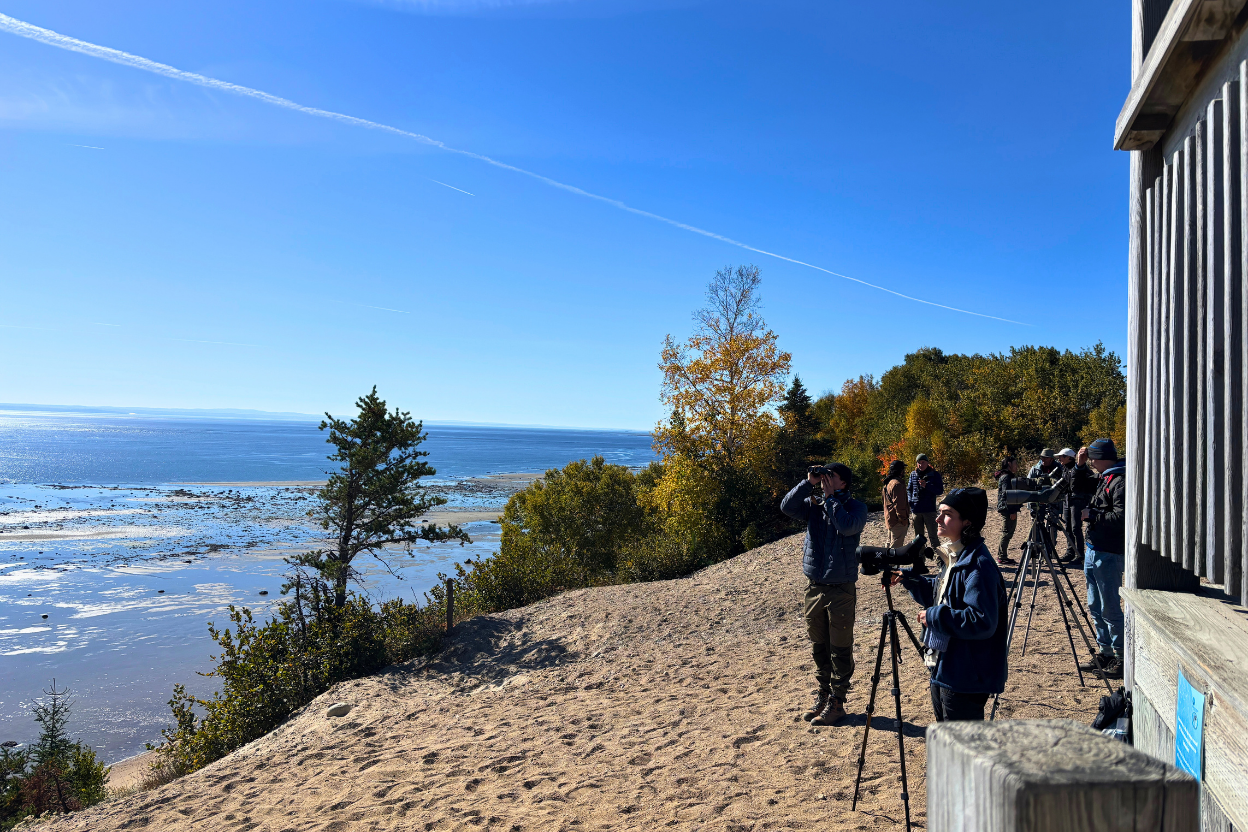
Raptor identification in flight runs from 8am to noon at the Yvan-Duchesne lookout, also in the dunes. This is the count in progress, with someone beside you naming birds as they come through and explaining how they know. The counter is Jessé Roy-Drainville, an outstanding ornithologist who logs the season live, and the numbers go up in near real time on Trektellen as he counts.
That link is worth keeping. You can watch the flight from home before you ever book, see what came through yesterday, and check the morning's tally before deciding whether to drive to the dunes or spend the day on the coast. Season totals for the station are archived on its Trektellen totals page, which is the honest way to calibrate your expectations rather than trusting a round average.
If you have ever wanted to get better at distant raptors and found that impossible from a book, standing next to a counter for a morning does more than a season of solo practice. Our introduction to hawk watching covers the flight-counting fundamentals if you want to arrive already fluent in the vocabulary.
Both sessions are weather-dependent, which is the honest caveat: nets do not open in rain, and there is no raptor flight in the wrong wind. The conferences and documentary screenings across the week are also free.
The Signature Paid Activities
These are the ones with real capacity limits. Prices below are all before tax.
An Enchanted Night with Owls is the festival's most distinctive activity and the one we would book first. It runs at 8pm and 10pm at the dunes for roughly an hour and a half, costs $26, and takes 20 people. The observatory offers a session in English, so check the current schedule for which night it falls on. It is a night at the observatory's owl-banding operation, and it is a genuine once-in-a-lifetime thing for most people. Laetitia Desbordes, the bander in charge of the Northern Saw-whet Owl banding program, is exceptional at bringing people into it. If the festival dates do not suit you, the owl nights also run outside the festival window, from early September into the second half of October. We have given the biology, the methodology, and what a night actually feels like their own piece in Northern Saw-whet Owl banding at Tadoussac.
Under the Wings of the Night is the other nocturnal option, on 21, 24, and 26 September at 8pm from the Pointe à John lookout in Les Bergeronnes. A thermal camera is provided, it costs $30, and it takes 15 people.
The birding cruises put you on the estuary, where a deep channel and enormous tidal mixing concentrate seabirds and marine mammals within sight of shore. Croisières Neptune runs a covered three-hour trip from Les Bergeronnes at 8am for $125, taking 25 people with a minimum of 20, plus an extra afternoon departure at 2pm on 26 September. A lightly booked sailing can be cancelled, so that minimum is worth knowing. Du Fleuve runs a zodiac from Les Escoumins for about two and a half hours at $111.30 with 12 places, on 26 September at 3:30pm and 27 September at 9:30am. The zodiac sits closer to the water and is colder and better for photography. What comes past the boat, and how to name it before it disappears behind a swell, is covered in seabirds of the St. Lawrence estuary. Beluga, minke, and fin whale are near-certain on either trip, which is a real part of the value.
The Guided Hikes, Village by Village
The hikes work the region's coastal sites and are sequenced along Route 138, so each one has a different character.
Discovering Tadoussac is the gentle one: two hours, about 3 kilometres, easy, $30, 15 places, on 26 and 27 September at 8am. Les Bergeronnes and Les Escoumins are both three hours, easy, $40, 15 places, at 8am, on alternating days through the week. Longue-Rive and Portneuf-sur-Mer are the serious shorebird outings: four hours, rated intermediate, $50, starting at 12:30pm to catch the tide, with 15 places rising to 25 on 26 September. Portneuf-sur-Mer in particular is among the most important autumn shorebird sites in eastern North America.
Discovering Haute-Côte-Nord is the full day, on 26 September at 8am: roughly seven hours, $95, transport included, 30 places with a 20-person minimum, departing from the Tadoussac church parking lot and working Escoumins Bay, Pointe-à-Émile, Pointe-à-Boisvert, and Pointe-des-Fortin. If you can only do one paid daytime activity, this is the one that shows you the most coast.
The Boreal Bonus Most Visitors Miss
Here is the part the festival undersells and no competing page makes at all. Late September on the Haute-Côte-Nord is one of the most accessible places in North America to look for boreal forest specialties, and they are available in the same week as the raptors and the seabirds, from roadside spruce rather than after a float-plane charter.
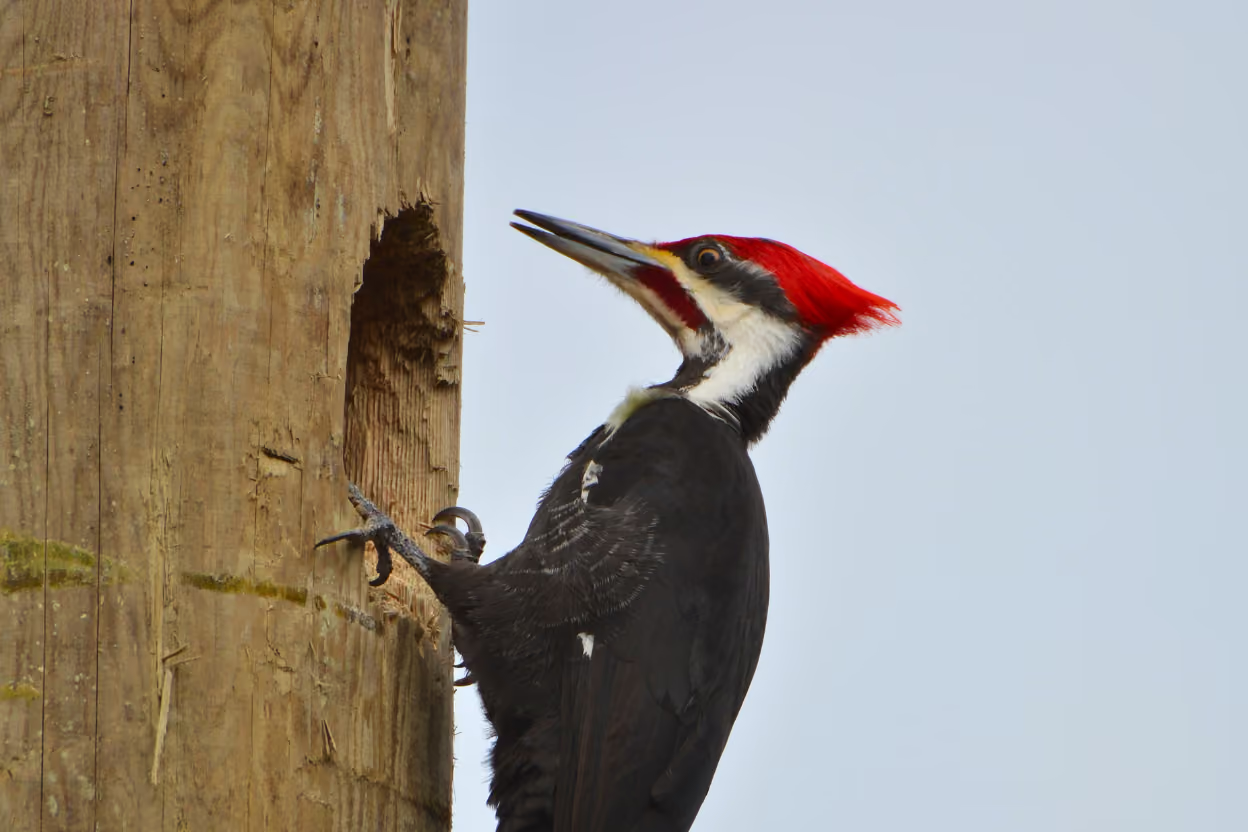
Realistically on the table: Black-backed Woodpecker, American Three-toed Woodpecker, Spruce Grouse, Canada Jay, Boreal Chickadee, Boreal Owl in the nets on a lucky night, and the irruptive finch cast of White-winged Crossbill, redpolls, Pine Siskin, Evening Grosbeak, and Bohemian Waxwing, whose numbers swing hard from year to year with cone crops.
For a birder from the United States or Europe, these are usually the hardest birds on the continent to arrange. Here they come attached to a festival. We want to be honest about the odds though: these are possible, not guaranteed, and they are far more likely with a guide or on the Les Bergeronnes and Havre Colombier ground than on your own first attempt. Canada Jay is the friendly exception, and tends to find you rather than the reverse, as we explain in our Canada Jay ecology guide. Where to actually look, habitat by habitat, is in birding in Tadoussac and the Haute-Côte-Nord.
Vagrants Are Part of the Deal
A migration bottleneck concentrates common birds, but it also concentrates the lost ones, and a week with hundreds of competent observers covering the same hundred kilometres of coast is exactly the condition under which rarities get found rather than merely occurring.
The records make the case better than we can. The dunes produced a Small-billed Elaenia in October 2021, a South American flycatcher with no business north of the tropics and one of the great vagrant records in Canadian birding. Pointe de l'Islet, in the village itself, produced a Black-tailed Gull in October 2019. Baie des Escoumins has 20 species of gull on its list, among them Ivory Gull and Ross's Gull. This is a coast where the improbable has a track record.
Make sure you are on the channel where the news travels. Rare bird news in Quebec moves on Discord well before it reaches eBird alerts, and during festival week the lag matters: a bird found at nine on the Portneuf sandbar can be gone by noon. The server to join is Québec Birds, and it is worth joining before you arrive rather than while standing in a parking lot with one bar of signal. We list it alongside the other regional servers, with the invite links and the etiquette around sensitive locations, in our guide to birding Discord servers and rare bird alerts.
It is a French-language server, which sounds like a barrier and mostly is not. Rare bird posts are a species name, a pin, and a photo, and species names are close enough between French and English that you will follow them fine. Ask in English if you need to and someone will answer.
We would not book a trip on the promise of a vagrant. We would say that your odds of being present for one are considerably better here in this particular week than they are birding alone almost anywhere, and considerably better again if your phone is buzzing when someone finds it. If you want to be ready rather than lucky, our guides to why birds turn up where they should not and how to identify a vagrant are the right preparation.
The Social Half
The festival is deliberately not only birds, and this is what turns a week of early mornings into something people return to annually. There are conferences and documentary screenings throughout, free to attend. A cyanotype workshop and a wild plants workshop run on 26 September, at $65 and $79. Bingo-Oiseaux runs from 21 to 26 September at 7am, at $10 a card or $20 for three. There is a Stéphane Lafleur concert on the evening of 26 September at $25, held with the Festival de la chanson de Tadoussac, and on 27 September at 11am a free bird feeder and birdhouse build that is a good one for families.
The Rassemblement des Migrateurs on 25 September, from 5:30 to 7pm in the reception hall of the Hôtel Tadoussac, is the week's social centre of gravity and where most people meet the people they will bird with for the rest of the week. It is followed at 7:30pm by the Ornitho-Quiz at the Tadoussac church. The Encan des Migrateurs, an online charity auction of donated prizes, funds the observatory directly.
Booking, Prices, and Refunds
Registrations opened on 21 July 2026 and run through Zeffy. You register for each activity individually.
One practical note worth knowing before you check out: Zeffy automatically adds a 15 percent platform contribution to your total. It is optional and can be removed by selecting "Other" during checkout. Plenty of people miss that and pay it without meaning to. If you would rather give directly to the research, the auction and a straight donation to the observatory both do that more efficiently.
All listed prices are before taxes.
The refund policy is more generous than most: full refund if you cancel 7 or more days before an activity, or 14 or more days for the cruises; full refund if the activity is cancelled for weather and you are notified; 50 percent from 24 hours to 6 days out; nothing inside 24 hours.
What to book first: the owl nights and the zodiac have the smallest capacities at 20 and 12 places, so they go earliest. The full-day excursion and the Neptune cruise both have minimums as well as maximums, so booking early helps the trip run at all.
How to Plan Your Days
The shape of a good day is dunes in the morning, coast in the afternoon on the tide, and something nocturnal a couple of nights. The free banding and raptor sessions both run mornings at the dunes, so you can do both without choosing, then drive north for an afternoon hike.
Check the count the night before. Because the dune count is posted live on Trektellen, you can see what is actually moving instead of guessing. A big day yesterday with the same wind forecast tomorrow is a strong signal to be at the lookout at eight. A flat few days with an onshore wind is a good reason to take a hike on the coast instead and keep the dunes for later in the week.
With three days, we would take the free morning sessions at the dunes every day, book one owl night, one cruise, and one of the four-hour Longue-Rive or Portneuf-sur-Mer shorebird hikes, and keep one morning loose for whatever is being reported.
With the full week, add the full-day Haute-Côte-Nord excursion on 26 September, the second nocturnal activity, at least one early morning spent quietly on a forest road for the boreal species, and the Rassemblement on the 25th. Give yourself one completely unscheduled day. It is the one you will end up using for the bird somebody found.
What the Weather Can Take Away
Both free daily activities are weather-dependent, and so is the quality of everything else. Nets do not open in rain. Raptor flight needs the right wind, and a day of easterly onshore wind at the dunes can be very quiet while the following day is extraordinary. Cruises can be cancelled outright for sea state. Late September on the estuary is genuinely cold on the water, colder than the air temperature suggests, and most people underdress for the boat.
None of this is a reason not to come. It is a reason to come for more than two days, and to keep your plans loose. Our guide to reading weather for bird activity covers what to hope for.
Is It Worth the Drive?
From Quebec City it is about three hours, from Montreal closer to six, and from Boston or Toronto it is a real commitment. Our answer is yes, and not mainly because of the numbers.
The birds are excellent: this is one of the best fall migration periods anywhere on the North Shore, with the raptor flight, the estuary, the boreal species, and a live chance at something rare, all inside one week and one hundred kilometres of road. But what people come back for is that it is a true birding community get-together. The activities are designed for exchange, the researchers are accessible in a way they simply are not the other 51 weeks of the year, and you leave having birded with people rather than beside them.
Go. You will not regret it.
Before booking, confirm all prices, dates, and capacities against festivalmigrateurs.com, as details can change from year to year.
FAQ
The festival itself is free and open to everyone, and two of its best activities cost nothing: the daily passerine banding demonstrations and the raptor identification sessions at the Tadoussac dunes, both running every morning of the week. The conferences and documentary screenings are also free. The signature activities are paid and capped, ranging from $26 for an owl night to $125 for the three-hour birding cruise, all before tax.
No, but it helps to know what you are booking. The festival is run in a French-speaking region and most materials and activities are in French. The observatory offers at least one owl night in English, so check the current schedule and book that session if you want a fully English experience. The free morning sessions at the dunes are bilingual in practice, because someone will always translate for you, and the researchers and guides are generally comfortable switching.
26 September is the busiest and richest day, carrying the full-day excursion, both intermediate shorebird hikes at expanded capacity, the concert, and several workshops. If you can only come for one day, take that one. If you want the quietest birding, the earlier weekdays have smaller groups.
Weather matters more than the calendar. A good wind at the dunes beats a well-scheduled day, and because the raptor count is posted live on Trektellen you can see what is actually moving before you commit a morning to it.
Yes, and the festival is unusually good for beginners. The banding demonstrations put birds in front of you at arm's length with someone explaining what you are seeing, the raptor sessions are guided identification rather than a silent count, and the easy-rated hikes assume no experience. The community is welcoming rather than competitive, which is not true of every birding event.
The nocturnal activities and the zodiac. The owl nights take 20 people per session, Under the Wings of the Night takes 15, and the Du Fleuve zodiac takes 12. Registrations opened on 21 July 2026, so book those before anything else. The guided hikes at 15 places each go next.
Note the minimums as well as the maximums: the Croisières Neptune cruise needs 20 participants and the full-day excursion needs 20, so an under-booked departure can be cancelled outright.