
Seabirds of the St. Lawrence Estuary: A Pelagic Trip That Is Not Pelagic
Puffins, phalaropes and jaegers within sight of shore, on water so rich that whales work it alongside the birds. Here is what comes past the boat on the St. Lawrence estuary, and how to name it in the five seconds you get.
A dark shape comes in low and hard off the beam, all elbows and bad intentions, and locks onto a kittiwake. The gull panics. The jaeger turns inside it, tighter than anything that size should be able to turn, and for four seconds everyone on the boat understands exactly what a Parasitic Jaeger is for.
Then it is away downwind, and the skipper opens the throttle and goes after it. Because four seconds of jaeger is not enough, and because a boat can do what a headland cannot. Everyone gets the bird. Somebody gets a photograph. That is the argument for going out on this water, and no species list conveys it.
The St. Lawrence estuary off Tadoussac gives you seabirds at a range you normally have to cross an ocean for, without crossing anything. This is what comes past the boat, and how to name it in the few seconds you get.
A Pelagic Trip That Is Not Pelagic
Most seabird trips involve a long, dull transit to reach productive water, a day of commitment, and a real seasickness lottery. The estuary reverses all three. The rich water is right here, close to shore, reachable in minutes, and you are never out of sight of land.
What you give up is the open-ocean list. This is an estuary, not the continental shelf, and anyone selling you shearwaters and storm-petrels by the dozen is selling a different trip. What you get instead is intimacy: alcids on the water at a distance where you can see the shape of a bill, phalaropes spinning almost within reach, and puffins that do not require a colony pilgrimage.
Why This Water Is So Rich
The reason is a piece of underwater geography that would be famous if you could see it.
The Laurentian Channel is a submarine canyon roughly 1,200 kilometres long, running about 300 metres deep where it approaches the estuary and deeper still out toward the Gulf, carrying Atlantic water inland. It does not carry on indefinitely. Its head lies right at the mouth of the Saguenay. Across the fjord's entrance sits a shallow sill about 20 metres deep, roughly 7 kilometres in from the river mouth, with about 275 metres of water behind it.
So twice a day, on the rising tide, the cold deep salt layer runs into the channel head and has nowhere to go but up. The Saguenay-St. Lawrence Marine Park calls this the heart and lungs of the system, and the phrase is earned. The upwelling drags nutrients and zooplankton to the surface and oxygenates the water, krill and capelin, sand lance and herring concentrate in the churn, and everything that eats them arrives to do so.
That is why the seabirds are here, why the whales are here, and why they are all in the same few square kilometres. It is also why the trips are timed the way they are.
The Alcids
These are the birds you came for, and the ones the boat gets you closest to. In autumn they are all in non-breeding plumage, which means more white on the face and throat than your field guide's cover image, and it also means several of the bill markings you may have memorised are faint or gone. Work on structure rather than pattern.
Razorbill is the commonest and the most satisfying. Crow-sized and genuinely thickset, with a large head on a short neck, and that unmistakable bill: thick, deep and blunt-tipped, like a bird drawn with a chisel. Breeding adults carry a crisp white band across it, but by autumn that band is reduced, and juveniles have a much smaller bill without it, so judge the bill by its bulk and blunt profile, not by its markings. On the water it often cocks its long tail upward, which no murre does. Even at range it reads heavy and blocky, squared off at the front.
Common Murre is the confusion species and the contrast is all in the outline. Slimmer throughout, with a straight, slender, dagger-like bill and a shorter tail, so the rear end looks smoother and rounder and sits flat on the water. Where a Razorbill looks chiselled, a murre looks tapered at both ends. In autumn both show white on the throat and face, so if you are relying on plumage you have already lost the bird.
Thick-billed Murre is where we part company with the optimistic species lists. It is not frequent here, and we would not go expecting one. If you do get a candidate, look for a shorter, thicker bill than Common Murre, and in winter plumage a darker, cleaner-cut face with the dark reaching below the eye, where Common Murre shows a pale face crossed by a dark line running back from it. The whitish gape line everyone quotes is a breeding feature and will not help you in September. Treat this as a genuine find rather than an expectation.
Black Guillemot is the easy one, because by autumn it turns strikingly pale, whitish on the head and underparts with grey barring above, while keeping a bold white wing patch that flashes on every wingbeat. Nothing else out there looks like it.
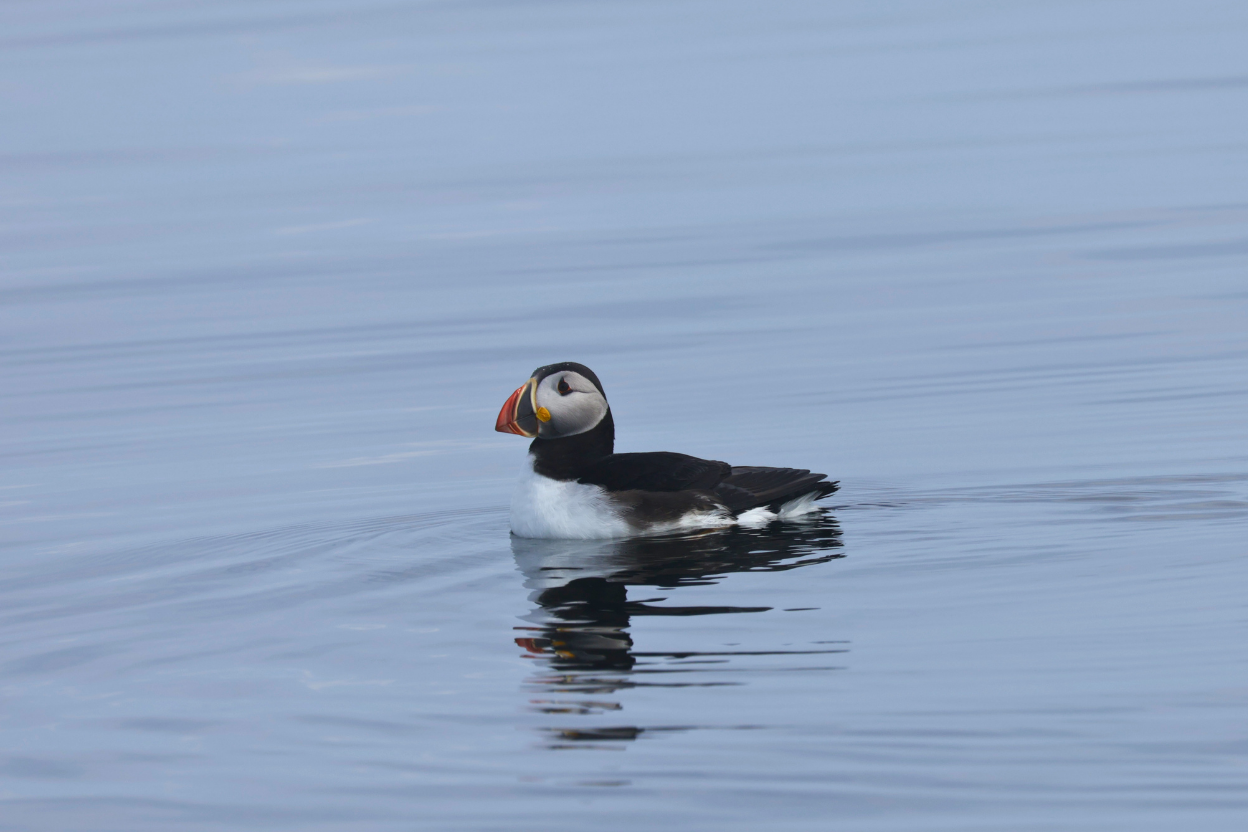
Atlantic Puffin is the surprise, and the one that reliably makes someone on the boat gasp. Puffins are a regular sighting here and often close, which upends the assumption that seeing one requires a dedicated trip to a breeding colony. Manage your expectations about the face, though: by autumn the bright outer bill plates have been shed, so the bill is smaller and duller, and the face has darkened to grey. It is still unmistakable, a stubby football with whirring wings and a comically upright posture on the water.
Jaegers, and Knowing When to Give Up
Jaegers are the most exciting birds on the trip and the most honestly difficult. All three North American species are possible here, they come through fast, usually chasing gulls, and the encounter is over quickly unless the boat can follow.
Parasitic Jaeger is the one you are most likely to get. Slimmer and lighter-framed than Pomarine, and above all more agile: it twists and jinks after gulls and terns in a way that looks almost predatory rather than merely fast. A dark-morph adult passing close is one of the genuinely thrilling sights of the estuary, a bird that looks like it was designed for piracy because it was.
Pomarine Jaeger is bigger in every dimension: barrel-chested, broader-winged, thicker-billed, and it flies more powerfully and less acrobatically. It also shows more white in the outer primaries, so the wing flash is bigger. On breeding adults the central tail feathers settle it outright, because Pomarine grows twisted, spoon-shaped ones that broaden at the tip, while Parasitic's are straight and taper to a point.
Long-tailed Jaeger is the scarcest of the three here, and the one the regulars most want to see. It is the smallest and slimmest, with a notably light, buoyant, almost tern-like flight, and it carries the least white in the wing of any jaeger, often no more than a hint on the outer primaries. Adults are greyer above with a crisp black cap and a clean contrast against darker flight feathers, and the central tail streamers are absurdly long. Juveniles are colder and greyer than the other two and more neatly barred behind. If somebody on the boat suddenly raises their voice, this is usually why.
Juveniles are the hard ones, and the usual shorthand about them is wrong. They do not lack central tail feathers. They show a short projection, and its shape is a genuine mark: blunt and rounded on Pomarine, pointed on Parasitic. The difficulty is that you need a decent view to use it, and juvenile plumage varies enormously between individuals.
So be willing to let one go. A distant bird in poor light, seen for three seconds while you were braced against a swell, is a jaeger species, and jaeger sp. is a completely respectable entry on a checklist. Anyone who never writes it down is either luckier than us or is guessing.
The Small Gulls Nobody Expects
This is the section that separates the estuary from a generic seabird list, and it is the part visitors are least prepared for.
Sabine's Gull is a legitimately beautiful bird and one of the easiest to identify at distance, because the upperwing carries a bold three-part pattern that nothing else shares: a black triangle in the outer primaries, a clean white triangle inside it along the trailing edge, and grey inner coverts, arranged so sharply it looks printed. The tail is shallowly forked and often reads as square at range, and the flight is buoyant and tern-like. This is a bird you can call across a lot of water.
Little Gull turns up closer to shore. It is the smallest gull in the world, and it moves like a marsh tern rather than a gull, flying and hovering then dipping to pick at the surface, though the wingtips are rounded rather than sharp. Adults show a strikingly dark, charcoal underwing that flickers on every beat. Do not lean on that in autumn, because many of the birds here are first-years, which have pale underwings and instead show a blackish M across the upperwing and a dark tail tip.
Black-legged Kittiwake is the everyday small gull out here, clean-cut and gentle-faced, with wingtips that look neatly dipped in black ink and carry no white mirrors, and a light, quick, rather stiff-beaten flight quite unlike the large gulls loafing around the harbour. Juveniles add a bold black M across the wing and a dark half-collar. It is also the bird the jaegers most often chase, so a commotion among kittiwakes is worth looking at rather than looking past.
Phalaropes on the Water
Phalaropes confound people because they are shorebirds that have given up on shores. They swim, buoyant as corks, and they spin in tight circles to draw invertebrates up to the surface, which is behaviour so distinctive that you can name the genus from a long way off.
Both species occur here and both can be close. Red-necked Phalarope is the smaller and finer of the two, with a needle-thin bill and a more contrasting, streakier look. Red Phalarope is the bulkier bird, with a bill noticeably thicker than any other phalarope's and a plainer, cleaner grey back in adult winter plumage. In flight, Red shows cleaner underwings while Red-necked shows dark markings there.
Now the part that catches almost everyone out. Do not expect the colours in the names: adults in autumn are grey and white, and the breeding plumage that earned those names is months and thousands of kilometres away. But a great many of the birds moving through in autumn are not adults at all. Juveniles are far darker, blackish-brown above with buff or golden feather fringes, boldly striped down the back in Red-necked and more evenly tawny-edged in Red. If you are braced for a pale grey bird and something dark and stripey spins past, that is a young phalarope and not a different family.
Gannets, and the Rest of the Cast
Northern Gannet needs no help from a field guide when it is an adult: a big, dazzling white bird with black wingtips and a buff-yellow wash to the head, folding and dropping into the water like a thrown spear. Once you have seen a group working a bait ball you will stop caring about your checklist for a while. Expect plenty that are not white, though. Immatures are dark grey-brown and heavily speckled, and the species takes several years to reach adult plumage, so a good share of the autumn birds are somewhere between the two.
The transit adds scoters and other sea ducks, cormorants, loons, and the large gulls. Storm-petrels are occasional rather than expected, fluttering low and dark over the surface if you get one, and they are a genuine bonus rather than a target. Shearwaters are not a regular feature of these trips, and we would rather tell you that in advance than have you spend three hours scanning for one.
Birding From a Moving Deck
This is the skill nobody teaches and the reason two people on the same boat come home with very different lists.
Leave the scope behind. A tripod is useless on a moving deck and a scope will not hold a bird. Binoculars in the 8x range do everything you need here, because the birds are close and the challenge is acquisition speed rather than magnification. Our focusing speed drills are worth doing before a trip like this; getting on a bird half a second faster is the difference between a Razorbill and an alcid species.
Brace with your legs, not your hands. Stand rather than sit if you can, keep your knees soft, and let the boat move underneath you while your upper body stays level. Elbows in against your ribs steadies the binoculars far better than gripping harder.
Position deliberately. Put the sun behind you where possible and stay out of the spray line, which on a small boat means thinking about where the bow is throwing water. Bring a lens cloth in a pocket, and accept that it will be needed constantly.
Learn to call birds by clock position. On a boat everyone's landmarks are moving, so "gull at two o'clock, low, level with the far point" gets twenty people onto a bird while "over there" gets nobody onto anything.
And be honest with your checklist. A great many birds will be five-second views, and the disciplined thing is to record what you were actually sure of and let the rest go to species level. Our notes on keeping field records and the four keys to quick identification both apply harder here than almost anywhere.
Choosing Between the Two Boats
Two operators run birding cruises during the festival week and they offer genuinely different experiences rather than better and worse ones.
The larger covered boat runs a longer trip from Les Bergeronnes with more capacity, shelter from wind and spray, and a stable platform. It suits anyone unsure of their sea legs, anyone birding with optics they would rather not soak, and anyone who wants more time on the water. Note that it has a minimum passenger count, so a lightly booked departure can be cancelled.
The zodiac runs shorter from Les Escoumins with a much smaller group. You sit close to the water, which is better for photography and gives a more immediate feel for the birds, and you are considerably colder and wetter for it.
Neither is the right answer for everyone. Pick on comfort and photography rather than on species, because the birds do not much care which hull you are in. Current schedules, costs and booking are in our guide to the Côte-Nord Migratory Bird Festival.
Dress for the water, not the forecast. Late September on the estuary is markedly colder than the same day ashore, and the wind is constant. Most people underdress. Add a layer beyond what feels sensible, bring a hat that will not blow off, and take motion sickness medication before boarding rather than once you need it.
The Whales Are Not the Point, But They Are There
This is one of the great whale hotspots in the North Atlantic, for exactly the reasons the birds are here: the upwelling at the channel head puts krill and small fish in reach. Beluga are resident year-round, and minke and fin whale are frequent on these outings.
We are not going to pretend that is irrelevant. It is a real part of what makes three hours on this water worth it, and the encounters can be extraordinary.
Decide in advance what you came for, though. The whales tend to surface at precisely the moment you are working on a distant alcid, and a boat full of people turning to look at a fin whale is a boat that is not looking at the jaeger going the other way. A birder who has settled that question beforehand enjoys both. A birder who has not spends the trip feeling slightly cheated by whichever one they missed.
If You Would Rather Stay on Land
A boat is not compulsory. Cap de Bon-Désir at Les Bergeronnes is listed among the region's best sites specifically for pelagic birds and marine mammals, because the deep water runs close to the rocks and birds work it within range of a scope.
Shore watching trades intimacy for endurance. You will not get the close alcids that make a boat memorable, and you will not chase a jaeger. But you can set up a scope on solid ground, stay as long as you like, and leave when the weather turns, none of which a boat offers. For anyone genuinely worried about seasickness, it is the better plan rather than the consolation prize.
The full run of coastal sites, and how to sequence them around the tide, is in birding in Tadoussac and the Haute-Côte-Nord. And the same geography that concentrates seabirds on this water concentrates raptors and songbirds on the sand above it, which we explain in why raptors funnel through Tadoussac.
Stay in Touch With What Is Being Found
Seabirds move, and so does the news about them. A jaeger working the shoreline, a Sabine's Gull off a headland, or something genuinely rare on the water can be reported in the morning and still findable in the afternoon if you hear about it in time.
On this coast that news travels on Discord well ahead of eBird alerts. Join the Quebec server before you travel rather than while you are standing on a quay with one bar of signal, and you will spend your trip reacting to what is actually about instead of finding out afterwards. We list the regional servers, with the invite links and the etiquette around sensitive sites, in our guide to birding Discord servers and rare bird alerts. It is also the fastest way to report what you find yourself, which is the other half of the bargain.
What Makes It Worth Doing
Take away the rarities and the list, and the reason to go is simpler than any of it. Most birders' experience of seabirds is a distant smudge over grey water, identified by faith as much as by field marks. Out here they come close enough that a novice can see the shape of a Razorbill's bill with their own eyes, watch a puffin bob past, and follow a jaeger through a chase.
Putting people in front of pelagic birds at that range is a genuine privilege, and watching somebody see their first one is the best part of the job. Bring warm clothes, keep your binoculars dry, and be ready to move fast when the skipper turns the boat.
FAQ
Look at the bill and the back end. A Razorbill has a thick, blunt, deep bill crossed by a white band, giving the head a heavy, squared-off look, and it often cocks its long tail up when sitting on the water. A Common Murre has a slim, straight, dagger-like bill and a rounder, smoother rear end that sits flat.
At distance, shape beats pattern. Razorbill reads as thickset and blocky with a heavy head; Common Murre reads as slimmer and more pointed at both ends. In autumn both show white on the throat and face, so plumage alone will not separate them.
Yes. Atlantic Puffin is a regular sighting on the birding cruises out of the Haute-Côte-Nord in autumn, and often at close range, which surprises visitors who assume puffins require a dedicated colony trip.
Expect the winter face rather than the postcard. By autumn the bill has shed its bright outer plates and the face has darkened, so the bird looks smaller-billed and greyer than the breeding-season images everyone has in mind. It is still unmistakable: whirring wings, stubby shape, and that upright bobbing posture on the water.
Bulk, bill and flight. Pomarine Jaegers are thick-chested with broad wings and larger bills, and they fly more powerfully and less acrobatically. Parasitic Jaegers are slimmer and more agile, twisting hard after gulls and terns. The white flash in the wing is bigger in Pomarine. In breeding adults the central tail feathers settle it: Pomarine's are twisted and spoon-shaped, broader at the tip, while Parasitic's are straight and pointed.
Be willing to let one go. Distant birds, juveniles, and anything seen briefly from a moving boat are frequently not identifiable to species, and jaeger sp. is a perfectly respectable entry on a checklist.
Less than you would for a true pelagic. These trips stay inside the estuary within sight of shore rather than crossing open ocean, so there is no long transit and no committing to a full day offshore if conditions turn.
It is still a boat on cold, tidal water. Conditions vary with wind and tide, trips can be cancelled outright for sea state, and late September on the water is considerably colder than the air temperature ashore suggests. If you are prone to motion sickness, take something before boarding rather than after, and choose the larger covered boat over an open zodiac.
Yes, and Cap de Bon-Désir at Les Bergeronnes is the site to use. It is listed among the region's best specifically for pelagic birds and marine mammals, because the deep water runs close in and birds and whales work it within scope range of the rocks.
Shore watching trades intimacy for patience. You will not get the close alcids that make a boat trip memorable, but you can stay as long as you like, keep a scope steady, and go home when the weather turns, none of which a boat allows.