
Why Raptors Funnel Through Tadoussac: Inside a Migration Bottleneck
Soaring raptors will not cross cold water, so coastlines gather them. Where the Saguenay fjord meets the St. Lawrence estuary, that rule produces one of eastern North America's cleanest migration bottlenecks, and one of its great places to stand.
Ask why some places get thousands of migrating hawks and the country twenty kilometres away gets almost none, and the answer is never that the birds like the view. It is physics, geography, and the fact that a soaring raptor is a glider with a fuel problem.
The clearest way to understand a migration bottleneck is to look hard at one. Tadoussac, on Quebec's North Shore, is among the tidiest examples in eastern North America: a place where a cold estuary, a deep fjord, and a sand dune conspire to squeeze a broad front of migrating birds into a corridor you can stand in. What happens there happens, in different clothes, at every hawk watch in the world.
It is also, and this matters more than a physics lesson usually admits, one of the most beautiful places we know to spend an autumn morning.
Why Soaring Raptors Will Not Cross Cold Water
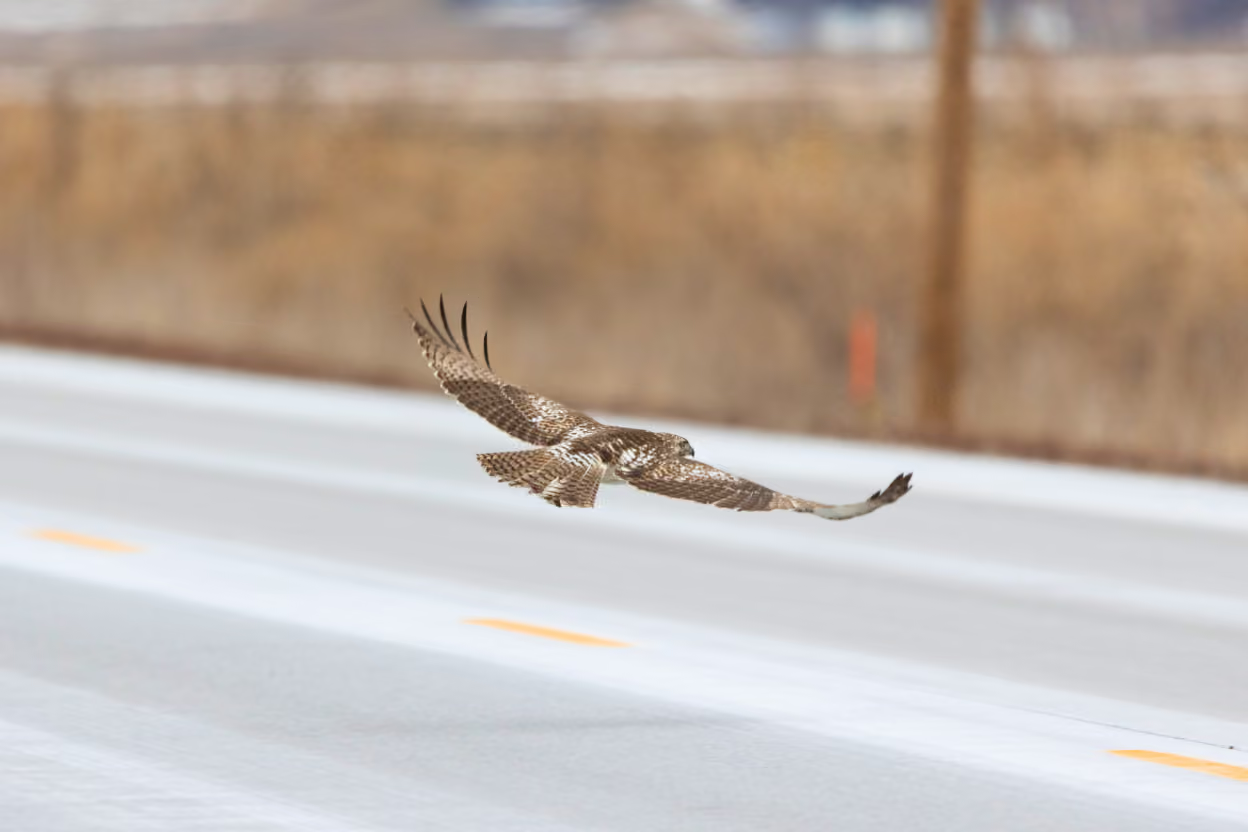
A migrating buteo is trying to travel as far as possible while flapping as little as possible. It does this by riding thermals, which are columns of air that rise because the sun has heated the ground beneath them. The bird circles inside a thermal, climbs, then peels off and glides forward, losing altitude slowly until it finds the next column and climbs again. This is enormously cheaper than powered flight, and it is the reason a Broad-winged Hawk (Buteo platypterus) can cross a continent on a body the size of a crow's.
Water breaks the system. Water has a very high heat capacity, so it absorbs the sun's energy rather than radiating it back as the land does. No warm surface means no rising column, and no rising column means a raptor over open water must power every metre of the crossing itself. For a bird built for gliding, with broad wings and low wing loading, that is expensive and it is dangerous, because there is nowhere to stop.
So they refuse. Faced with a wide, cold crossing, a soaring migrant turns and follows the edge of the water instead. Counters call the shoreline a leading line, and the phrase is exact: the coast leads the birds, and they run along it the way water runs along a gutter.
This is not absolute. Falcons and harriers, which have narrower wings and are more willing to flap, cross water far more readily than the buteos and eagles do. That difference in willingness is itself visible in the count, and it is one of the things that makes a coastal watch different from a ridge watch.
What a Bottleneck Actually Is
A bottleneck is what you get when the leading line runs out of room. Migrants moving on a broad front across open country meet a barrier, turn to follow it, and are gradually compressed. Where two barriers converge, the birds have nowhere left to spread out, and a season's worth of migration passes through a gap you could throw a stone across.
The important thing to understand is that a bottleneck does not make birds. It concentrates them. The same number of hawks left the boreal forest whether or not you were standing at the pinch point; the geography simply routes them past you instead of over a hundred kilometres of forest where nobody is looking. This is precisely why research stations get built at bottlenecks, and it is why the counts they produce are so valuable.
The famous ones vary enormously in scale. Veracruz in Mexico is the largest on earth, where the coastal plain narrows between the Gulf and the Sierra Madre and, according to Hawk Mountain Sanctuary, an average of 4.5 million birds passes the two count sites each autumn. Hawk Mountain itself, in Pennsylvania, is where systematic hawk counting in North America essentially began, on an Appalachian ridge that works by updraft rather than by water, and it has run the longest continuous raptor count in the world since 1934. Falsterbo in Sweden is the classic European coastal funnel, and Eilat in Israel sits at the neck of a continental land bridge between Africa and Eurasia.
Tadoussac is small by that company, and saying so plainly is more useful than inflating it. Its interest is not raw volume. It is that the geometry is unusually clean, the station has been counting for three decades, the raptors are only one of three migrations crossing the same sand, and the place itself is extraordinary.
The Tadoussac Geometry
Two things happen at Tadoussac at once. The first is the St. Lawrence estuary itself, which by this point is many kilometres wide, deep, and very cold. It is an effective wall to a soaring bird, and it runs southwest, which is exactly the direction autumn migrants want to travel. Birds moving down the North Shore drift seaward until the coast stops them, then continue along it.
The second is the Saguenay fjord, which cuts inland from the estuary at Tadoussac. A bird tracking southwest along the shore arrives at the fjord mouth and finds a second body of cold water directly across its path. The two barriers meet at a point, and the sand dunes sit right at the apex of that angle, high above the water.
The result is a genuine pinch. Migrants that were spread across many kilometres of forest are compressed against the shore, and then compressed again by the fjord, and they pass the dunes low and close. The Observatoire d'oiseaux de Tadoussac describes its lookout as sitting on the edge of the boreal forest and along the St. Lawrence, which is the whole story in a clause: forest on one side making thermals, cold water on the other refusing to.
Standing on the Dunes
The dunes are not a metaphor. They are two immense marine sand terraces, uncovered roughly 10,000 years ago as the last glaciers melted and the land rebounded, and they sit above the estuary like a natural grandstand. The observatory's lookout is 60 metres above the water, with an open panorama across the St. Lawrence and down over the bay at Moulin à Baude, and a footpath running down the eastern slope to the beach at the foot of the sand.
What this means in practice is that you are not craning at specks. You are standing above the flight line with the birds coming past at or below eye level, against water rather than sky, which is the single best lighting condition for seeing a raptor's underwing pattern properly.
The setting does the rest. Boreal forest runs to the horizon behind you, in late September turning through the tamaracks and birches. The estuary in front is part of the Saguenay-St. Lawrence Marine Park, cold and nutrient-rich enough that marine mammals work the water below while you are watching the sky, which produces the unusual problem of not knowing where to point your binoculars. On a clear morning with the sun coming up the estuary and a stream of birds crossing in front of it, this is one of the finest places to stand in eastern Canada, and it would be worth the walk up even if nothing were migrating at all.
What the Count Records
An ornithologist runs a standardised daily count at the Yvan-Duchesne lookout from 24 August to 25 November. Across those three months the observatory records an average of 7,000 raptors of 13 species, alongside more than 60,000 passerines, with exceptional years reaching up to 300,000.
The count has run since 1993 and has been standardised since 1996, covering more than 100 species annually, with the data shared publicly through the Canadian Migration Monitoring Network on the NatureCounts platform. That combination of a long, consistent time series and an open dataset is what turns a nice view into science.
The current counter is Jessé Roy-Drainville, and one of the genuinely modern pleasures of this site is that you can watch him work from anywhere in the world. The tallies go up in near real time on Trektellen, and the season archives sit on the station's totals page. If you want to understand what a bottleneck does, watching a real one fill up day by day teaches more than any amount of theory, and it costs nothing.
The Season, Species by Species
The most useful thing about a long-running count is that it turns a vague autumn into a schedule. Different raptors own different weeks, and knowing which is which is the difference between arriving and arriving on purpose.
Early September belongs to Broad-winged Hawk and American Kestrel. Broad-wings are the kettle birds, moving in social flocks and going early precisely because they depend on strong thermals that fade as the season cools.
The middle of the season is accipiter time, and the cast here is not the one you would expect at a watch further south. Sharp-shinned Hawk is overwhelmingly the most numerous. American Goshawk is a realistic bird here rather than the prize it is almost everywhere else, which is one of the quiet advantages of counting this far north, on the edge of the boreal forest the species actually breeds in. Cooper's Hawk, a staple of hawk watches in the northeastern United States and southern Ontario, is essentially absent this far down the estuary. These are birds that hunt migrating songbirds, so they travel with their food supply.
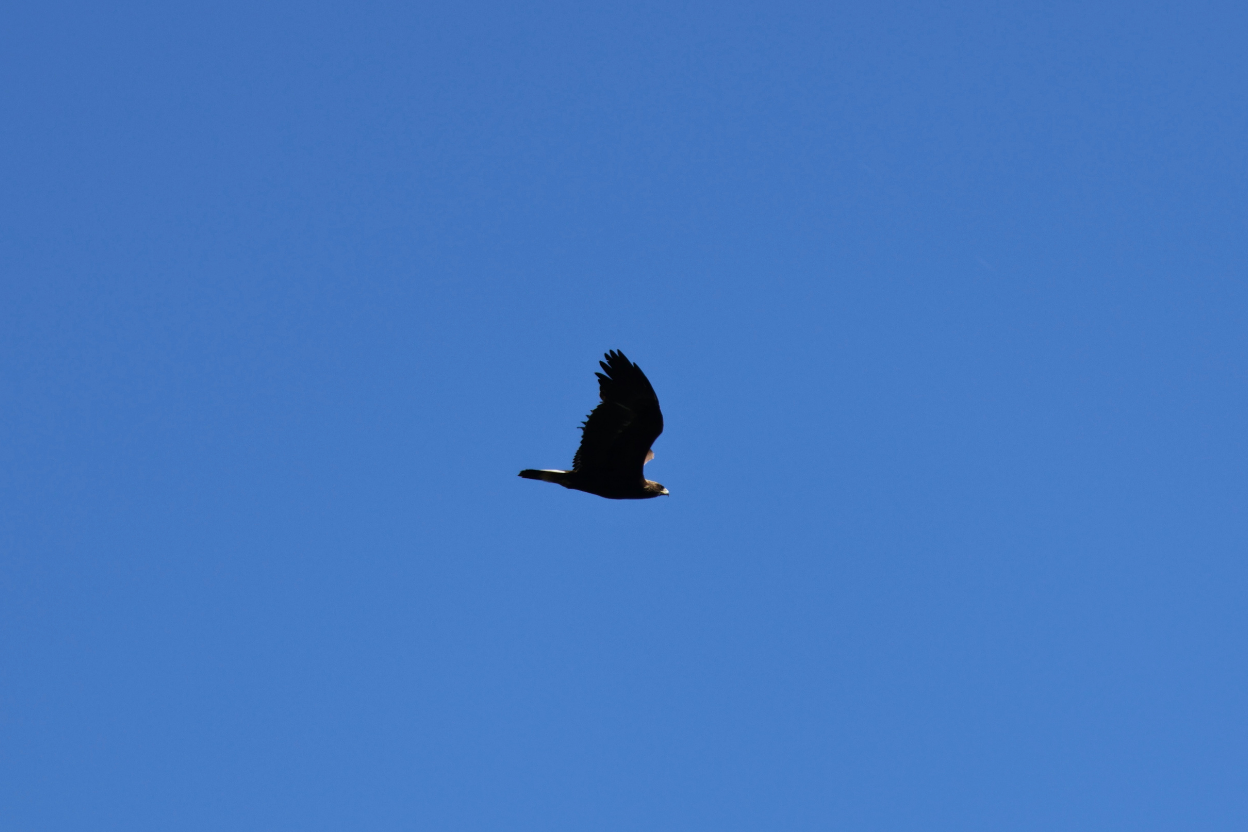
October and November bring the late, heavy birds: Golden Eagle and Rough-legged Hawk, both breeding far north and both moving once the early crowd has gone. Fewer raptors are in the air in November, but the ones that are tend to be the ones people most want to see.
Why Young Birds and Adults Arrive at Different Times
Here is a pattern almost no casual observer would ever detect, and one that only a station counting the same line for decades can show. At Tadoussac, young Sharp-shinned Hawks peak in mid-September while adults peak in mid-October, roughly a month apart in the same species on the same flight line.
This kind of age-class separation is widespread in raptor migration, and the usual explanations are that inexperienced birds leave earlier and are pushed out of contested territory, that adults can afford to linger while food remains, and that juveniles are more prone to drifting onto the coast in the first place while experienced adults hold a truer line inland. The practical consequence for a visitor is straightforward: the birds you see in September and the birds you see in October are not simply more or fewer, they are different individuals at different stages of life.
It is also a good illustration of why a count matters. Nobody standing on the dune for a week would ever see this. It only emerges from thirty seasons of someone writing down what went past.
The Passerine Flood
Here is the thing most visitors do not expect, and the reason we would tell anyone to arrive at first light rather than mid-morning. The raptors are the headline, but on the right day the songbird passage over these dunes is the bigger spectacle by an order of magnitude.
The numbers make the point. Against an average of 7,000 raptors in a season, the same count logs more than 60,000 passerines, and in exceptional years that figure has reached 300,000. These are not birds trickling past. On a good morning they come over the sand in continuous streams, flock after flock, low enough to hear, for hours.
The mechanism is related to the raptors' but not identical. Songbirds migrate at night, and a night's flight over the boreal forest leaves many of them drifted out toward the coast by dawn. As the light comes up they reorient, and the same shoreline that acts as a wall to a soaring hawk acts as a corridor to a warbler working its way back inland and southwest. The dune sits exactly where that reorientation happens.
What comes past is the whole northern songbird cast: warblers, thrushes, kinglets, sparrows, blackbirds, pipits, and finches, in a rolling sequence that shifts week by week as the season moves from long-distance migrants to short-distance ones. The observatory has run songbird monitoring here since 1995 and operates a banding station alongside the count, which is how a bird you see as a silhouette at fifty metres becomes a measured, aged, banded record in a dataset.
If you go, go early. The raptor flight builds with the thermals and peaks late morning, but the passerine movement is a dawn phenomenon and is largely over by the time most visitors have finished breakfast.
Irruptive Boreal Birds and the Budworm
A large proportion of those passerines are irruptive boreal species, meaning birds whose numbers swing violently from year to year rather than following a steady annual rhythm. This is why the passerine total varies by a factor of five between seasons while the raptor total stays comparatively stable.
The mechanism is food. Crossbills, redpolls, Pine Siskin, Evening Grosbeak, Pine Grosbeak and Bohemian Waxwing all depend on conifer seed and berry crops that fail and boom on their own cycles. In a good cone year the birds stay north and almost none reach you. In a failure year they pour south, and a station on a bottleneck records a flood.
Spruce budworm complicates this in an interesting way. An outbreak means abundant caterpillars, which is excellent feeding through the breeding season and produces more young birds. But the same infested stands tend to produce very poor cone crops, so those extra birds have nothing to eat by winter and move. The Finch Research Network publishes the annual Winter Finch Forecast that tracks exactly this, and Tadoussac appears in it as a reference site for what is actually moving. Check the current year's forecast before you plan an autumn trip, because a finch year and a non-finch year are barely the same experience.
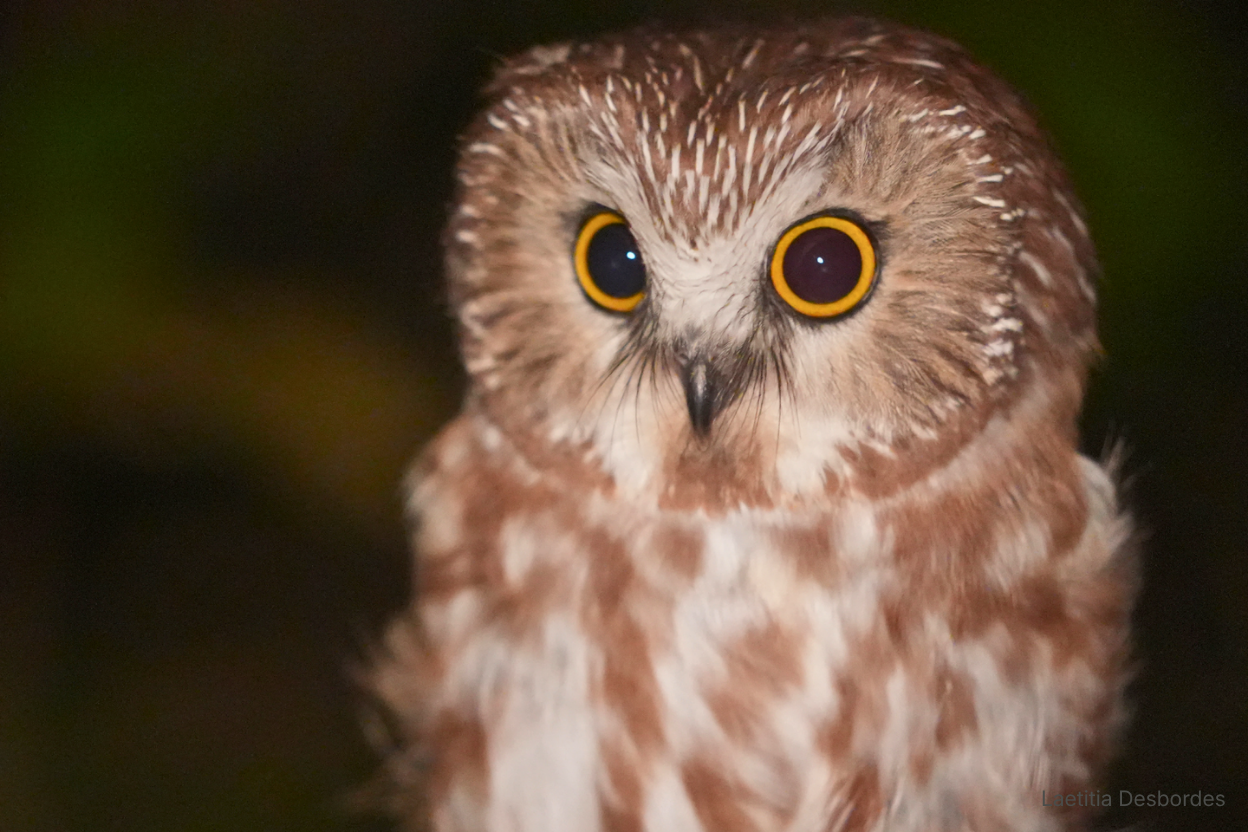
Where to find the resident boreal specialties on the ground, as opposed to overhead, is covered in birding in Tadoussac and the Haute-Côte-Nord. The third migration over the same sand, the nocturnal one, is in Northern Saw-whet Owl banding at Tadoussac.
The Spring Anomaly
Tadoussac is best known to many birders for something that is not the autumn count at all, and the two get confused constantly, so it is worth separating them carefully.
In May 2018 the observatory recorded more than 500,000 warblers in a single day, moving on a southwest heading. The mechanism is reverse migration: favourable overnight winds, in that case reaching up to 100 kilometres per hour at altitudes between 100 and 1,000 metres, carry northbound migrants too far, and at sunrise the birds find themselves overshot and turn back along the coast.
Counting a flood like that needs its own method. Since 2023 the observatory uses estimated counts on high-volume days: two counters position themselves back to back, tally the birds crossing an imaginary line for one minute, then extrapolate that rate across a ten-minute interval, identifying species in the gaps between counts.
That 2018 day was extraordinary, not typical. It is not the autumn count, it is not raptors, and anyone quoting it as what Tadoussac produces annually is misreading the station. Treat it as a spectacular demonstration of what the same geography can do under freak conditions.
What Wind Does to a Day
Two people can visit the same lookout a day apart and come away with completely different impressions of the place, and the variable is almost always weather.
Thermals need sun on land, so heavy overcast, rain and fog flatten the raptor flight. Wind determines whether the birds that are moving pass in front of you or well inland, since a wind off the water pushes migrants away from the shore while a wind with a component off the land presses them against it. And the largest single factor is frontal timing: migrants hold while conditions are poor and move in numbers once a front has cleared through, which is why the morning after a cold front is the classic big-count setup for songbirds and raptors alike.
Our guides to reading weather for bird activity and using weather radar for migration go into how to anticipate this rather than discover it on arrival. For the counting craft itself, see our introduction to hawk watching, and for the wider picture of how these routes assemble, our explainer on North America's migration flyways.
Why Thirty Years of Counting Matters
Raptors are hard to census. They are thinly spread, they nest secretively across enormous territories, and standard breeding surveys barely detect them. Counting them where geography concentrates them is one of the few practical ways to track whether populations are rising or falling at all. The same is true of boreal songbirds breeding across a forest almost nobody surveys.
That only works with consistency. One person counting one autumn produces an anecdote. The same protocol at the same line for three decades produces a trend, and a trend is what tells a conservation agency that something is going wrong while there is still time to act on it. The unglamorous truth of a bottleneck station is that its value accumulates through repetition, in weather nobody would choose, by people writing down numbers that only mean something in aggregate.
How to See It, Any Autumn
The count runs daily from late August to late November, every year, so the migration is not a one-week event and does not need to be planned around a festival. Early September gives you Broad-winged Hawk and kestrels with the songbird passage still building. Mid to late September is the richest compromise, with accipiters overhead, the passerine flood at its peak, and boreal species moving. Late October into November trades volume for Golden Eagle and Rough-legged Hawk, and for having the dune largely to yourself.
Whenever you go, arrive at first light for the songbirds and stay through late morning for the raptors, and check the live count on Trektellen the night before so you know what has been moving.
Get on the channel where sightings travel, too. The count tells you what crossed the dune, but the birds found away from it, a rarity on a sandbar or an unexpected flock inland, move on Discord long before they reach eBird alerts. Joining the Quebec server before you arrive rather than after is often the difference between hearing about a bird and seeing it, and we list the regional servers in our guide to birding Discord servers and rare bird alerts.
For one week each September the observatory opens its research operation to the public, with free daily raptor identification and banding demonstrations at the dunes, and that week is covered in our guide to the Côte-Nord Migratory Bird Festival.
And if you never get there at all, the count is still public, live, and free to follow from anywhere on earth. That is a fairly remarkable thing for a sand dune in Quebec to offer.
FAQ
A migration bottleneck is a place where geography forces a broad front of migrating birds into a narrow corridor. Soaring raptors travel on a wide front across open country, but when they meet a barrier they cannot cross efficiently, usually a large body of water or a mountain range, they turn and follow its edge instead. Where two such barriers meet, the birds have nowhere left to spread out.
The result is concentration rather than abundance. A bottleneck does not create more birds, it simply funnels the ones already moving past a single point, which is why counting stations are built at them.
Soaring raptors travel by riding thermals, which are columns of warm air rising off ground the sun has heated. Water absorbs heat rather than radiating it back, so thermals do not form over a cold estuary or open sea. A raptor that starts across a wide crossing has to power its own flight the whole way, which is expensive and dangerous for a bird built to glide.
So they follow the shoreline. The coast becomes what counters call a leading line, and birds drift along it until the geography lets them continue. Species with lower wing loading, such as harriers and falcons, are more willing to cross water than the broad-winged buteos.
A kettle is a group of raptors circling together inside the same thermal, climbing as the column of warm air lifts them. Broad-winged Hawks form the most dramatic ones because they migrate in tight, highly social flocks and because their broad wings and light bodies make them exceptionally efficient at converting lift into distance.
Once at the top of the thermal, the flock peels off and glides down along its path until it finds the next one, then climbs again. That climb-and-glide pattern is how a Broad-winged Hawk crosses a continent while barely flapping, and it is why they migrate earlier in the autumn than most other raptors, while thermals are still strong.
The Observatoire d'oiseaux de Tadoussac counts daily from 24 August to 25 November, and different birds own different parts of that window. Broad-winged Hawk and American Kestrel move in early September. Sharp-shinned Hawk runs through the middle, with young birds peaking in mid-September and adults in mid-October. Golden Eagle and Rough-legged Hawk come late, in October and November.
Mid to late September is the best compromise if you want variety plus the passerine and boreal movement at the same time. Late October and November trade volume for the chance of a Golden Eagle.
At a coastal site, the productive wind is generally one that pushes birds toward the shoreline and gives them lift along it, usually a following wind with a component off the land. A wind blowing off the water tends to push migrants inland, away from the lookout, and heavy rain or thick fog shuts the flight down entirely because thermals stop forming.
The pattern that matters most is the day after a front. Migrants pile up while conditions are poor and move in numbers when the weather clears, so a cold front passing overnight followed by a clear, cool morning is the classic setup for a big count.