
Birding in Tadoussac and the Haute-Côte-Nord: The Complete Site and Trip-Planning Guide
The Haute-Côte-Nord strings ten serious birding sites along a hundred kilometres of Route 138, and almost none of it is documented in English. Here is where to go, when, in what order, and where to sleep.
The Haute-Côte-Nord has a problem that is very good news for a visiting birder. It holds one of the highest concentrations of quality birding sites in Quebec, roughly ten of them strung along a hundred kilometres of a single highway, and almost none of it is documented in English as a planning resource. The French-language site lists exist. What does not exist anywhere is an account that sequences them, connects them to the tide, and tells you where to sleep.
That is what this is. It works whether you come for the festival week in September or in the middle of February, because the place is worth planning a trip around on its own terms.
We answer the four questions a trip planner actually has, in the order they arrive: is it worth going, when should I go, which sites do I work and in what order, and where do I stay.
Where This Is, and How You Get There
The Haute-Côte-Nord runs along the north shore of the St. Lawrence estuary, starting at Tadoussac where the Saguenay fjord meets the river and continuing northeast through Les Bergeronnes, Les Escoumins, Longue-Rive, Portneuf-sur-Mer and Forestville.
The drive is about three hours from Quebec City, which is 215 kilometres away, and close to six from Montreal at 480 kilometres. From the northeastern United States it is a long day, and from Toronto it is a serious commitment, so plan accordingly rather than treating it as a weekend.
The ferry matters to your timing. Route 138 crosses the mouth of the Saguenay on a free ferry between Baie-Sainte-Catherine and Tadoussac. The crossing takes about ten minutes and departures run year-round every 13, 20, 40 or 60 minutes depending on the season, but queues build in high season and at peak hours, and a missed sailing can cost you the light. Build slack into any morning where you need to cross before dawn.
The geography makes planning easy. Because the sites string out along one highway rather than scattering, your itinerary is essentially linear: you work east and come back, or you work east and sleep further along. There is very little backtracking if you plan the day around the tide rather than around the map.
The Five Sites We Would Work First
If you had limited time and wanted the best of the coast, these are the five. The dunes for the migration overhead, and four sites on the shorebird coast to the east. Each links to its eBird hotspot, and checking recent checklists before you drive is worth more than any site description including this one, because what is present changes week by week through the autumn.
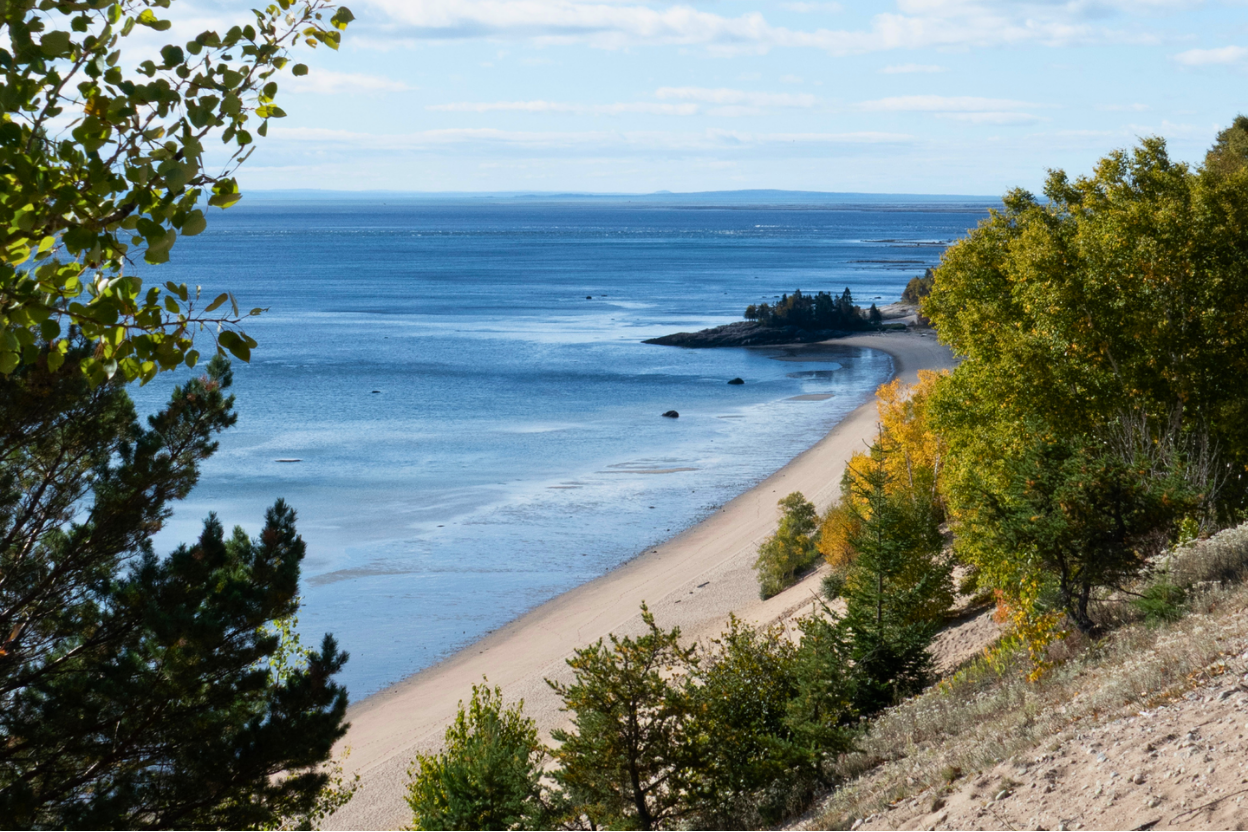
Les Dunes de Tadoussac is the anchor and the most important birding site in the region. Two ancient marine sand terraces sit above the estuary, with the observatory's lookout 60 metres above the water and an open panorama across to the far shore. 286 species have been documented here. In autumn it is the raptor site, with an average of 7,000 raptors of 13 species passing each season, but the songbird passage at dawn is heavier still, and the site's capacity for surprise is real: a Small-billed Elaenia, a South American flycatcher with no business north of the tropics, was banded here in October 2021. Give it every morning you have, starting at first light. Why the geography works is explained in why raptors funnel through Tadoussac.
Pointe-à-Émile is the first of the eastern coastal points and one of the four stops on the festival's full-day excursion. It is a working coastal vantage for shorebirds and sea ducks rather than a destination in its own right, and it rewards a stop of an hour rather than a morning. Like all these points it is highly dependent on tide and on what has dropped in, so check the recent record before committing time to it.
Pointe-à-Boisvert and the Longue-Rive salt marsh sit about 65 kilometres east of Tadoussac and are the best waterfowl and shorebird combination on the coast. This is a genuine salt marsh with distinct survey zones rather than a single viewpoint, so give it three or four hours and walk it properly. Time it for mid-tide. At high water the birds are pushed off the flats and out of view, and at dead low they are impossibly distant; the productive window is the falling or rising water in between, when the feeding edge is close enough to work.
The Banc de Portneuf-sur-Mer is the one to prioritise if you only do a single shorebird site. The festival rates the sandbar as one of the most important sites in eastern North America for Black-bellied Plover, Short-billed Dowitcher and White-rumped Sandpiper, and that is not regional pride talking: the bar holds birds in real numbers, with Semipalmated Sandpiper among the other regulars and enough volume that scanning carefully is genuinely worth the effort rather than a formality. It is a long site and a four-hour visit is not excessive.
Pointe des Fortin sits on the east bank of the Portneuf River and is the shorter, easier companion to the sandbar. It works well at high tide, when shorebirds pushed off the flats gather here, and it adds sea ducks along the beach. This is the site to use when the tide is wrong for Portneuf, which makes the two of them a natural pair for a single afternoon.
The Rest of the Coast
Pointe de l'Islet sits in Saguenay Fjord National Park at Tadoussac, with over 200 species documented and an overlook where the fjord meets the estuary. It is walkable from the village, it is excellent for sea watching and marine mammals, and it has produced serious rarities including a Black-tailed Gull in October 2019. If you are without a car, this and the dunes are your trip.
Pointe à John, at the end of Rue de la Mer in Les Bergeronnes, has over 220 species recorded and is the place for gulls plus both dabbling and diving ducks. It doubles as the site for the festival's thermal-camera night walks.
Cap de Bon-Désir at Les Bergeronnes is the shore-based seabird site, listed specifically for pelagic birds and marine mammals because deep water runs close to the rocks. It is the answer for anyone who wants alcids and jaegers without getting on a boat, and it is covered alongside the boat options in seabirds of the St. Lawrence estuary.
Baie des Escoumins is the best gull site in Quebec and not by a small margin, with 20 species of gull recorded, including Ivory Gull, Ross's Gull and Common Gull, the Eurasian Larus canus rather than its recently split American cousin. The vantage point to work it from is Pointe à la Croix, on the bay, and its eBird record is the one to check before you make the drive. For a gull specialist this bay alone justifies the trip, and it is a winter site as much as an autumn one.
The Forestville quay and marsh holds sea ducks and seabirds, notably large groups of scoters, and a protected marsh behind the dock with a trail that has produced Virginia Rail. Havre Colombier, between Forestville and Betsiamites, is the far end of the run, good for diving ducks and pelagics, with a chance of Black-backed Woodpecker in the forest around it.
Where to See Boreal Birds in Quebec
This is the part the region's own materials treat as an afterthought, and it is the strongest reason for an American or European birder to choose the Haute-Côte-Nord over any other coastal migration site.
Boreal specialties are usually the hardest birds on the continent to arrange. They generally mean a long drive to nowhere, or a float plane. Here the boreal forest comes down to the highway. You can work black spruce and balsam fir from a gravel side road before breakfast and be on a sandbar by mid-morning.
Read the habitat rather than the map. The single most useful thing to look for is dead standing timber: burns, blowdowns, and budworm-killed stands. That is where the woodpeckers are, and a live green forest of the same species may hold almost nothing. Bog edges and the transition zones between spruce and mixed wood are the other places worth slowing down for.
Black-backed Woodpecker is the most gettable of the difficult ones. Work standing dead spruce and listen rather than look: the giveaway is a slow, deliberate, oddly quiet tapping and the sound of bark flaking off, not a loud drumroll. Havre Colombier and the Forestville area are the anchors.
American Three-toed Woodpecker is the harder of the pair by a distance, in the same habitat and with the same technique, and it needs more hours and more luck. Do not build a trip around it.
Spruce Grouse wants quiet gravel side roads at first light, where birds come out to grit. This is a drive-slowly-with-the-windows-down species, and the ones you find are usually standing in the road looking unbothered.
Canada Jay is the friendly exception to all of this. It tends to find you rather than the reverse, appearing silently at a rest stop as soon as food is unpacked, which is a behaviour with a long and well-studied history behind it, covered in our Canada Jay ecology guide.
Boreal Chickadee is a voice before it is a bird. Learn the wheezy, nasal, drawn-out call, work every chickadee flock you meet, and expect the boreal birds to be quieter and more retiring than the Black-capped Chickadees they are travelling with.
Boreal Owl is nocturnal and genuinely difficult, and the realistic route to one is a night at the observatory's banding station rather than your own searching, as we explain in Northern Saw-whet Owl banding at Tadoussac.
The irruptive finches are the wild card: White-winged Crossbill, redpolls, Pine Siskin, Pine Grosbeak, Evening Grosbeak and Bohemian Waxwing. In a good year they are everywhere and in a poor year you will barely see one, and the difference is the conifer cone crop rather than anything you can influence. Check the current Winter Finch Forecast before you travel.
Be honest with yourself about the odds. Boreal birding is slow, quiet, patient work with long empty stretches, and none of these species is guaranteed. What makes the Haute-Côte-Nord special is not that they are easy here, but that trying for them costs you an early morning rather than a separate expedition. It also fits the day perfectly, because dawn in the forest ends exactly when the coastal sites come good on the tide.
Working the Tide
More trips are wasted on this coast by ignoring the tide than by any other mistake, and it is entirely avoidable.
The estuary has a large tidal range, and the shorebird sites are mudflats and sandbars. At high water the flats are covered and the birds are pushed off entirely. At dead low they are scattered across an enormous expanse and too distant to identify. The productive window is the middle of the tide, when the feeding edge is within scope range and the birds are concentrated along it.
The practical method is to look up the tide tables before you set out and build the day around them, not the other way round. Boreal forest at first light regardless of tide, then coastal sites timed to mid-tide, then the dunes or a headland in the evening. When the tide is wrong for Portneuf, work Pointe des Fortin at high water instead. Weather is the other variable that will reshape a day, and the two together are worth ten minutes of planning each evening.
When to Go
Late September is the peak and the reason most people come. The raptor flight is on, the passerine passage is heaviest, shorebirds are still on the bars, seabirds are on the estuary, and the boreal forest is accessible, all in one week. It is also the festival week, which we cover in our guide to the Côte-Nord Migratory Bird Festival.
May and early June bring the spring migration and the reverse-migration phenomenon that made Tadoussac famous among researchers, with warblers in numbers that can be extraordinary on the right morning. Boreal species are singing then too, which makes them far easier to locate than in autumn silence.
Summer is marine mammal season and the busiest tourism period, with breeding boreal birds available and shorebird passage starting to build from late July as the first southbound adults arrive.
October and November trade volume for quality: Golden Eagle and Rough-legged Hawk over the dunes, sea ducks building on the coast, and the first winter gulls.
Winter is thin but not empty. Baie des Escoumins is a gull destination in its own right, and an irruption year puts finches and Bohemian Waxwings through the region.
A Three-Day Route
Day one: arrive and bird Tadoussac. Dunes at first light for the songbird passage and stay for the raptor flight as the thermals build. Afternoon at Pointe de l'Islet for the fjord and sea watching. This day requires no driving beyond the village.
Day two: east along Route 138. Early gravel side roads for boreal species, then Les Bergeronnes and Cap de Bon-Désir, then Pointe à la Croix and Baie des Escoumins for gulls, timing the afternoon around mid-tide at Longue-Rive if the water suits.
Day three: the shorebird coast. Portneuf-sur-Mer sandbar on the falling tide, with Pointe des Fortin as the high-water alternative, and Pointe-à-Boisvert on the way back. Return to the dunes for the last of the light.
A Five-Day Route
Take the three-day route above and add two things. A boat day, out on the estuary for alcids, jaegers, phalaropes and whales, which is a different experience from anything you can get ashore. And a proper boreal morning, meaning a full first light to mid-morning spent slowly on forest roads around Havre Colombier or Forestville rather than an hour squeezed in before the coast.
With five days you can also push northeast to Forestville and Havre Colombier without making it a round trip in a day, and you gain the single most valuable thing on this coast: a spare day. Weather here removes options regularly, and a trip with no slack in it is a trip that loses the raptor flight to an easterly and never gets it back.
Where to Stay
Tadoussac is the obvious base and the right one for most trips. It puts you walking distance from the dunes, has the widest choice of accommodation from the historic hotel down to campgrounds, and has restaurants and fuel. It is also the busiest and the first to fill.
Les Bergeronnes is the quieter alternative and is closer to the observatory's field operations and to Cap de Bon-Désir. If your trip is weighted toward seabirds and nocturnal activities rather than the dunes, it is arguably the better base and it is usually easier to book.
Les Escoumins suits a trip focused on the eastern sites, cutting the daily drive to Longue-Rive and Portneuf considerably. Forestville works for anyone spending real time at the far end.
Book early, and earlier than you think. Festival week fills the village, and July is not early for a late-September stay. If you are travelling in the last week of September without a reservation, you are likely to end up sleeping a long way from where you want to bird.
The map below covers Tadoussac and the villages along the coast, so you can see what is available and how far each option sits from the sites you plan to work.
Practical Notes
This is a French-speaking region, and while tourism businesses in Tadoussac generally operate in English, that thins quickly as you go east. A few phrases go a long way, and the effort is noticed and appreciated.
Mobile coverage is patchy along Route 138 and effectively absent on forest side roads. Download offline maps and your tide tables before you leave the village, and do not rely on being able to look up an eBird alert from a gravel road.
Fuel up in the towns. Stations are spread out and hours are limited outside the summer season, which is exactly when birders visit.
Biting insects are a serious matter in June and July in the forest, and a non-issue by late September. If you come in summer, bring more repellent than you think and consider a head net for boreal birding.
Get on the rare bird channel. News in Quebec moves on Discord well before it reaches eBird alerts, and on this coast a bird can be found and gone within the morning. We cover the regional servers in our guide to birding Discord servers and rare bird alerts.
Is It Worth the Trip?
For a birder, this is one of the best-value destinations in eastern North America, and the reason is compression. In a hundred kilometres of one highway you have a world-class migration bottleneck, a shorebird coast rated among the most important in eastern North America, the finest gull site in the province, seabirds and whales on water you can reach in minutes, and boreal forest specialties available from a roadside.
Very few places let you work a spruce road at dawn, a sandbar at midday, and a raptor flight in the afternoon without moving your bags. Fewer still do it against scenery this good. Come for four or five days in late September if you can, keep your plans loose, and let the tide and the wind tell you what kind of day you are having.
FAQ
Late September is the peak, and it is not close. Raptors are streaming past the dunes, the passerine passage is at its heaviest, shorebirds are still working the sandbars to the east, seabirds are on the estuary, and boreal species are reachable in the forest behind, all in the same week.
The other seasons are real, though. May and early June bring the spring reverse migration and the warbler spectacle the region is famous for. Summer is for marine mammals and breeding boreal birds. Winter is thin but produces gulls at Baie des Escoumins and irruptive finches in a good year.
Yes, effectively. The birding sites string out along Route 138 over roughly 100 kilometres, from Tadoussac east to Forestville and beyond, and there is no practical public transport between them. Several of the best sites are also reached by side roads or short access tracks.
The one exception is Tadoussac itself. If you stay in the village you can walk to the dunes and to Pointe de l'Islet, which covers the raptor watch and a fjord overlook without driving. That is a genuinely good two days. Everything beyond it needs a vehicle.
Three days is the sensible minimum and gets you the dunes, one boat trip, and one proper shorebird site on the tide. Five days lets you work the coast east to Portneuf-sur-Mer without rushing, add early mornings for boreal species, and keep a spare day for weather.
Weather is the argument for more days. The raptor flight depends on wind, the nets do not open in rain, boats are cancelled for sea state, and shorebirding depends on the tide falling at a civilised hour. A two-day trip can lose most of that to one bad system.
For a birder, yes, and autumn is arguably the better trip. The whale-watching crowds thin after Labour Day while the migration is peaking, so late September gives you the best birding of the year with easier accommodation and quieter sites.
Beluga are resident year-round, so the marine mammal interest never disappears entirely. What changes is the intensity of the tourism around it, which from a birder's point of view is an improvement.
The Haute-Côte-Nord is one of the most accessible places in North America to try, because the boreal forest comes right down to Route 138 and you can work it from roadsides rather than chartering a float plane. Black-backed Woodpecker, American Three-toed Woodpecker, Spruce Grouse, Canada Jay and Boreal Chickadee are all possible, along with the irruptive finches in the right year.
Habitat matters more than location. Look for standing dead spruce, burns, and budworm-killed stands for the woodpeckers, quiet gravel side roads at first light for Spruce Grouse, and mixed flocks for Boreal Chickadee. These are birds that reward hours and quiet rather than driving between named spots.