
Bird Vagrancy and Range Expansion: Why Birds Turn Up Where They Shouldn't
A lost Tropical Kingbird in a city park and a Glossy Ibis nesting in Maine look like the same story. They are not. Here is how vagrancy and range expansion actually differ, and why both are showing up more often.
We were walking a tidy city park in eastern Canada, the kind with mown grass and a duck pond, when a chunky flycatcher dropped onto a wire and began hawking insects over the lawn. Yellow belly, heavy bill, a bird with no business being there. It was a Tropical Kingbird (Tyrannus melancholicus), a species of the American tropics whose northern edge barely clips southern Texas and Arizona, sitting on a wire thousands of kilometers from where it belonged.
That bird was a vagrant. One individual, off course, alone. That same autumn, in salt marshes not far away, Glossy Ibis were feeding where a birder in 1900 would never have found them, because the species has spent two centuries pushing its breeding range north into Maine. That is range expansion. Same jolt of surprise for the observer, completely different biology underneath. This post is about telling those two things apart, and about why both seem to be happening more often, or at least appearing to.
Vagrancy and range expansion are not the same thing
A vagrant is a single bird that has ended up well outside its normal range through a wrong turn, a storm, or a navigational slip. Western Tanager (Piranga ludoviciana) is the familiar version. Nearly every autumn a lone individual of this western species turns up at a feeder somewhere in the east, one lost bird at a time. Range expansion is a population-level shift instead: many birds, over years and decades, settling and breeding in places they did not used to occupy. The distinction matters because a single Tropical Kingbird and a marsh full of newly established Glossy Ibis are explained by different sciences, and they call for different responses when you find them. Recognizing which one is in front of you is a field skill in its own right, and we cover it in How to Identify a Vagrant or Range-Expanding Bird.
Why a single bird ends up in the wrong place
Several mechanisms push a lone bird off course, and they are not mutually exclusive. Spring overshooting is the simplest: a strong tailwind carries a migrating bird past its intended breeding grounds before it stops. Reverse migration and orientation error come next, where a bird, often an inexperienced juvenile, effectively reads its compass upside down and heads in the wrong direction entirely. Wind drift and weather do the dramatic work, with storms and jet streams displacing birds far across land or ocean. And natural post-breeding dispersal accounts for a good share of it too, as young birds wander widely before they settle, which is exactly how a species probes ground beyond its current edge.
Here we owe you honesty. The relative weight of these mechanisms is genuinely debated, and researchers have not pinned down a single universal cause of vagrancy. Recent work has even linked spikes in vagrancy to geomagnetic disturbance, one more strand still being untangled. Treat the list above as the leading explanations rather than a settled account. When you actually find a rarity, the practical side lives in two companion posts: How to Find Rare Birds and How to Document and Report Vagrant Birds.
Why a whole population pushes its range
Range expansion runs on different fuel. Three factors combine, and the mix varies by species. The most visible is climate change, which makes places that were once too cold newly survivable and shifts suitable habitat north. The most overlooked is habitat, wetland restoration in particular, because a colonizing wader or egret needs somewhere to land, feed, and breed, and created and restored marshes have given exactly that. The third is the bird itself. A migratory, adaptable species that is already inclined to wander will probe its own range edge, so overshoots and dispersers are not just curiosities. They are the leading edge of the expansion. Climate gets the headlines, but on its own it rarely tells the whole story.
Three Old World birds doing this right now
The clearest way to see the pattern is through three herons and an ibis that crossed the Atlantic from the Old World under their own power and are still pushing north. We keep them brief here, because each has its own full account.
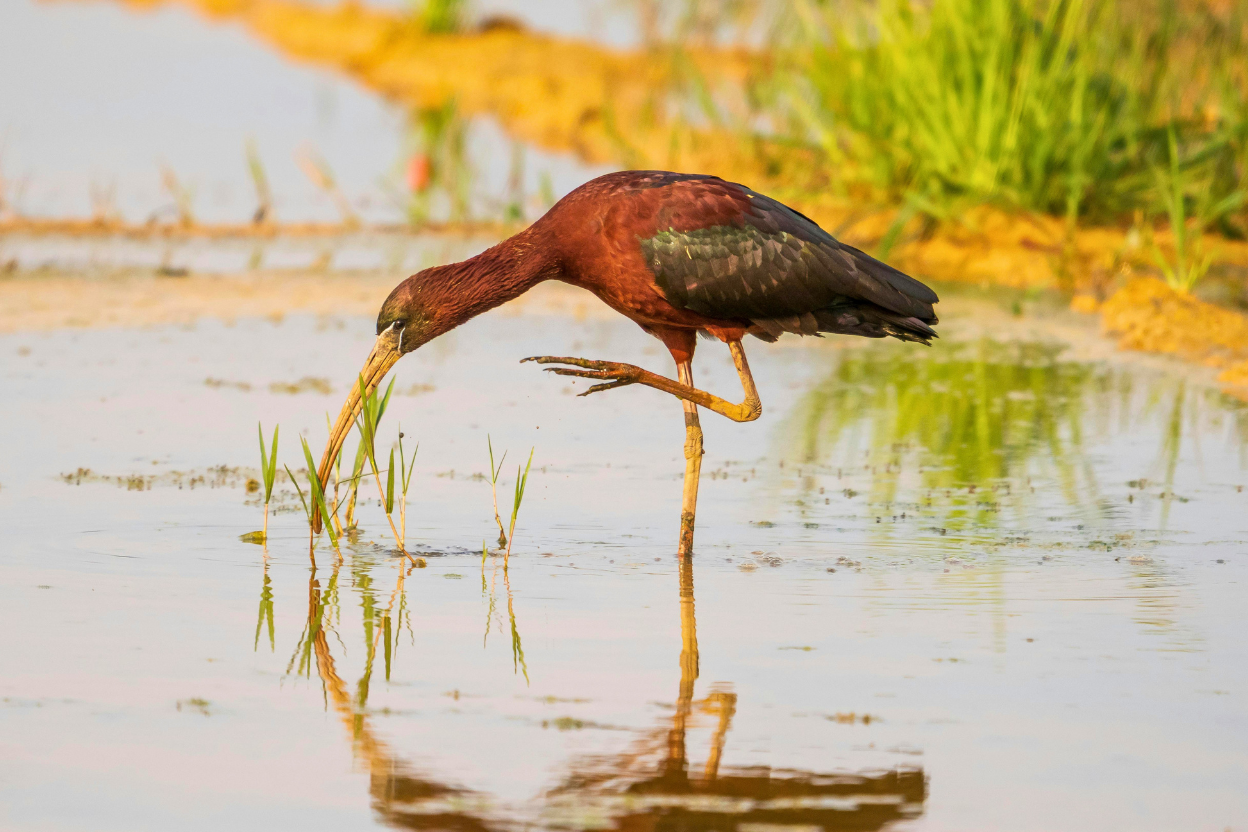
Glossy Ibis (Plegadis falcinellus) reached the New World from Africa in the early 1800s, apparently on trade winds, then expanded dramatically up the Atlantic coast to breed as far north as Maine, with a closely parallel expansion documented in Europe over the same span. The full timeline is in Glossy Ibis Range Expansion in North America.
Western Cattle-Egret (Ardea ibis) is the fastest of the three. It crossed the Atlantic on its own, was established in the Americas by the late 1800s, first reached North America in the 1940s where early birds were dismissed as escapees, and swept coast to coast within a few decades. The 2023 taxonomic split of the old Cattle Egret into two species makes the North American bird the Western Cattle-Egret. We tell that story in Cattle Egret in North America.
Little Egret (Egretta garzetta) is the newest chapter, caught at a stage the other two passed through long ago. It crossed from West Africa to the Caribbean, bred at Barbados from the 1990s, and now appears as a rare but increasingly regular vagrant north to Newfoundland, Quebec, and Maine. It is still a vagrant and incipient colonizer rather than an established breeder, which is precisely why every sighting counts. More in Little Egret in North America.
One honest caveat holds all three together. None of these expansions has been a straight line. Glossy Ibis and Western Cattle-Egret have both declined in parts of the Northeast since their peaks, so expansion here means a long directional trend with real setbacks, not a tidy climb.
Are we seeing more, or just looking more?
In 2026 it can feel like rare birds are turning up everywhere. Some of that is real, driven by weather and by genuine long-term change. But a large part of it is us. There are far more birders now than there were twenty years ago, most of them carrying a phone that identifies birds by sound and logs every sighting to eBird in seconds. A well-watched county today produces records that a sparsely watched one never could, so an apparent surge in a single year is a noisy signal at best. The meaningful pattern is the multi-decade trend, confirmed across many observers and, better still, backed by breeding records rather than one-off sightings. We raise this because it is easy, and tempting, to mistake a better-watched sky for a busier one.
What to do with all this
The next time a bird stops you because it is simply in the wrong place, the first useful question is which of the two stories you are watching. Is this one lost individual, or the leading edge of a population on the move? Often you cannot tell from a single bird, and that uncertainty is the honest state of the science. But knowing the two categories exist changes how you watch, what you photograph, and what you report. Learn to spot a candidate in How to Identify a Vagrant or Range-Expanding Bird, then let the ibis and the egrets show you, slowly, what a real range expansion looks like up close.
FAQ
Vagrancy is about individuals. A vagrant is a single bird that has strayed far outside its normal range, usually by accident. Range expansion is about populations, describing many birds that, over years and decades, colonize and breed in new areas. A lone western bird at an eastern feeder is a vagrant. A wading bird now nesting hundreds of kilometers north of where it once did is range expansion. The two can be linked, because repeated vagrancy sometimes seeds a new population, but they are not the same event.
Several forces are usually at work. Some birds overshoot their breeding grounds on strong spring tailwinds. Others suffer orientation errors, including reverse migration, where a bird heads the opposite way to the one it intended. Storms and high-altitude winds displace birds across great distances, and young birds naturally disperse widely before settling. Scientists still debate how much each factor contributes, and there is no single universal explanation.
Climate change is the most visible driver of range expansion, because warming makes once-inhospitable areas survivable and shifts suitable habitat northward. It is rarely the only factor, though. Habitat change such as wetland restoration and a species' own adaptability matter too. For vagrancy specifically, the evidence is more mixed, and part of any apparent increase reflects the growing number of birders reporting sightings rather than a true rise in lost birds.
Overshooting happens when a migrating bird flies past its intended destination, most often in spring when strong following winds carry it beyond its breeding range before it stops. A southern species can end up well to the north as a result. Overshooting is one of the more straightforward causes of vagrancy, and it tends to produce predictable pulses of out-of-range birds at certain times of year.
Both things are true, which makes single-year spikes hard to read. Genuine long-term change is happening, but the number of observers and the tools they carry have grown enormously. Real-time alerts, sound identification, and eBird logging mean more birds get found and recorded than ever before. The reliable signal is a trend that holds across many years and many observers, ideally confirmed by breeding, not a busy-looking single season.
Sometimes. A single lost bird rarely does anything but survive or perish alone. But when vagrants of the same species arrive repeatedly over years and find mates and suitable habitat, they can establish a foothold. The Western Cattle-Egret is the classic case, having reached the Americas on its own and gone on to colonize two continents. This is how vagrancy can grade into range expansion.