
Why Do Birds Peck at Windows? The Rival That Isn't There
The bird battering your window every spring is fighting its own reflection, not you. Here is why it happens, which birds do it, and how to break the cycle humanely.
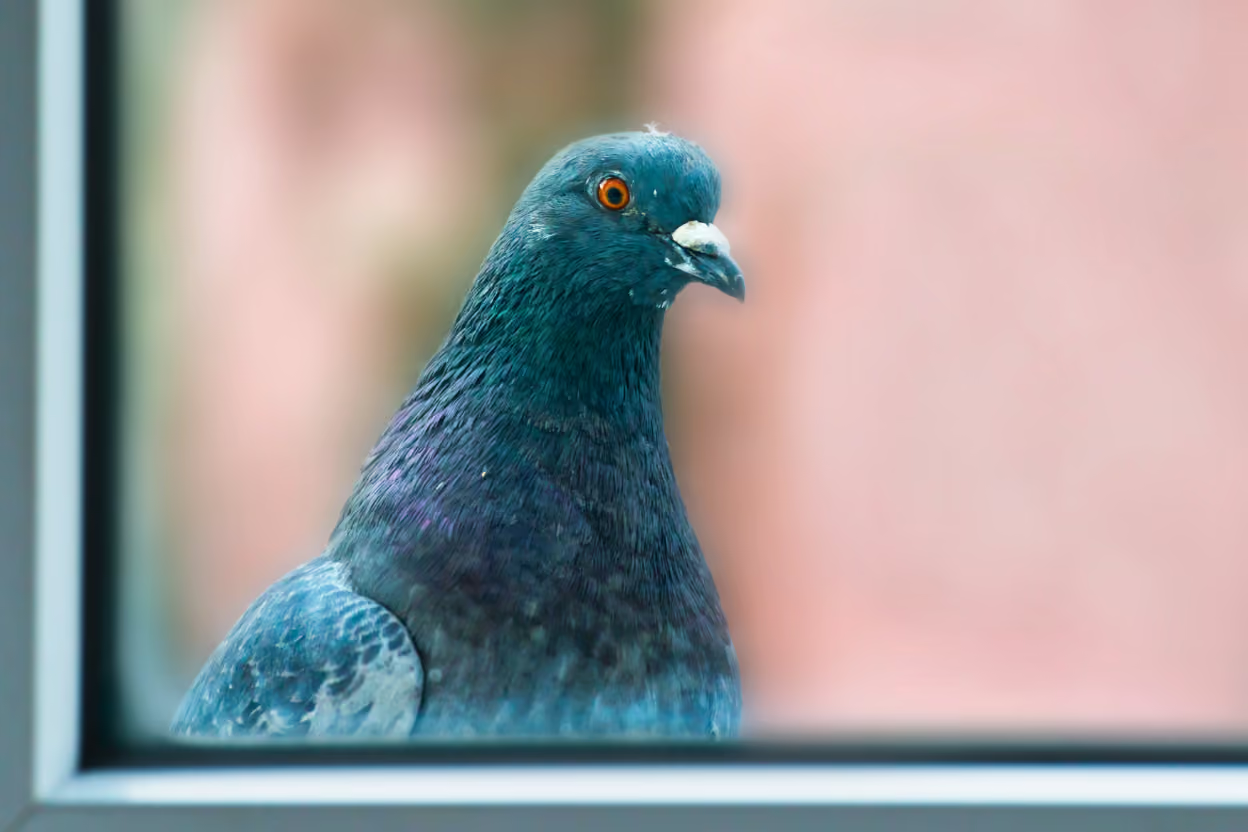
Every spring it starts the same way. Just after dawn, a soft, insistent thud against the glass, then another, then a flurry of them. You pull the curtain and there is an American Robin (Turdus migratorius) on the sill, hurling itself at the window, pecking and fluttering at the pane as if its life depended on driving something off. It will be back tomorrow, and the day after, and it may keep at the same window for weeks. The first time it happens it is baffling, and a little distressing, because the bird seems to be hurting itself for no reason at all.
There is a reason, and once you know it the behavior makes complete sense. The bird is not attacking your house. It is attacking its own reflection, which it has mistaken for a rival on its territory, and it cannot understand why the intruder will not back down. It is one of the most common and most misunderstood bird behaviors people bring to us, so here is what is actually happening, which birds do it, and how to bring it to a humane end.
As an Amazon Associate we earn from qualifying purchases. A couple of the fixes below are products we are comfortable recommending, and using these links supports the site at no extra cost to you.
Why a bird attacks its reflection
The cause is territory. In the breeding season, most birds defend a patch of ground that holds their nest, their mate, and their food, and a male in particular will drive off any rival of his own species that trespasses. The trouble is that a window, especially in bright light against a darker interior, works like a mirror, and the bird sees a perfect copy of itself looking back. It cannot tell that the rival is a reflection. So it does what instinct demands and attacks, and because the reflection attacks back in perfect synchrony and never retreats, the bird cannot win and cannot stop. Some individuals become genuinely obsessed, returning to the same pane day after day for weeks.
This is the same territorial drive that makes a woodpecker drum on a resonant surface to announce itself, which we explain in why do woodpeckers peck. The difference is only the target. One bird is shouting at rivals it cannot see; the other is fighting one it can see all too well. Both peak in spring, for the same hormonal reason, and both tend to ease once the bird has paired up and settled into nesting.
Which birds do it
A handful of species are the usual culprits, and they tend to be the bold, conspicuous birds that nest in suburban yards and defend territory vigorously. The Northern Cardinal (Cardinalis cardinalis) is perhaps the most famous, the male's bright red making the phantom rival especially provoking, and cardinals will attack house windows and car mirrors alike. The American Robin and the Northern Mockingbird (Mimus polyglottos) are close behind, both pugnacious defenders of a nesting patch. Bluebirds, sparrows, and other songbirds do it too. Even woodpeckers will batter a window at their own reflection, which is the version that brings homeowners to our piece on why woodpeckers peck on houses. If you want to put a name to your particular window warrior, our guide to the backyard woodpeckers of North America can help with the woodpeckers at least.
Pecking is not the same as a collision
Before going further it is worth drawing a line that most articles miss, because it matters enormously for the birds. A bird repeatedly pecking or fluttering at a window it is perched in front of is fighting its reflection, and while it can tire or bruise itself, it usually survives the experience. A bird flying full speed into a window is a completely different and far more serious problem. Those collisions happen because the glass reflects open sky and trees, or because the bird can see straight through to habitat on the other side, and it never perceives the glass at all. Window collisions kill hundreds of millions of birds every year in North America, and they are one of the largest human-made threats to bird life. It is a big enough subject that we are giving it its own dedicated treatment, so here we will stay with the territorial pecking. The encouraging part is that the main fix for the annoying problem is also the main fix for the deadly one, so solving the first helps prevent the second.
How to stop it: take away the reflection
Every effective solution comes down to one idea. The bird is reacting to a reflection, so if you remove or break up that reflection on the outside of the glass, the rival vanishes and the behavior loses its trigger. The crucial detail, which people get wrong constantly, is that the treatment has to be on the outside of the window. Anything applied to the inside still leaves a clean reflective surface facing the bird. The US Geological Survey and bird-collision groups both stress the same point: the goal is to make the glass visibly not a mirror.
The cleanest long-term fix is to break up the reflection across the whole pane. Window film applied to the outside dulls the mirror effect while still letting you see out, and because it covers the whole surface it solves the problem at its source rather than chasing the bird from spot to spot. Patterned films and closely spaced decals work the same way, as long as the markings are no more than a couple of inches apart so the bird reads the glass as a solid object. As a bonus, the same treatment is exactly what reduces deadly window collisions, so it does double duty.
For a faster, cheaper deterrent, hang reflective scare tape in strips on the outside of the affected window. The movement and flashing both break up the reflection and unsettle the bird, the same trick that works against woodpeckers. Beyond products, a few free measures help: hang a sheet, screen, or piece of shade cloth over the outside of the glass until the bird loses interest, remove the branch or railing it launches from, and move feeders and nest boxes either right against the house or well away from it so birds are not drawn into territorial range of the glass. If the target is a car mirror, simply bag or cover the mirror while the car is parked.
Be patient, and be kind
It helps to remember that the bird is not being malicious or stupid. It is a hormone-driven animal doing exactly what millions of years of instinct tell it to do, confronted with a perfectly modern problem we invented: a sheet of glass that throws its own image back at it. Territorial attacks almost always fade as the breeding season winds down and the bird turns its attention to feeding young, so even doing nothing usually ends the behavior within a few weeks. And whatever you do, it must be non-lethal, since virtually all of these birds are protected by law in both the United States and Canada. Break up the reflection, wait out the season, and the rival at the window simply disappears, for both of you.
FAQ
Almost always because it has seen its own reflection in the glass and mistaken it for a rival bird intruding on its territory. This happens most in the breeding season, when birds are defending a nest and a mate, and a window in bright light acts like a mirror. The bird attacks the reflection to drive the intruder off, but of course the reflection never leaves, so the pecking continues. It is territorial behavior, not an attempt to get into your house.
Because it cannot win and does not understand why. The reflection mirrors the bird's every move and never retreats, so the bird keeps trying to drive off a rival that will not leave. Some individuals become genuinely fixated and return to the same pane day after day for weeks. The window is simply the most convincing reflection in its territory, much as a metal gutter is the loudest drum for a woodpecker.
Usually not seriously. A bird pecking and fluttering at its reflection can tire or bruise itself, and the behavior is stressful, but birds doing this from a perch generally survive it. This is very different from a bird flying at full speed into glass and colliding with it, which often injures or kills the bird. If your bird is hovering or perching and tapping at the window, it is the territorial kind, which is far less dangerous than a true collision.
Break up or remove the reflection on the outside of the glass, since that is what the bird is reacting to. Treatments applied inside the window do not work, because the outer surface still reflects. The most thorough fix is window film or closely spaced decals on the outside, which dull the mirror effect across the whole pane. Reflective scare tape, an external screen or cover, and moving feeders away from the window all help too. Anything that stops the glass looking like a mirror will end the attacks.
They are two different problems. A bird pecking at a window is fighting its own reflection from a perch, a territorial behavior that is annoying but rarely fatal. A bird flying into a window at speed is a collision, caused by the bird not seeing the glass at all, and these strikes kill hundreds of millions of birds a year. The good news is that the main fix, making the glass visibly not a mirror, helps prevent both.
Usually, yes. Territorial window attacks are tied to the breeding season, so they typically fade on their own as birds pair up and shift their energy to raising young, often within a few weeks. If the behavior is constant or the bird seems to be exhausting itself, breaking up the reflection on the outside of the glass will end it sooner. Since the birds are protected by law, any help you give has to be non-lethal.