
Why Do Woodpeckers Peck? The Four Reasons Behind the Sound
The calm, complete answer to why woodpeckers peck. The four reasons behind every bout, the surprising science of the skull, and how to tell which one you are hearing.
The first woodpecker sound most of us learn to recognize is not a call. It is a drum, that fast hollow roll on a dead branch at the edge of the woods. For a long time we heard it the way most people do, as a bird hammering for food. Then one spring we started paying attention to the rhythm, and the whole soundscape changed. A Downy taps out a short, soft roll. A Hairy fires off a burst so fast it buzzes. A Northern Flicker runs on and on, almost a song. And a Pileated lands a deep, resonant roll that speeds up and fades at the end, trailing off like a question. Once we could tell the species apart by their drumming alone, it was obvious that this was not feeding at all. It was conversation. Woodpeckers do not sing, so they drum, and the drum is a big part of how they hold territory and find a mate.
That is one of four reasons a woodpecker pecks, and the reasons are worth separating cleanly, because the whole family's behavior, from the bird foraging quietly on a trunk to the one hammering your gutter at dawn, comes down to telling them apart. This is the calm version of the answer. Every surface-specific question, why a bird chooses your house or your chimney or a metal sign, gets a short answer and a link to the post that handles it in full. Here we deal with the why itself.
Foraging for insects under the bark
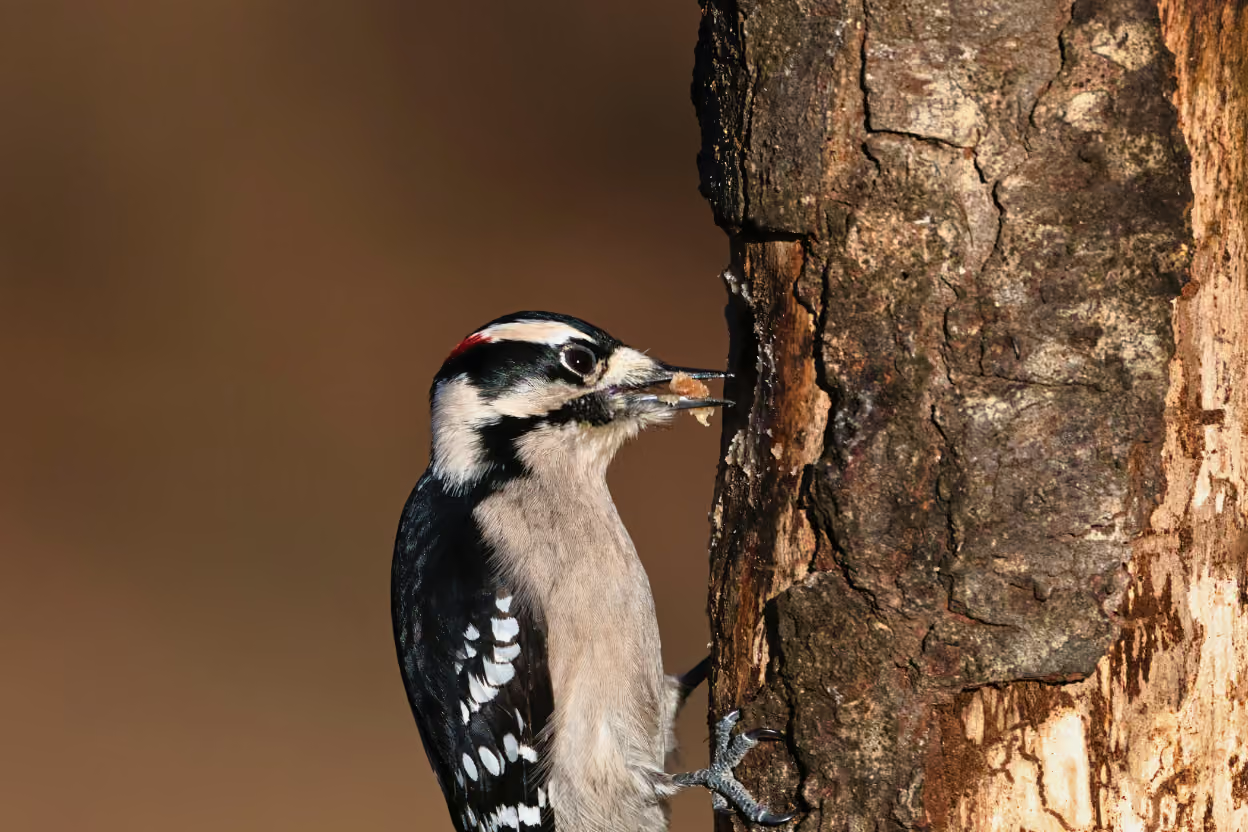
The most common reason is food. Woodpeckers are built to find and extract insects that live where few other birds can reach them, in and under the bark of trees. A bird works a trunk in short, exploratory taps, listening and feeling for the hollow signature of a tunnel, then chisels in and uses its extraordinary tongue, which wraps around the inside of the skull when retracted, to spear or lap up the larvae inside. This is why a woodpecker on your siding is so often a message about the wood rather than the bird. Where there are wood-boring beetles, carpenter ants, or termites, a woodpecker will find them. The pecking is a symptom, and the insects are the cause.
Not every woodpecker is hunting insects, though. The sapsuckers feed on sap, and the Yellow-bellied Sapsucker (Sphyrapicus varius) does it with real method. It drills neat horizontal rows of shallow holes called sap wells, then makes the rounds to harvest the sap that flows out along with the insects it traps, tending and defending the wells like a small managed larder. Other animals cash in on the work, and migrating hummingbirds in particular often depend on the sapsucker's wells for an early-season meal before the first flowers open. It is still foraging, just of a quieter, more agricultural kind than chiseling for grubs.
Drumming to communicate
The second reason is the one that surprises people, because it has nothing to do with food. Woodpeckers do not have a true song, so they communicate by drumming, striking a resonant surface in a rapid roll to advertise territory and attract a mate. It serves exactly the function that song serves for a robin or a thrush. Because the point is to be heard, a drumming woodpecker chooses the loudest, most resonant object it can find, which is why a dead hollow limb, a metal gutter, and a chimney cap are all fair game. It also explains the timing. Drumming rises sharply in spring, roughly March through June, and it is loudest at dawn when the air is still and sound carries farthest. A bird that returns to the same metal flashing every morning is not stuck on a bad idea. It has found the best loudspeaker in its territory. We follow that behavior onto human structures in why woodpeckers peck on metal.
Excavating a nest or roost cavity
The third reason is shelter. Woodpeckers are cavity nesters, and unlike the chickadees and bluebirds that depend on finding a ready-made hole, a woodpecker excavates its own, usually in dead or dying wood that is soft enough to work. A nest hole is a serious project, a large round entrance leading to a gourd-shaped chamber, and it is the reason woodpeckers matter so much to the wider forest. When they move on, those cavities become homes for nuthatches, wrens, swallows, bluebirds, and small owls that cannot dig their own. That single habit makes woodpeckers a keystone group, birds whose presence quietly supports a long list of others. On a house, the same instinct turned toward a soft fascia board or a wall cavity is what produces the large, clean holes a homeowner dreads. We sort feeding holes from nest holes in why woodpeckers peck on houses.
The bonus reason: storing food
The fourth belongs to a smaller cast, but it is too good to leave out. Some woodpeckers peck to store food rather than to find it. The Acorn Woodpecker is the famous example, a bird that drills a dead trunk, pole, or wall full of thousands of small holes and wedges a single acorn into each one, building a communal granary it defends and refills for years. It is the same toolkit, the bill and the drilling, aimed at a completely different goal. Because that behavior collides most often with wooden utility poles, we tell the full granary story in why woodpeckers peck on telephone poles.
How a woodpecker pecks without hurting itself
A woodpecker hammers its head into solid wood around 12,000 times a day, at up to 20 strikes a second, with decelerations that would concuss a person many times over. For decades the textbook explanation was that the skull works as a built-in shock absorber, a tiny crash helmet, and that idea even inspired engineers designing protective gear. A 2022 study in Current Biology took high-speed video of pecking woodpeckers, including the Pileated, and overturned it. The head does not cushion the blow at all. It behaves like a stiff hammer, because any give in the skull would soften the strike and waste the bird's effort, which is the opposite of what a woodpecker needs.
So why is the brain fine? Mostly because it is small. A woodpecker's brain is so light, and packed so snugly and oriented so well within the skull, that even a violent-looking impact stays well below the pressure that injures a much larger human brain. The bird is not protected by absorbing the shock. It is protected by being small enough not to need to. Other features help around the edges, a reinforced bill, strong neck and trunk muscles driving the blow, and a third eyelid that holds the eye in place, but the headline is simpler and stranger than the old story. Woodpeckers hammer unprotected, and physics lets them get away with it.
How to tell which reason you are hearing
Once you know the four reasons, you can usually work out which one a particular bird is acting on, and you rarely need to see it to do so. Three clues do most of the work: the sound, the timing, and the mark left behind.
The sound. A steady, rhythmic roll is drumming, which means communication, not damage. Irregular, businesslike tapping and chiseling, with pauses while the bird listens and probes, is feeding. A slow, heavy, repeated excavation in one spot over days is cavity work. The drum itself often gives away the species. A Downy Woodpecker (Dryobates pubescens) taps a short, soft roll of about 12 to 17 beats in under a second. A Hairy Woodpecker (Dryobates villosus) fires roughly 26 beats in one emphatic second, so fast it buzzes. A Northern Flicker (Colaptes auratus) drums longer, nearly two seconds, often answered by its own yammering call. And the Pileated Woodpecker (Dryocopus pileatus) lands a deep, resonant roll that speeds up and softens at the end, trailing off in a way that, once you have heard it, you will always recognize. Cornell's guide to drumming is the best place to train your ear with recordings.
The timing. Spring is the giveaway for drumming. From roughly March through June, and most intensely in the still air at dawn, a burst of loud, rhythmic pecking is almost always territorial. Feeding and excavation, by contrast, happen year round and at any time of day. If the racket arrived with the warm weather and peaks at first light, you are listening to a courtship advertisement, however much it sounds like an assault on your house.
The mark. If the bird leaves something behind, the shape tells the rest. Shallow, scattered, irregular holes are feeding. A single large round hole is a nest cavity. Neat rows of small, evenly spaced holes are a sapsucker's sap wells. And deep rectangular cavities cut into a trunk are the unmistakable signature of a Pileated digging for carpenter ants. On a metal gutter or a chimney cap there is usually no mark at all, which is itself the clue that the bird is drumming rather than feeding or nesting.
So what is your woodpecker doing?
Put the three clues together and the bird usually explains itself. A loud spring roll at dawn on something metal is a male advertising for a mate. Quiet, irregular tapping on your siding through the year is a bird telling you there are insects in the wood. A large hole appearing over a few days is someone moving in. Each of those leads somewhere specific, and we have a post for each surface the question tends to arrive on, whether that is houses, chimneys, metal, or telephone poles. If you have reached the point of wanting the noise to stop, how to stop woodpeckers pecking on your chimney walks through the deterrents that actually work. And if you would rather know who you are listening to, our guide to the backyard woodpeckers of North America puts a name and a face to each drummer.
None of it is random, and almost none of it is the bird being difficult. A woodpecker pecks to eat, to talk, to nest, and sometimes to stock the pantry, and every bout you hear is one of those four things. Learning to read which is the difference between an annoyance and one of the most quietly remarkable performances in your own backyard.
FAQ
No. A woodpecker hammers up to 20 times a second, around 12,000 times a day, yet it does not concuss itself. A 2022 study showed the skull is not a shock absorber, as was long believed, but a stiff hammer. The brain stays safe mainly because it is small, light, and tightly packed within the skull, which keeps the pressure of each impact well below the level that injures a much larger human brain.
Early-morning pecking is almost always drumming, the rapid roll a woodpecker uses to claim territory and attract a mate. Dawn air is still, so the sound carries farther, and the bird often chooses the most resonant surface it can find to be heard. If a woodpecker is hammering at first light in spring, it is advertising, not feeding.
Drumming peaks in spring, roughly March through June, when woodpeckers are establishing territories and courting. Feeding and excavation continue year round, but the loud, rhythmic drumming that draws the most attention is a seasonal, breeding-season behavior. This is why complaints about woodpecker noise spike in the spring.
Pecking is the general act of striking wood, which a woodpecker does to find food and to excavate cavities. Drumming is a specific, rapid, rhythmic roll used purely for communication, the woodpecker equivalent of song. Drumming is steady and musical in its regularity, while feeding is irregular and exploratory. The easiest tell is rhythm: an even roll is communication, broken tapping is feeding.
A woodpecker pecks roughly 12,000 times a day, striking at up to 20 times a second during a burst. Because so much of its feeding, nesting, and communicating depends on hammering, a woodpecker is essentially pecking whenever it is not resting or sleeping.
Usually not. A healthy tree easily survives a woodpecker's foraging, and the bird is often doing it a favor by removing the wood-boring insects it came for. Woodpeckers also excavate nest cavities that later shelter many other birds and small mammals, which makes them a keystone part of the forest. Heavy pecking is more often a sign that a tree is already insect-ridden or dying than a cause of its decline.