
How to Identify a Vagrant or Range-Expanding Bird
A Roseate Spoonbill hands you the ID; a dark ibis out of range does not. Here is how to tell when a bird is truly out of place, and how to build a case that holds up.
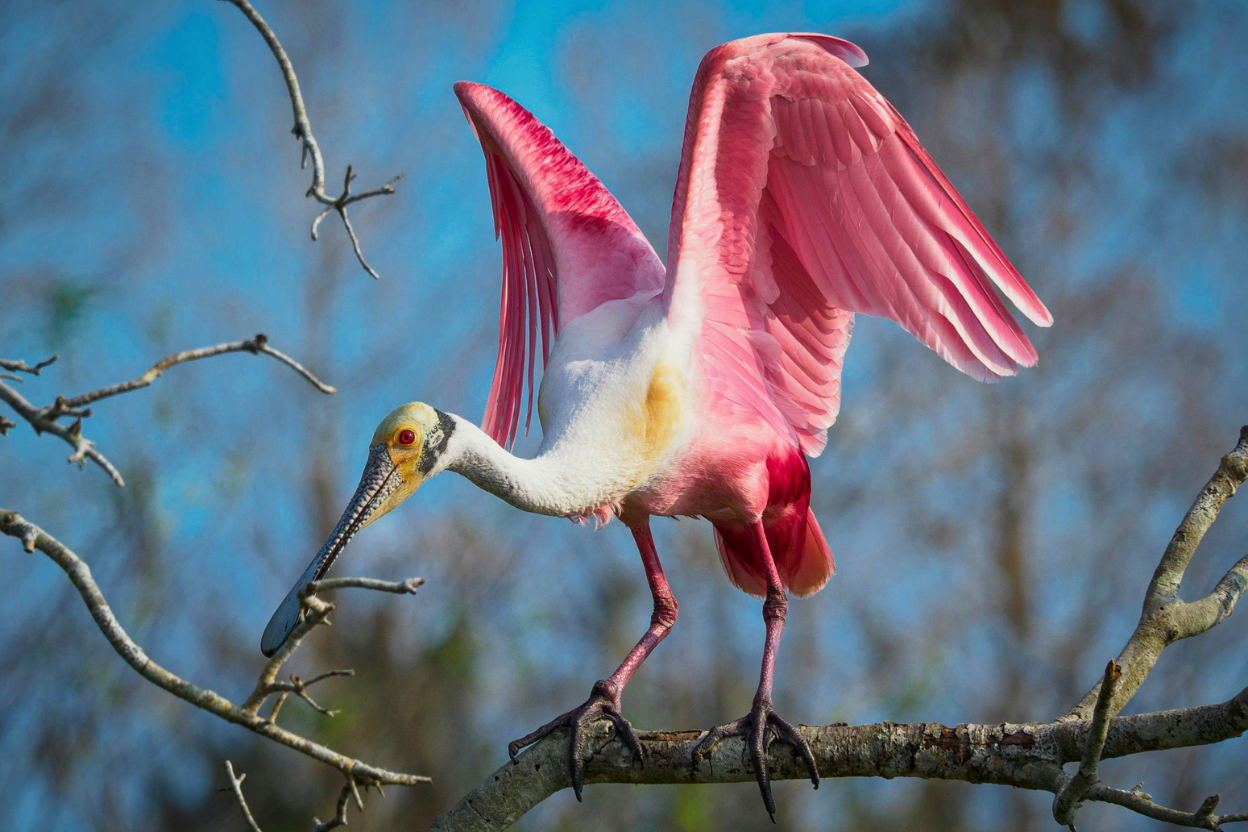
We were driving past a salt marsh in Canada, not birding so much as glancing, when a big pale pink bird with an impossible bill stood up out of the reeds. The first reaction was not a name but a question. What is that? A second later it resolved: a Roseate Spoonbill (Platalea ajaja), a bird of the Gulf coast and the Neotropics, wading a marsh well over a thousand kilometers north of where the field guide says it should be. We were not looking for it. That is usually how it goes.
The spoonbill is the easy kind of rarity. There is nothing in a Canadian marsh you could mistake it for. A pink bird with a spatulate bill is the only one of its kind in the hemisphere, so the identification hands itself to you. Most out-of-range birds are not so generous. The Glossy Ibis feeding two ponds over could just as easily be a White-faced Ibis, and telling a genuine rarity from a common look-alike wearing bad light is the real skill. This post is about that skill: how to recognize when a bird is truly out of place, and how to build an identification that holds up. If you want the why behind these birds turning up at all, that lives in Bird Vagrancy and Range Expansion Explained.
Start from what belongs
The first tool is not a field mark, it is an expectation. Every place and every season has a predictable cast of birds, and the fastest way to notice a rarity is to know that cast cold. When you are fluent in the common species of your patch, the odd one out announces itself, the way a wrong note stands out only to someone who knows the tune. A bird that does not fit the expected set for your location and date is a candidate, and arrival timing at the edge of a species' range is often the very first clue, before you have resolved a single feather. Range maps and eBird's flags for unusual species and dates are there to sharpen that expectation, not replace it.
Assume common first, then prove yourself wrong
Here is the discipline that separates reliable records from wishful ones. When a bird looks off, the right instinct is not to reach for the rarity, it is to assume the common look-alike and then try hard to rule it out. Most birds that look strange at first are common species distorted by distance, harsh light, feather wear, molt, or an unfamiliar juvenile plumage. If you start by asking why the bird in front of you is not the expected species, and you cannot find a solid reason, it almost always is the expected species. Only when the common candidate genuinely fails does the case for something rarer become trustworthy.
This is also, not coincidentally, the reasoning eBird reviewers reward. A report that leans on having seen the species many times elsewhere is weak, because it suggests the bird was assumed rather than examined. A report that explains which look-alike was considered and how it was ruled out is the one that gets accepted. We keep the reporting side light here, because the full workflow lives in How to Document and Report Vagrant Birds.
Read structure before color
When you do work an identification, take the features in the order that resists deception. Structure comes first: overall size and shape, the proportions of bill, neck, and legs, the way the bird carries itself. Behavior comes next, how it feeds, flies, and holds its posture. Habitat and timing frame both. Plumage color, the thing beginners reach for, comes last, because color is the feature most easily bent by light and wear. A dark ibis at distance is the case in point. The eBird archives are full of out-of-range Glossy Ibis reports that describe a dark, glossy, curve-billed wader with pale facial lines, a description that fits White-faced Ibis just as well. Structure and the fine detail of the face, not the general impression of a dark ibis, are what separate them.
Work the cluster's own hard cases
The three Old World colonizers in this cluster each pose the problem a little differently. Glossy Ibis is the classic look-alike trap, nearly identical to White-faced Ibis across much of the continent, which is why every out-of-range dark ibis deserves a careful look and, ideally, a photo of the face and eye. The exact marks are laid out in Glossy Ibis vs White-faced Ibis, and the species' own story is in Glossy Ibis Range Expansion in North America.
Little Egret is the needle in a very white haystack, a bird that hides among Snowy Egrets and is picked out on structure and bare-part detail rather than color. The separating marks are in Little Egret vs Snowy Egret, and its transatlantic story is in Little Egret in North America. Western Cattle-Egret is the opposite problem, distinctive enough to name easily but easy to overlook as just another egret at a distance, especially now that it is a scarcer sight in the Northeast than it was decades ago. Its rise and retreat are told in Cattle Egret in North America.
Mind the conditions you are looking through
One honest caution before you call anything. The conditions of an observation quietly shape what you think you saw. Flat gray light drains color, strong backlight turns a pale bird dark, distance flattens structure, and a phone photo through heat haze can invent or erase a mark. A good identification accounts for how it was made, not just what was seen. When the view is poor, the honest move is to hold the record loosely, note the uncertainty, and lean harder on the structural clues that survive bad light. We go deeper on documenting an observation, warts and all, in How to Document and Report Vagrant Birds, and on tracking rarities down in the first place in How to Find Rare Birds.
The payoff
Most days the disciplined answer is that your odd bird was a common one in bad light, and that is a good outcome, because it means the day you do find a real rarity, your record will be one people trust. And every so often the bird simply stands up out of the reeds, pink and spoon-billed and beyond argument, and hands you the identification for free. Learn the common birds well enough and you will be ready for both.
FAQ
Start from what belongs. Every location and season has a predictable set of species, and a bird that does not fit that set is worth a second look. Range maps in a field guide or app show the expected edge, and tools like eBird flag species that are unusual for your area and date. A bird can be locally rare in two ways, either genuinely out of its range or simply scarce where it normally occurs. The out-of-range birds are the vagrants and range-expanders, and timing at the edge of the map is often the first clue.
Assume it is the common look-alike, then try to prove yourself wrong. Most birds that look odd at first are common species affected by light, distance, wear, or molt, so the disciplined move is to build the case that rules the expected species out rather than leaping to the rarity. Note structure and behavior while the bird is still in view, and get a photo if you possibly can. If you cannot find a solid reason it is not the common bird, it probably is.
Not strictly, but it helps enormously, and for a genuine rarity it is close to expected now. A clear photo, even a poor one, lets reviewers and records committees confirm what you saw. When a photo is not possible, careful field notes still carry weight, especially a description of the structural and behavioral marks and an explanation of how you ruled out the similar species. The full reporting workflow is covered in our guide to documenting and reporting vagrants.
Because the odds say so. For every genuine rarity you will see thousands of common birds, and confirmation bias makes it easy to turn a worn or oddly lit common bird into the rare one you were hoping for. Assuming the common species first, then looking for concrete reasons it cannot be that species, is what turns a hopeful guess into a credible record. It is also the reasoning eBird reviewers look for when they assess a report.
Structure first, then behavior, then timing. Overall size and shape, bill and leg proportions, and the way a bird moves are harder to fake than plumage color, which shifts with light and wear. A candidate usually shows a structural or behavioral mismatch with the common local look-alike, seen at a time or place near the edge of its known range. The exact marks that separate confusion pairs, such as Glossy from White-faced Ibis or Little from Snowy Egret, live in our dedicated pair guides.