
Glossy Ibis vs White-faced Ibis: A Field Identification Guide
Two nearly identical dark ibis, one expanding east, one wandering from the west. The whole identification lives in the face, and this is how to read it, honestly.
A flock of dark ibis drops into a flooded field, thirty or forty birds heads-down in the shallows, all of them the same chestnut and green at a glance. In the east these are Glossy Ibis, every one, until the day one of them is not. So we do what you learn to do with a flock like this. We start working the faces, one bird at a time, looking for a red eye in a sea of dark ones. With these two species, the whole identification lives in the face.
Why these two get confused
Glossy Ibis (Plegadis falcinellus) and White-faced Ibis (Plegadis chihi) are close to identical at any distance. Both are football-shaped dark waders with long down-curved bills and the same iridescent chestnut, green, and bronze that reads as plain black in poor light. Historically the two barely met, because White-faced Ibis is the western bird, mostly west of the Mississippi, and Glossy Ibis the eastern one. But as Glossy pushes north and inland and White-faced wanders east, the two increasingly turn up in the same marsh, and telling them apart has become a skill birders on both sides of the continent now need. The reason behind that widening overlap is the story we tell in Bird Vagrancy and Range Expansion Explained. This post is only about separating the two birds once they are in front of you.
The face tells the truth
On a breeding adult in decent light, three things settle it, and all of them sit on the head and legs.
Start with the eye. Glossy Ibis has a dark eye. White-faced Ibis has a red one. That single mark is the most reliable feature the two offer, and it is the one to reach for first.
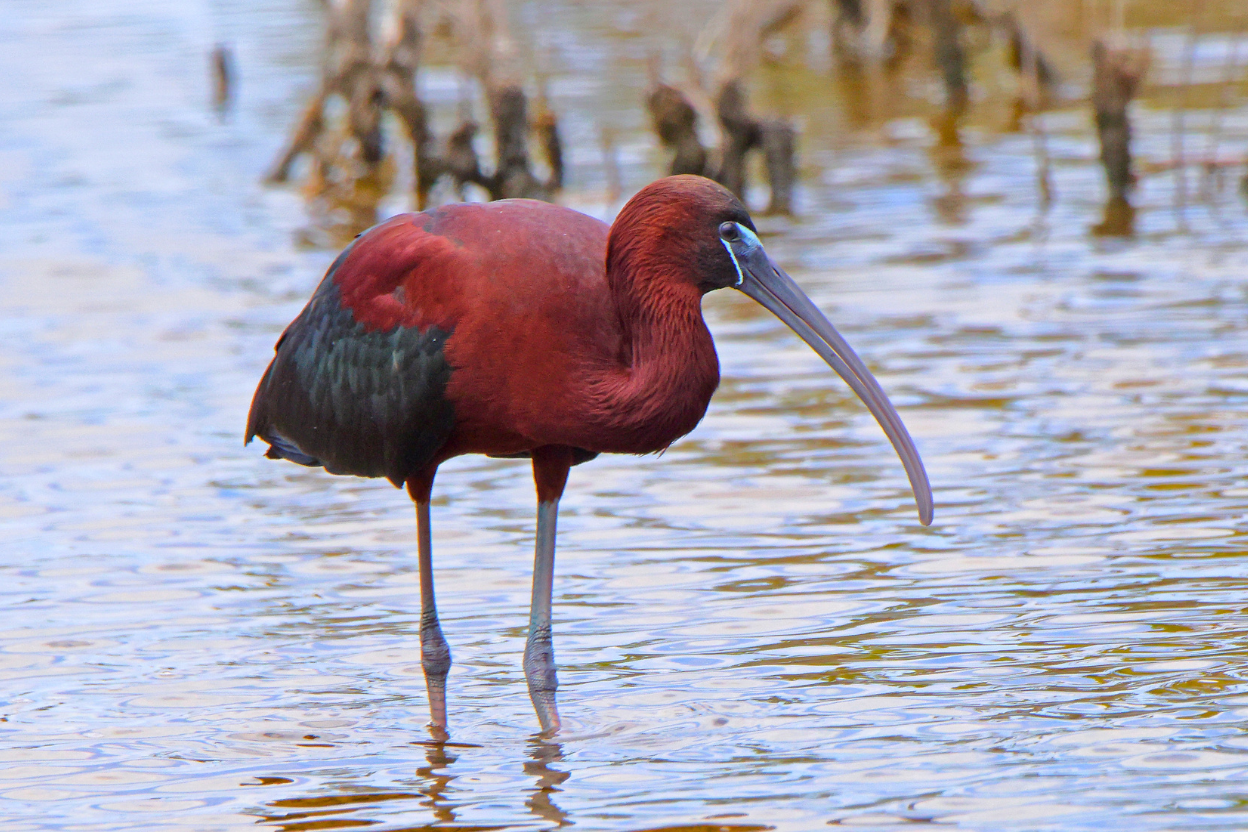
Then read the facial skin and its border, which is where the names come from. A breeding White-faced Ibis has a patch of bright pink bare skin on the face, ringed by a band of white feathers that goes all the way around the eye. A breeding Glossy Ibis has no white feathering at all. Instead its dark gray facial skin is edged by two thin lines of pale, almost electric blue bare skin that run from the bill toward the eye but do not meet behind it. White feathers encircling the eye means White-faced. Pale blue lines that stop short means Glossy.
Finally, check the legs. Breeding White-faced Ibis shows reddish-pink legs. Glossy Ibis legs stay a duller grayish-brown, sometimes with a reddish cast but never the clean red of a White-faced. Legs are a supporting mark rather than a clincher, but in a scope they help.
When the marks fade, say so
Here is the part most guides rush past, and it is the most important one. Everything above applies to a breeding adult in good light. Outside of that, the two birds slide toward each other fast. In nonbreeding plumage the White-faced loses its white facial border and the pink skin dulls to a muddy red, so the white face that names it is simply gone. Juveniles of both species are browner and plainer, and the guides are blunt about it: young Glossy and young White-faced often cannot be separated at all unless you are close.
The one thread that holds is the eye. A White-faced keeps its red eye through the year, and a Glossy stays dark-eyed in every plumage, so eye color is the fallback when everything else has washed out. But eyes are small and dark and easily fooled by distance, flat light, and the color shift of a phone photo, and plenty of careful birders have stared at the same bird and disagreed. When you cannot see the eye well and the face gives you nothing, the correct entry is not a guess. It is Plegadis species, unresolved. Leaving a bird unidentified is not a failure. It is what keeps the birds you do call worth trusting, which is the whole argument of How to Identify a Vagrant or Range-Expanding Bird.
The hybrids nobody wants to find
There is one more wrinkle. Where the ranges overlap, Glossy and White-faced Ibis interbreed, and the hybrids wear a confusing mix of both sets of marks, a little pink in the facial border, a little red in the eye, legs that split the difference. If a bird seems to be arguing with itself, showing you one species on the face and another on the legs, a hybrid is a real possibility, and forcing it into one column does more harm than leaving it open.
Why a dark ibis is worth a second look now
The two species have long overlapped on the western Gulf Coast, where each strays into the other's range. What is new is the scale of it. Glossy Ibis has expanded up the Atlantic coast and inland, and White-faced strays have reached the Atlantic more and more often in recent decades, so a red-eyed ibis in the east, or a blue-lined one in the west, is exactly the kind of out-of-place bird this cluster is about. When you find one, that is the moment to slow down, photograph the face, and treat it as a candidate worth documenting. The full arc of Glossy's move across the continent is in Glossy Ibis Range Expansion in North America.
So the next time a flock of dark ibis goes heads-down in a field, work the faces. Most will be the expected bird. But the eye that flashes red where it should not, or the face that shows blue where you expected white, is the one that makes the whole scan worth it.
FAQ
Look at the eye first. A Glossy Ibis has a dark eye, while a White-faced Ibis has a red one, and that single mark is the most reliable difference the two offer. On a breeding adult you can confirm it with the face: white feathers ringing the eye and pink facial skin mean White-faced, while thin pale blue lines that stop short of the eye mean Glossy.
Often not with confidence. In nonbreeding plumage the White-faced Ibis loses its white facial border and the pink skin dulls, so the two look nearly identical. The one mark that holds is eye color, red on White-faced and dark on Glossy, but eyes are hard to judge at distance or in flat light. When you cannot see it clearly, the honest call is to leave the bird as an unidentified Plegadis.
Yes. Where their ranges overlap, Glossy and White-faced Ibis interbreed, and the hybrids show a mix of both species' marks, such as some pink in the facial border together with a partly dark eye, or intermediate leg color. A bird that seems to show one species on the face and the other on the legs may be a hybrid, and it is better left unresolved than forced into one species.
The classic overlap is the western Gulf Coast, where the eastern Glossy Ibis and the western White-faced Ibis have long met and each strays into the other's range. That contact zone is widening. Glossy Ibis has expanded north and inland, and White-faced Ibis increasingly wanders east to the Atlantic, so the two now turn up together far more often than they once did.
Usually only at close range. Juvenile Glossy and White-faced Ibis are both plain brown and lack the facial marks that separate breeding adults, so they often cannot be told apart from a distance. Eye color remains the most reliable clue, dark on Glossy and red on White-faced, but when it cannot be seen well the safest record is Plegadis species.