
Winter Survival Adaptations for North American Birds
Learn how birds survive winter in North America: torpor, feather insulation, food caching, communal roosting, and winter finch irruptions explained.
Winter in northern North America is a test of biological engineering. Temperatures plummet, food sources contract or disappear entirely, and the energetic cost of staying warm rises steeply. Yet dozens of bird species not only survive these conditions but thrive in them, from the Black-capped Chickadee singing on a minus-twenty morning to the Snowy Owl coursing over a frozen Quebec field. The secret lies in a set of physiological and behavioral adaptations that represent some of the most impressive solutions in the animal kingdom. Understanding birds winter survival strategies transforms a cold January walk into a field study in resilience.
This guide covers the major physiological changes, behavioral tactics, and population-level responses that allow North American birds to endure winter, with a focus on species you are likely to encounter across eastern Canada and the northern United States.
Physiological Changes for Winter Survival
The bodies of birds that overwinter in cold climates undergo measurable changes in the weeks leading up to and during winter. These are not merely passive responses to cold: they are active, hormonally regulated programs that prepare birds for the season ahead.
Feather condition is the first line of defense. Birds complete a pre-basic molt in late summer and early fall, replacing worn plumage with fresh feathers just before the cold season. Winter plumage in many species is denser than summer plumage, with more down feathers and longer contour feathers that trap a larger layer of insulating air. The familiar sight of a puffed-up chickadee on a cold morning reflects an active thermoregulatory behavior: the bird is compressing and releasing its feathers to regulate the depth of the insulating layer around its body.
Torpor: Controlled Hypothermia
Some bird species use a form of controlled hypothermia called torpor to dramatically reduce energy expenditure overnight. In torpor, a bird's core body temperature drops by as much as 10 degrees Celsius from its normal daytime level, and metabolic rate falls correspondingly. Heart rate and breathing slow, reducing caloric burn during the dangerous, food-free hours of darkness.
Common Poorwills of western North America are the only bird species known to enter true extended torpor lasting days to weeks, comparable to mammalian hibernation. But many other species, including hummingbirds and swifts, use nightly torpor regularly during cold periods. Black-capped Chickadees enter a mild version of nightly hypothermia, dropping body temperature several degrees each night and warming back to normal before dawn activity resumes. Research has shown that chickadees using nightly hypothermia survive cold snaps at higher rates than those maintaining constant body temperature overnight.
Behavioral Tactics for Surviving Cold
Physiology alone is not enough. Birds combine internal adaptations with a suite of learned and instinctive behaviors that reduce heat loss, secure food, and minimize exposure to the worst conditions.
Food Caching and Memory
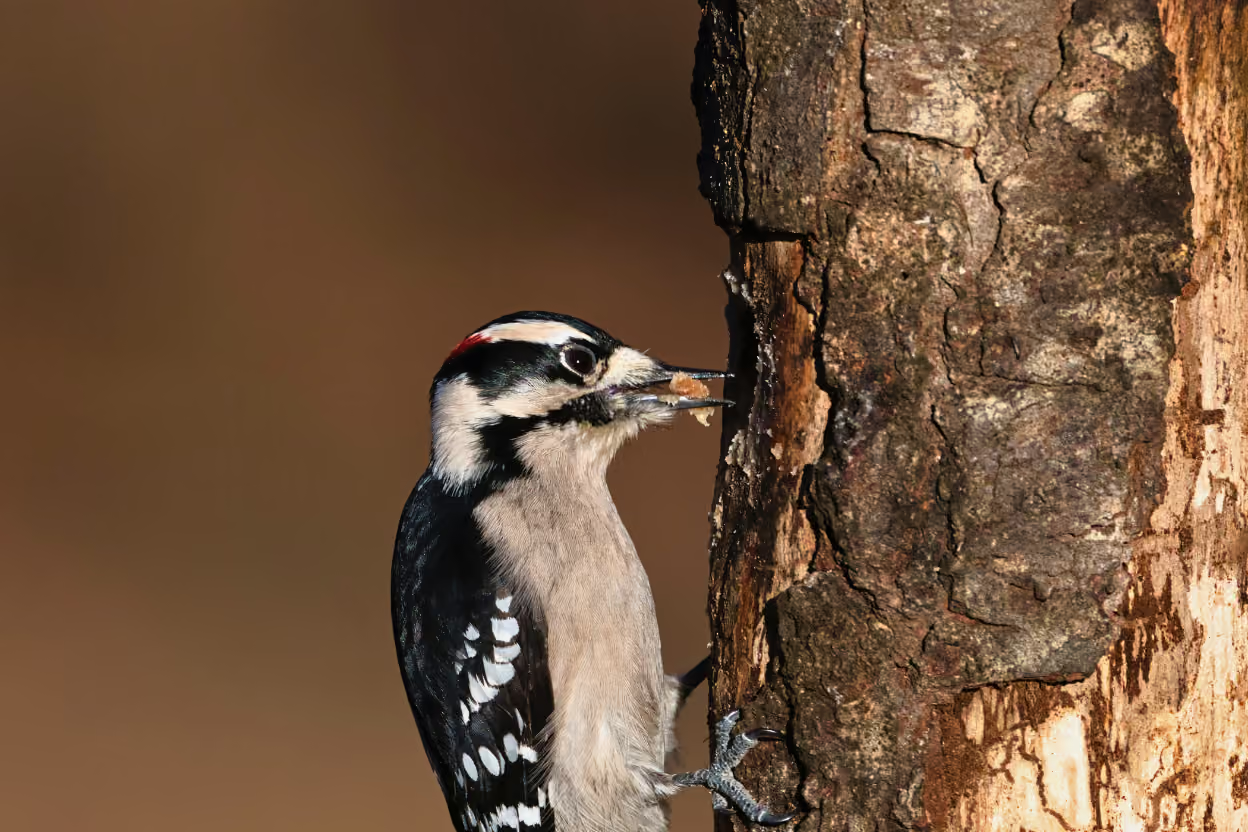
Several North American species cache food during periods of abundance and retrieve it weeks or months later. Black-capped Chickadees, Red-breasted Nuthatches, and various woodpecker species all practice food caching with impressive spatial memory. A single Black-capped Chickadee may cache thousands of individual food items in hundreds of different locations across its territory each autumn. The hippocampus, the brain region associated with spatial memory, is measurably larger in caching species than in non-caching relatives, and it expands seasonally in chickadees during the fall caching period.
Gray Jays, known as Whiskey Jacks across much of Canada including Quebec, are especially dramatic cachers. They begin storing food in late summer and rely on these caches through breeding, which begins in late February even as deep snow still covers the boreal forest. Colony pairs with disrupted caches show dramatically reduced reproductive success.
Roosting Together for Warmth
Communal roosting, in which multiple birds crowd into a single cavity, dense thicket, or sheltered spot, reduces heat loss through shared body warmth and shelter from wind. Eastern Bluebirds regularly pack into nest boxes on cold winter nights, with groups of 10 or more recorded in a single box. Pygmy Nuthatches of western North America are known to cluster in cavities with dozens of individuals. Even species that are territorial during the breeding season often relax those boundaries in winter to share productive roost sites.
Winter Finch Irruptions: When the North Sends Its Birds South
One of the most exciting winter birding phenomena in North America is the irruptive migration of boreal finches and other northern species. In most years, crossbills, redpolls, Pine Siskins, Evening Grosbeaks, and Pine Grosbeaks remain on their boreal breeding grounds through winter, relying on abundant cone and seed crops. But in years when cone crops fail across large areas of the boreal forest, these species move south in large numbers, sometimes appearing far outside their normal winter range.
These movements are called irruptions, and they are nomadic responses to food scarcity, driven by the highly variable mast production of boreal trees. For birders in Quebec and New England, an irruption winter can bring Common and Hoary Redpolls to backyard feeders, Pine Grosbeaks to mountain-ash trees in suburban neighborhoods, and White-winged and Red Crossbills to local conifers. Predator irruptions follow the same logic: Snowy Owls move south in years when lemming populations crash in the Arctic.
Predicting Winter Finch Irruptions
Ornithologist Tyler Hoar has produced an annual Winter Finch Forecast for more than two decades, analyzing cone and berry crop reports from across the boreal zone to predict which finch species are likely to move south in a given year. The forecast is published each fall through the Ontario Field Ornithologists and has become an essential planning tool for birders across eastern North America. A poor spruce crop in the eastern boreal typically forecasts redpoll and crossbill irruptions into Quebec and New England, while widespread birch cone failure tends to move Evening Grosbeaks and Pine Siskins into populated areas.
Staying Warm at the Extremities
One of the most elegant avian cold-weather adaptations involves the circulatory system. The legs and feet of birds like ducks, gulls, and ravens are not well insulated, yet they can stand on ice for hours without losing dangerous amounts of core heat. The secret is a countercurrent heat exchange system in the legs, where warm arterial blood flowing down from the body passes alongside cold venous blood returning from the feet. Heat transfers from artery to vein before reaching the extremity, pre-warming the returning blood and keeping the feet just above freezing with minimal loss of core heat.
Frequently Asked Questions
What is torpor in birds and which species use it?
Torpor is a state of reduced metabolic activity in which a bird's body temperature drops significantly below its normal active level, reducing energy expenditure during cold or food-scarce periods. Common Poorwills use extended torpor resembling hibernation. Hummingbirds, swifts, and Black-capped Chickadees use shorter nightly torpor episodes to save energy overnight during cold weather.
Why do birds fluff their feathers in cold weather?
Fluffing feathers creates a deeper layer of trapped air around the body, increasing insulation. It is an active thermoregulatory behavior that allows birds to adjust their insulation level in response to changing temperatures without significant additional energy expenditure.
What are winter finch irruptions and why do they happen?
Irruptions are large-scale southward movements of boreal finch species that occur when cone and seed crops fail across broad areas of the boreal forest. Species like Common Redpoll, Pine Siskin, and Evening Grosbeak move south to find food, appearing far outside their usual winter range. Irruptions are driven by food scarcity, not temperature, and vary unpredictably from year to year.
How do birds cache food and remember where they put it?
Caching species like Black-capped Chickadees use a highly developed spatial memory system centered in an enlarged hippocampus to store and retrieve thousands of food items hidden in bark crevices, under leaves, and in other sites across their territory. They can relocate cached items weeks after hiding them, even under snow cover.
Do birds that stay north for the winter actually suffer?
Well-adapted resident species like chickadees, ravens, woodpeckers, and nuthatches have physiological and behavioral tools that allow them to maintain energy balance even at extreme temperatures. Survival rates are closely tied to food availability rather than temperature, and supplemental feeding at backyard feeders can meaningfully increase winter survival rates for some species.
Winter Is Where the Adaptation Shows
The birds that remain through a northern winter are not simply enduring hardship: they are expressing adaptations refined across thousands of generations of cold-season survival. Every chickadee at your winter feeder, every crossbill working through a spruce cone crop, and every owl hunting a frozen field represents a living solution to one of the most demanding environments on Earth. Pay attention to them, and winter birding will never feel like second-best to the spring rush again.