
Chilean Flamingos in Patagonia: Where and When to See Them
Where to see Chilean Flamingo in Patagonia, site by site.
Most visitors expect to see Chilean Flamingo somewhere remote, at the end of a long drive, through a scope. What they do not expect is to find a hundred of them ten minutes walk from their hostel, standing in a lagoon that reflects the Andes, turning a deeper shade of pink as the sunrise light builds. That is Laguna Nimez in El Calafate. The other encounter nobody expects: pulling over on Ruta 40 because something pink caught the eye from the car window, and realising the roadside laguna holds thirty flamingos at arm's length, no entry fee, no crowd, just the wind and the birds and the steppe going to the horizon in every direction.
Chilean Flamingo (Phoenicopterus chilensis) is present year-round at multiple accessible sites across both Chilean and Argentine Patagonia. It is simultaneously one of the most visually dramatic birds on the continent and one of the most reliably seen. This guide covers every major site, the best timing at each, and the identification details that matter when you are looking at a mixed flock.
Why December Delivers the Deepest Pink
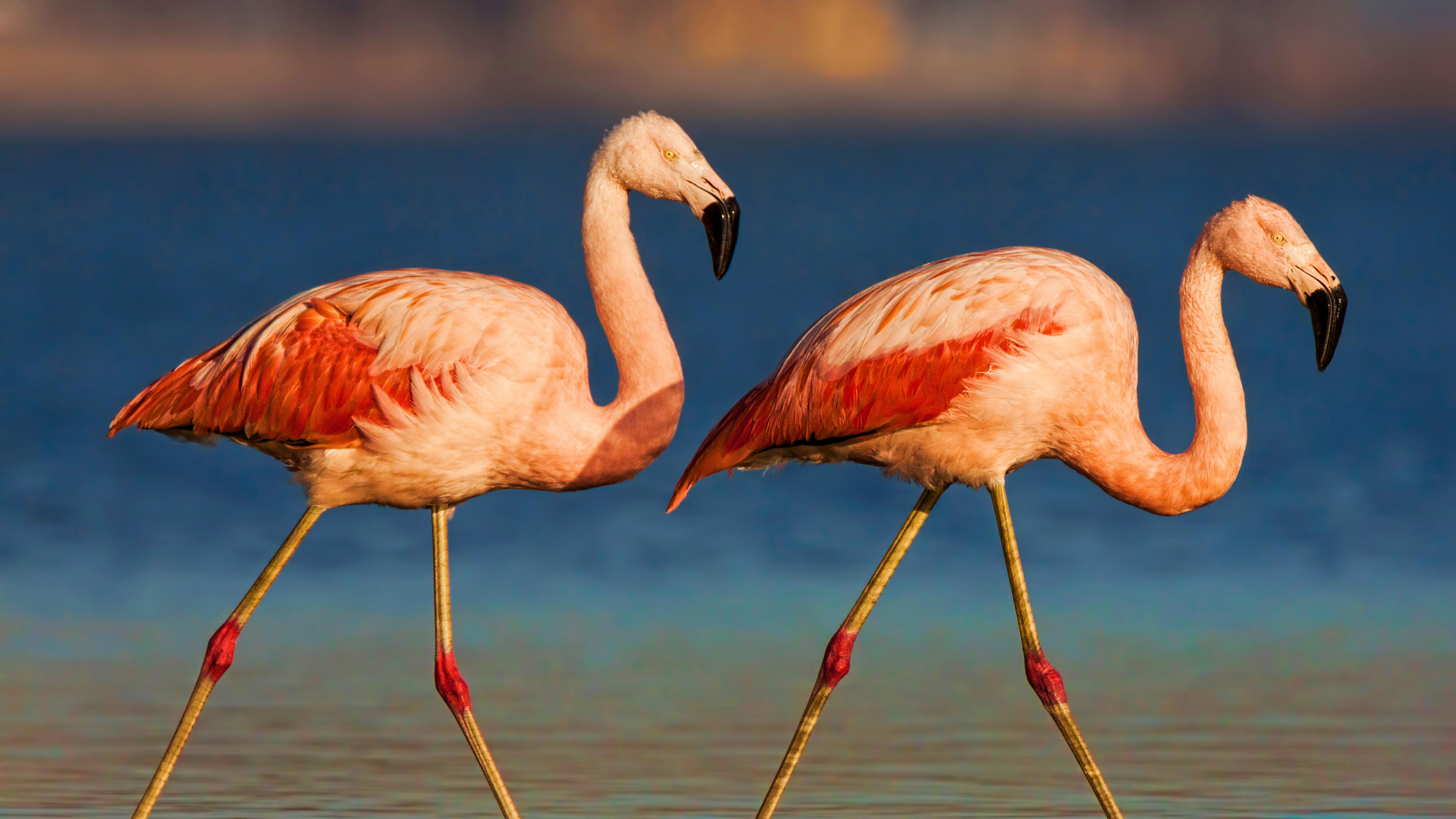
The pink colouration of a flamingo is not fixed. It comes from carotenoid pigments derived from the algae, crustaceans, and other invertebrates in the diet, and it intensifies during the breeding season as birds are feeding heavily and at peak physical condition. In December, at the height of the austral summer breeding season, Chilean Flamingos in Patagonia carry more pigment than at any other time of year. The pink is deeper, richer, and more saturated than in winter birds.
Combined with the long days and the quality of the sunrise and sunset light in December, this produces the images that define the species in the popular imagination. The flamingos at Laguna Nimez at dawn in December, their colouration amplified by warm directional light against the blue backdrop of Lago Argentino and the white backdrop of the Andes, are genuinely among the most beautiful wildlife sights in South America.
As we explain in our Best Time to Go Birding in Patagonia guide, December is the optimal month for this species and for Patagonian birding generally. But Chilean Flamingo is present year-round at the major sites and worth seeking at any time.
Identification: Separating Chilean from Andean Flamingo
At most Patagonian sites below 1,500 metres you will be looking at Chilean Flamingo. However, where ranges overlap at higher-altitude saline lakes in the Andean corridor, Andean Flamingo (Phoenicoparrus andinus) and James's Flamingo (Phoenicoparrus jamesi) may occur alongside Chilean. Knowing the field marks is worthwhile.
Chilean Flamingo has grayish legs with distinctive red joints at the knee and red feet, a combination visible at reasonable distance and the most reliable identification feature in the field. The bill is pale pink with a black tip, angled sharply downward. The body colour ranges from pale whitish-pink in winter birds to rich rose-pink in breeding condition adults.
Andean Flamingo is the larger of the two Andean species and shows yellow at the base of the bill, not present in Chilean. The legs are yellow, not grey with red joints. The body tends toward a paler, more washed-out pink than Chilean in comparable condition.
James's Flamingo is the smallest of the three and in Patagonia is uncommon below the Andean puna zone. The bill is brick-red with a black tip and proportionally shorter than the other species. Rarely encountered on the standard Patagonia birding circuit.
For full species recordings and range maps, the eBird Chilean Flamingo page is the most reliable current reference.
The Best Sites
Laguna Nimez, El Calafate — our top site. The finest accessible flamingo watching in all of Argentine Patagonia. Chilean Flamingos are present year-round, with peak numbers of 80 to 150 birds in December and January. The reserve's network of trails brings you within 30 to 50 metres of feeding and resting groups at the shallow western end of the lagoon. At sunrise the light falls directly onto the birds from the east and the Andes provide the backdrop that every flamingo photograph from Patagonia aspires to. Go at dawn on your first morning in El Calafate and every morning after that. Full guide at our El Calafate Birding Guide.
Laguna Amarga, Torres del Paine. The entrance lagoon to Torres del Paine National Park is one of the most dramatically situated flamingo sites on Earth. The saline lagoon sits against the backdrop of the Paine massif, with the towers visible behind the birds on clear days. Numbers here vary, with groups of 20 to 80 birds typical in December. The lagoon is visible from the park entrance road and can be watched from the vehicle window or on foot from the road margin. Full guide at our Torres del Paine Birding Guide.
Ruta 40 roadside lagunas, Argentine steppe. The seasonal and permanent lagunas visible from Ruta 40 and the parallel steppe roads between El Calafate and Gobernador Gregores hold Chilean Flamingo throughout the year. Watch the roadside as you drive and stop immediately at any pink movement visible from the window. The birds at these sites are often completely unhabituated to vehicles and will allow the car to approach remarkably closely before moving. Apply the self-drive stop method from our Self-Drive Birding in Patagonia guide and these roadside lagunas become one of the most rewarding flamingo experiences in the region.
Puerto Natales road lagunas, Chilean steppe. The small lagunas visible from the road between Puerto Natales and Torres del Paine hold Chilean Flamingo reliably from October through March. The site approximately 40 kilometres north of Puerto Natales is the most consistent. Numbers are smaller, typically 15 to 40 birds, but the intimacy of the roadside encounter compensates entirely.
Seno Otway and Laguna Cabeza del Mar, Punta Arenas area. The saline lagoon system near Punta Arenas holds Chilean Flamingo year-round and is the most accessible site on the Chilean side for visitors based in the city. Numbers peak in summer and the lagoon is accessible by short drive from the city centre.
Peninsula Valdes coastal lagoons. The saline lagoons of the Peninsula Valdes interior and the Isla de los Pajaros area hold breeding Chilean Flamingo in summer. The colony at Isla de los Pajaros is viewed from a distance with a scope, but the roadside lagunas on the interior circuit can produce close encounters during the December to February window.
Behaviour Worth Watching
Filter feeding. Chilean Flamingo feeds by holding its bill upside down in the water and pumping water through the lamellae that line the bill, filtering algae, diatoms, and small crustaceans. Watching a group of 50 birds feeding in synchronised motion, all heads submerged, bills working, moving slowly through the shallows, is one of the most hypnotic wildlife experiences the region offers.
Communal roosting. Flamingos roost standing in the water, often on one leg, in tight groups. Dawn roost dispersal, when the birds begin to feed and move across the lagoon as the light builds, is the most productive observation period and the most photogenic. At Laguna Nimez this happens within the first 30 minutes after sunrise.
Flight. A flock of Chilean Flamingos taking flight is one of those moments that recalibrates your sense of the bird entirely. The wingspan is vast, the pink of the body is joined by the vivid black and red of the underwing, and the flock moves in coordinated waves that fill the sky above the lagoon.
Practical Notes
At Laguna Nimez, go as early as the reserve opens. The flamingos are most active and most approachable in the first hour of light before the day visitor flow begins. Bring the longest lens you have for photography. For birding, 8x42 binoculars are entirely adequate at the close ranges the reserve provides.
At the roadside steppe lagunas, approach in the vehicle rather than on foot. Flamingos at unvisited lagunas are often significantly more tolerant of a parked car than of a standing human. Pull off the road, cut the engine, and observe from inside the vehicle for the first five minutes before making any decision to exit.
For the complete list of Patagonia's most rewarding species and the sites where each is found, see our 20 Best Birds to See in Patagonia guide. For planning your circuit to cover all the major flamingo sites, see our Two-Week Patagonia Birding Itinerary.
The allure of off-the-beaten-path travel
Lorem ipsum dolor sit amet, consectetur adipiscing elit ut aliquam, purus sit amet luctus venenatis, lectus magna fringilla urna, porttitor rhoncus dolor purus non enim praesent elementum facilisis leo, vel fringilla est ullamcorper eget nulla facilisi etiam dignissim diam quis enim lobortis scelerisque fermentum dui faucibus in ornare quam viverra orci sagittis eu volutpat odio facilisis mauris sit amet massa vitae tortor.
Unveiling the charm of lesser-known Destinations
Orci sagittis eu volutpat odio facilisis mauris sit amet massa vitae tortor condimentum lacinia quis vel eros donec ac odio tempor orci dapibus ultrices in iaculis nunc sed augue lacus.
- Lorem ipsum dolor sit amet consectetur facilisi etiam dignissim diam quis enim
- Mauris aliquet faucibus iaculis dui vitae ullamco sit amet luctus
- Posuere enim mi pharetra neque proin dic rhoncus dolor purus non enim
- Dui faucibus in ornare posuere enim mi pharetra neque proin dicit
Finding solitude in hidden gem locations
Lorem ipsum dolor sit amet, consectetur adipiscing elit ut aliquam, purus sit amet luctus venenatis, lectus magna fringilla urna, porttitor rhoncus dolor purus non enim praesent elementum facilisis leo, vel fringilla est ullamcorper eget nulla facilisi etiam dignissim diam quis enim lobortis scelerisque fermentum dui faucibus in ornare quam viverra orci sagittis eu volutpat odio facilisis mauris sit amet massa vitae tortor condimentum lacinia quis vel eros donec ac odio tempor orci dapibus ultrices.
The thrill of discovering untouched natural beauty
Dolor sit amet, consectetur adipiscing elit ut aliquam, purus sit amet luctus venenatis, lectus magna fringilla urna, porttitor rhoncus dolor purus non enim praesent elementum facilisis leo, vel fringilla est ullamcorper eget nulla.
- Lorem ipsum dolor sit amet consectetur tempor orci dapibus ultrices
- Mauris aliquet faucibus iaculis dui vitae ullamco elementum facilisis
- Posuere enim mi pharetra neque proin dic fermentum dui faucibus in ornare
- Purus sit amet luctus posuere enim mi pharetra neque proin dic
“Ut enim ad minim veniam, quis nostrud exercitation ullamco laboris nisi ut aliquip ex ea commodo consequat uis aute irure dolor in reprehenderit in voluptate velit”
Exploring cultural marvels off the tourist radar
Donsectetur adipiscing elit ut aliquam, purus sit amet luctus venenatis, lectus magna fringilla urna, porttitor rhoncus dolor purus non enim praesent elementum facilisis leo, vel fringilla est ullamcorper eget nulla facilisi etiam dignissim diam quis enim lobortis scelerisque fermentum dui faucibus in ornare quam viverra orci sagittis eu volutpat odio facilisis mauris sit amet massa vitae tortor condimentum lacinia quis vel eros donec ac odio tempor orci dapibus ultrices in iaculis nunc sed.