
Magellanic Woodpecker: How to Find Patagonia's Largest Woodpecker
How to find Patagonia's largest woodpecker by sound, habitat and site.
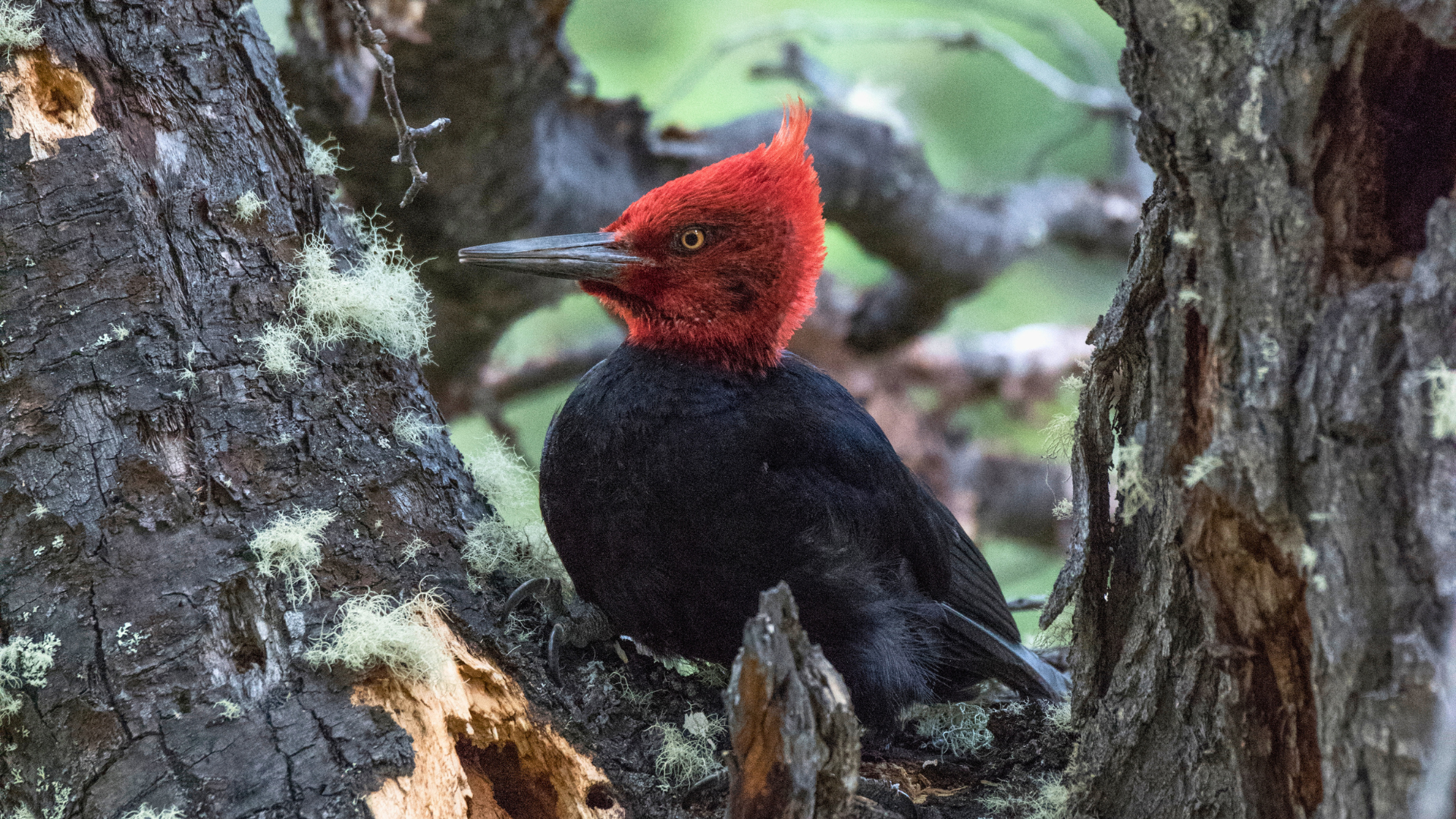
Learning the calls is how you find the Magellanic Woodpecker. Not by scanning trunks, not by walking further into the forest, but by stopping, listening, and letting the sound lead you. Once you know the double-rap drumming that carries through mature Nothofagus forest, the bird reveals itself. And the first sight of it up close, its scale against the tree, the crimson of the male's head in filtered forest light, is something with its own special aura. There is no other bird quite like it in the southern hemisphere.
The Magellanic Woodpecker (Campephilus magellanicus) is the largest woodpecker in South America, the second largest in the world after the Imperial Woodpecker of Mexico. Adults reach 45 centimetres in length. The excavations they make in dead and dying lenga beech are large enough to be obvious at a distance. Despite its size, despite its noise, despite its habit of working loudly on the same trunk for extended periods, it confounds birders who approach its forest the wrong way. This guide covers exactly the right approach.
The Sound Strategy: How to Find the Bird
The Magellanic Woodpecker announces itself in three ways before you ever see it. Understanding all three is the foundation of any successful search.
The double-rap drumming is the primary locator and the sound that carries furthest. Both sexes drum, but the male drums more frequently and with greater force. The pattern is a loud, resonant double-knock, distinctly different from the continuous rapid drumming of most woodpecker species. In still forest it carries 200 to 300 metres easily. When you hear it, stop moving immediately. Turn slowly until you can determine direction. Move toward it in short, quiet steps, stopping every 20 to 30 metres to listen again. The bird usually moves slowly along a trunk or branch while drumming and can be approached to within ten metres if the approach is quiet and unhurried.
The call is a loud, nasal, repeated series often rendered as a laughing kek-kek-kek or a single drawn-out scream. The female call tends to be slightly higher in pitch than the male's. Both calls carry well through the forest and will alert you to a bird before the drumming begins. Familiarise yourself with both on Merlin before entering any Nothofagus forest. As we explain in our Best Field Guides and Digital Tools guide, Merlin's sound ID function is particularly valuable in dense Nothofagus for exactly this species.
Excavation noise is the third locator and perhaps the most satisfying to follow. A Magellanic Woodpecker actively chiselling a dead lenga trunk for carpenter ants and beetle larvae produces a loud, hollow, irregular hammering distinctly different from drumming. When you hear this, move slowly toward it. The bird is occupied and less alert. These are the closest encounters.
Habitat: Where to Look and Why
The single most important fact about finding Magellanic Woodpecker is this: it requires mature Nothofagus forest with large, old, partially dead trees. Young lenga beech plantations, disturbed secondary forest, and forest edges without large trunks rarely produce the species. The bird depends on large diameter trees both for the excavation cavities it uses for nesting and roosting, and for the dead wood that holds the insects it feeds on.
In practice, this means concentrating your search effort on the sections of any forest trail where the trees are largest and oldest. Look for trunks with a diameter exceeding 50 centimetres and for the large, distinctive rectangular excavations that indicate regular woodpecker use. Fresh wood chips at the base of a trunk with an active cavity above it is one of the most reliable indicators that a Magellanic Woodpecker is working that tree.
The species is a strong forest interior bird. It avoids open edges and clearings and is almost never seen in the open. The productive search zone is inside continuous mature forest, at least 100 metres from any significant gap, and ideally in the sections of trail that see the least human foot traffic during the day.
Sex and Age: What You Are Looking At
The Magellanic Woodpecker shows striking sexual dimorphism that makes field identification of the pair entirely straightforward.
The male has an entirely crimson-red head, from the bill base to the back of the crown, with no black on the face or neck. The body is jet black above and below except for a white stripe running down the side of the neck and a white patch on the folded wing visible at rest. The crimson head in forest light has a luminosity that is difficult to describe and impossible to forget at close range.
The female has an entirely black head with a distinctive curved crest that gives the head a slightly pointed silhouette. The base of the bill is marked with a small red patch that is not always visible at distance. Body plumage is otherwise similar to the male.
Juveniles are similar to adults but with browner tones to the black areas and a less well-developed crest on the female. Finding a breeding pair, as we did in the El Chalten valley forest, allows direct comparison of both sexes simultaneously and provides insight into how the pair uses territory and coordinates movement through the canopy. The pair bond is strong and persistent, and pairs often work in close proximity throughout the day.
The Best Sites
El Chalten and Fitz Roy valley forest is our most consistently productive site across multiple visits. The lenga forest between kilometres 3 and 6 on the Laguna de los Tres trail holds old-growth stands with large diameter trunks and frequent excavation signs. The Laguna Torre trail provides different forest character with equal woodpecker quality. Start before 7am for the quietest conditions and highest drumming activity. Full guide at our El Chalten Birding Guide.
Torres del Paine, Ascencio Valley and Base de las Torres provides the most accessible Magellanic Woodpecker forest on the Chilean side. The lenga forest in the first 3 kilometres of the Ascencio Valley trail from Hotel Las Torres is excellent habitat and reliably productive. The birds are present year-round and in December the increased calling and drumming activity of the breeding season makes them easier to locate. Full guide at our Torres del Paine Birding Guide.
Tierra del Fuego National Park near Ushuaia holds outstanding habitat in the Lapataia sector forest. The mature lenga and coihue stands along the park's forest trails are among the densest and most structurally complex in the region, providing excellent foraging and nesting habitat. Full guide at our Birding Ushuaia guide.
Los Glaciares National Park near El Calafate provides less well-known but genuinely productive habitat in the Nothofagus forest sections near the Perito Moreno Glacier car park. Stop at the forest margin sections on the final 15 kilometres of the glacier road and work slowly along the tree line.
Carretera Austral, central and southern sections holds Magellanic Woodpecker throughout the continuous Nothofagus forest corridor from Chaiten south. The species is significantly easier to observe in the open lenga and coihue forest of the transition zone than in the dense Valdivian rainforest further north. Full guide at our Carretera Austral Birding Guide.
Practical Field Notes
Go early. Drumming and calling activity peaks in the first two hours after dawn and again in the final hour before dusk. Midday is the least productive period as the birds tend to rest in dense forest away from the trail corridor.
Move slowly and stop often. A birder covering three kilometres of forest trail in one hour will miss most Magellanic Woodpeckers. A birder covering the same trail in three hours, stopping every 50 metres to listen for 60 seconds, will find them reliably at productive sites.
Learn the drumming before you go. Listen to multiple recordings on eBird before your trip until the sound is automatic. In the forest it will arrive before you consciously register it, and that automatic recognition is what stops you mid-stride and starts the approach.
December is the best month. As we explain in our Best Time to Go Birding in Patagonia guide, December breeding activity dramatically increases drumming and calling frequency. The birds are more vocal, more visible, and more reliably found than at any other time of year.
The Aura of the Bird
There is a reason experienced birders who have seen hundreds of woodpecker species across the world still describe their first Magellanic Woodpecker encounter with a particular quality of attention. The bird has its own special aura.
Part of it is the size, genuinely startling against even a large lenga trunk. Part of it is the crimson head of the male, which in the right forest light has an almost luminous quality that no photograph fully captures. Part of it is the sound, which fills the forest with an authority that announces something significant before you have any idea what it is.
But most of it is the forest itself. The old-growth Nothofagus that this bird requires, the mature lenga with its twisted form and pale grey bark and the silence inside it that is different from any other silence, is a place that demands a certain kind of attention. The Magellanic Woodpecker lives at the centre of that attention. Finding one, and understanding what you are looking at, is one of the finest rewards Patagonia birding offers. For the full list of the region's most sought species, see our 20 Best Birds to See in Patagonia guide.
The allure of off-the-beaten-path travel
Lorem ipsum dolor sit amet, consectetur adipiscing elit ut aliquam, purus sit amet luctus venenatis, lectus magna fringilla urna, porttitor rhoncus dolor purus non enim praesent elementum facilisis leo, vel fringilla est ullamcorper eget nulla facilisi etiam dignissim diam quis enim lobortis scelerisque fermentum dui faucibus in ornare quam viverra orci sagittis eu volutpat odio facilisis mauris sit amet massa vitae tortor.
Unveiling the charm of lesser-known Destinations
Orci sagittis eu volutpat odio facilisis mauris sit amet massa vitae tortor condimentum lacinia quis vel eros donec ac odio tempor orci dapibus ultrices in iaculis nunc sed augue lacus.
- Lorem ipsum dolor sit amet consectetur facilisi etiam dignissim diam quis enim
- Mauris aliquet faucibus iaculis dui vitae ullamco sit amet luctus
- Posuere enim mi pharetra neque proin dic rhoncus dolor purus non enim
- Dui faucibus in ornare posuere enim mi pharetra neque proin dicit
Finding solitude in hidden gem locations
Lorem ipsum dolor sit amet, consectetur adipiscing elit ut aliquam, purus sit amet luctus venenatis, lectus magna fringilla urna, porttitor rhoncus dolor purus non enim praesent elementum facilisis leo, vel fringilla est ullamcorper eget nulla facilisi etiam dignissim diam quis enim lobortis scelerisque fermentum dui faucibus in ornare quam viverra orci sagittis eu volutpat odio facilisis mauris sit amet massa vitae tortor condimentum lacinia quis vel eros donec ac odio tempor orci dapibus ultrices.
The thrill of discovering untouched natural beauty
Dolor sit amet, consectetur adipiscing elit ut aliquam, purus sit amet luctus venenatis, lectus magna fringilla urna, porttitor rhoncus dolor purus non enim praesent elementum facilisis leo, vel fringilla est ullamcorper eget nulla.
- Lorem ipsum dolor sit amet consectetur tempor orci dapibus ultrices
- Mauris aliquet faucibus iaculis dui vitae ullamco elementum facilisis
- Posuere enim mi pharetra neque proin dic fermentum dui faucibus in ornare
- Purus sit amet luctus posuere enim mi pharetra neque proin dic
“Ut enim ad minim veniam, quis nostrud exercitation ullamco laboris nisi ut aliquip ex ea commodo consequat uis aute irure dolor in reprehenderit in voluptate velit”
Exploring cultural marvels off the tourist radar
Donsectetur adipiscing elit ut aliquam, purus sit amet luctus venenatis, lectus magna fringilla urna, porttitor rhoncus dolor purus non enim praesent elementum facilisis leo, vel fringilla est ullamcorper eget nulla facilisi etiam dignissim diam quis enim lobortis scelerisque fermentum dui faucibus in ornare quam viverra orci sagittis eu volutpat odio facilisis mauris sit amet massa vitae tortor condimentum lacinia quis vel eros donec ac odio tempor orci dapibus ultrices in iaculis nunc sed.