
Birding Ushuaia: The Complete Guide to the World's Most Southerly Birding City
The complete zone by zone birding guide to Ushuaia. Waterfront, national park, Isla Martillo, and Paso Garibaldi covered with species lists and timing advice.
Most people standing on the Ushuaia waterfront are looking south toward Antarctica. We understand the pull. But spend ten minutes looking at what is already in front of you. Steamer ducks carving up the shallows. Blackish Oystercatchers working the rocks. Northern and Southern Giant Petrels side by side, a comparison you will not get this easily anywhere else on the continent. The Beagle Channel waterfront is one of the most productive thirty-minute birding walks in all of Patagonia, and most cruise passengers walk straight past it on the way to the duty-free shops.
Ushuaia is the southernmost city in the world and the gateway to Antarctica, but for birders it is something else entirely: a base for five completely different birding habitats within a one-hour radius, ranging from temperate Nothofagus forest to high Andean moorland to the richest penguin colony experience in mainland South America. We have spent more than five days birding this area across multiple visits. This guide covers every zone, every target species, and exactly how to use your time here whether you have six hours before boarding or a full week to explore.
Zone 1: The Beagle Channel Waterfront
Start here. Always. The waterfront between the port and the Arakur reserve trail is where Ushuaia delivers its most immediate and accessible birding, and it is the zone that most visitors completely overlook.
The key species on the waterfront are all habituated to human presence and approachable at very close range. Magellanic Steamer-Duck is the dominant waterbird, almost permanently present on the channel in pairs and family groups. The dusky subspecies of Black-crowned Night Heron is a genuinely interesting local form worth looking at closely when one appears in the harbour rocks or the low waterside vegetation. This subspecies, darker and richer than the nominate form, is easy to overlook if you are not expecting it.
Northern Giant Petrel and Southern Giant Petrel are both regular on the Beagle Channel and the waterfront is one of the easier places in Patagonia to compare the two species side by side. The key ID feature is the bill tip: green in Northern, red-pink in Southern. Both species are large, dark, and intimidating on the water, where they sit heavily and feed on whatever the harbour provides.
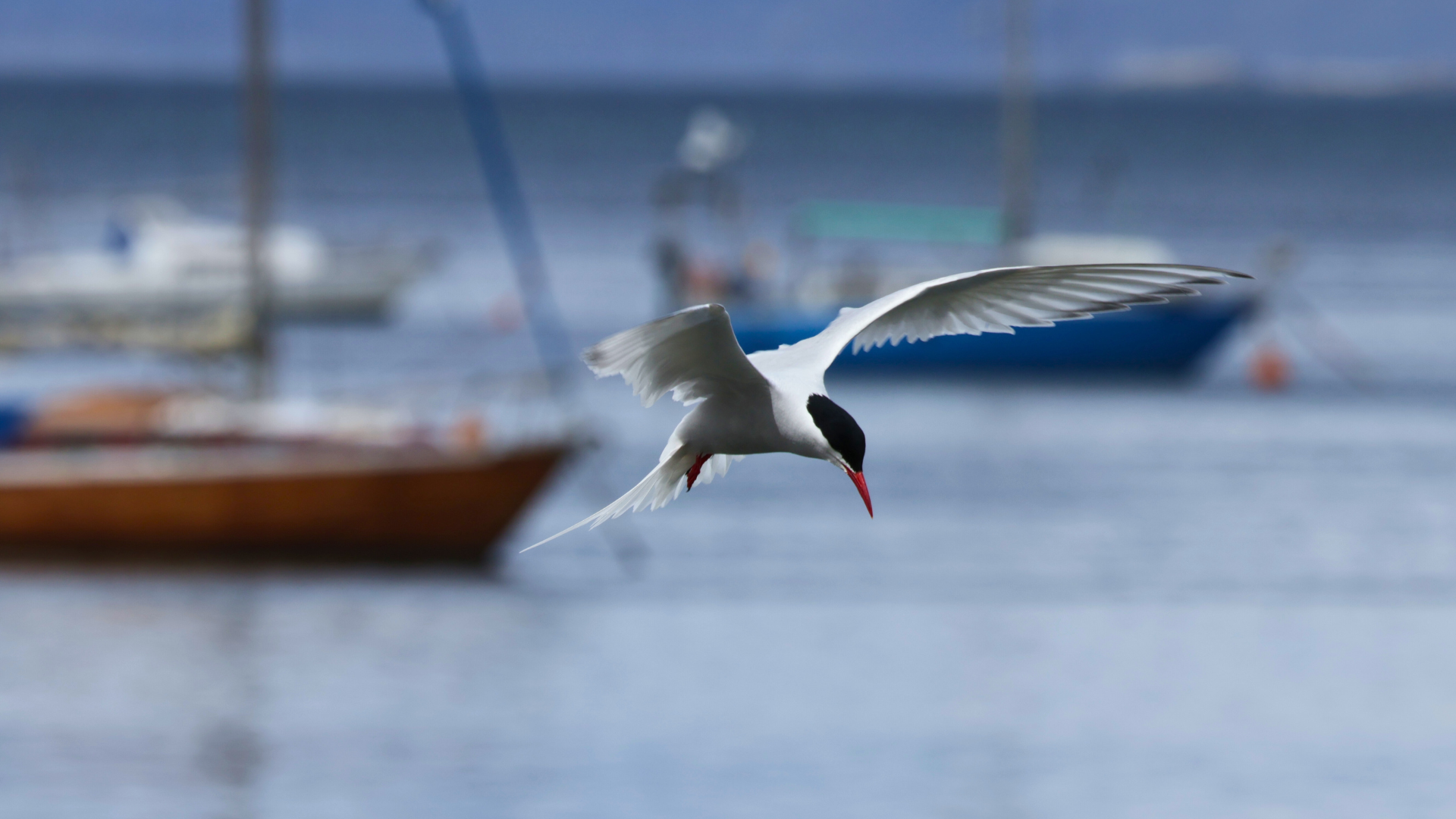
Blackish Oystercatcher works the rocky sections of the waterfront constantly and is almost guaranteed at any low-tide session. Dolphin Gull is present throughout the harbour area, its red bill and grey body distinctive against the Kelp Gulls it associates with. Kelp Goose pairs feed on algae exposed at low tide along the shallower sections. South American Tern hunts over the channel throughout the day in summer. Imperial Shag and Magellanic Cormorant both roost on jetties and rocky outcrops within the harbour.
Key species: Magellanic Steamer-Duck, Blackish Oystercatcher, Dolphin Gull, Northern and Southern Giant Petrel, Imperial Shag, Magellanic Cormorant, South American Tern, Kelp Goose, dusky Black-crowned Night Heron.
Time needed: 30 minutes to 2 hours. Go at low tide for maximum oystercatcher and goose activity.
Zone 2: Bahia Encerrada Urban Reserve
Bahia Encerrada is a small urban wetland reserve on the eastern edge of Ushuaia, walkable from the city centre. It is worth a visit but does not warrant a full morning. Think of it as a productive stop on the way somewhere else rather than a primary destination.
The reserve holds Yellow-billed Teal and Yellow-billed Pintail year-round. White-tufted Grebe and Silvery Grebe both use the sheltered water. Buff-necked Ibis has been recorded at the wetland margins. The scrubby edges hold Rufous-collared Sparrow, House Wren, and Austral Negrito on fence posts. Spend 45 minutes here at most and move on to the national park or the waterfront.
Key species: Yellow-billed Teal, Yellow-billed Pintail, White-tufted Grebe, Silvery Grebe, Buff-necked Ibis, Austral Negrito.
Time needed: 30 to 45 minutes.
Zone 3: Tierra del Fuego National Park
The national park begins 12 kilometres west of Ushuaia and is the most diverse birding site in the immediate area. The park encompasses Nothofagus forest, glacial lakes, the Beagle Channel shoreline, and the Martial Range above the treeline, providing habitat for forest specialists, waterbirds, and high-altitude species all within its boundaries.
The forest trails in the Lapataia sector are the primary target for serious birders. Magellanic Woodpecker is the headline species and is genuinely present throughout the park's mature Nothofagus forest. Move slowly, listen for the resonant drumming before searching visually, and cover the sections of mature lenga beech with the largest trees. The park holds some of the most accessible Magellanic Woodpecker habitat in all of southern Patagonia.
Thorn-tailed Rayadito is abundant and completely fearless in the park forest, approaching within metres and foraging along bark surfaces at eye level. White-throated Treerunner spirals up trunks in the more mature forest sections. Austral Parakeet flocks move noisily through the canopy throughout the day. Patagonian Sierra Finch feeds on the ground at clearings and picnic areas.
The Lapataia Bay area at the end of the park road is excellent for coastal species. Black-necked Swan, Flying Steamer-Duck, Kelp Goose, and Flightless Steamer-Duck are all present on the bay. At the forest edge where Nothofagus meets open moorland, Austral Pygmy-Owl is present and most reliably found by listening for mobbing alarm calls of small forest birds. As we described in our 20 Best Birds to See in Patagonia guide, this is exactly the technique that produced our own Ushuaia Pygmy-Owl sighting.
Key species: Magellanic Woodpecker, Thorn-tailed Rayadito, Austral Pygmy-Owl, Austral Parakeet, White-throated Treerunner, Black-necked Swan, Flying and Flightless Steamer-Duck, Kelp Goose.
Time needed: Half day minimum. Full day for the serious forest birder targeting woodpecker and owl.
Zone 4: Isla Martillo and Estancia Harberton
The Harberton drive and Isla Martillo penguin colony is the single most compelling wildlife experience available from Ushuaia and deserves its own full day. The 85-kilometre drive east from Ushuaia to Estancia Harberton passes through excellent Nothofagus forest with good birding potential on the way. Allow time for stops.
The colony itself, with Magellanic Penguins, Gentoo Penguins, and occasional King Penguins, is covered in full in our Magellanic Penguin Colony Guide. Before we even boarded the small boat at Harberton, a King Penguin was standing near the ramp. The channel crossing, the colony, and the return drive through the forest add up to one of the finest single-day wildlife experiences in South America.
The Harberton estancia itself holds good numbers of passerines including Rufous-backed Negrito, Long-tailed Meadowlark, and Dark-bellied Cinclodes around the buildings and shoreline. The Acatushun Museum of Birds and Mammals of the Southern Ocean at Harberton is also worth a visit for the extraordinary research collections it holds.
Key species: Magellanic Penguin, Gentoo Penguin, King Penguin on Isla Martillo. Imperial Shag, Dolphin Gull, South American Tern, and Southern Giant Petrel on the channel crossing.
Time needed: Full day. Book Piratours Isla Martillo concession well in advance.
Zone 5: Paso Garibaldi and the High Moorland
Paso Garibaldi, the mountain pass on Route 3 east of Ushuaia, gives access to the high Andean moorland above the treeline and is the most underbirded zone in the entire Ushuaia area. Almost nobody stops here. That is a significant mistake.
The open moorland holds White-bellied Seedsnipe, one of the most sought and difficult Patagonian species. Seedsnipes are cryptic, ground-dwelling birds that crouch motionless when approached and are almost invisible until they move. Walk slowly across open rocky fell, scan at ground level, and watch for the subtly patterned brown-and-white shape that does not quite look like a rock. When one flushes, the distinctive flight call is diagnostic.
Rufous-chested Dotterel breeds on the high moorland in summer and is far more conspicuous, its rufous breast and white supercilium making it visible at distance. Dark-faced Ground-Tyrant works the rocky ground persistently. Austral Canastero uses the shrubby moorland margins. Above the moorland, the exposed ridgeline is good for Andean Condor on thermals in the afternoon. Read our full guide at The Andean Condor in Patagonia for timing and technique.
Key species: White-bellied Seedsnipe, Rufous-chested Dotterel, Dark-faced Ground-Tyrant, Austral Canastero, Andean Condor.
Time needed: 2 to 3 hours. Go in the morning for seedsnipe activity.
How to Allocate Your Time in Ushuaia
6 hours before an Antarctica cruise: Waterfront first, one hour minimum. Bahia Encerrada for 45 minutes on the way. Focus remaining time on the waterfront and a short walk at the national park entrance.
2 days: Day one: waterfront at dawn, Bahia Encerrada mid-morning, Tierra del Fuego National Park afternoon and evening. Day two: Paso Garibaldi morning, Isla Martillo full day via Harberton.
3 to 5 days: The above plus dedicated repeat visits to the national park for Magellanic Woodpecker, targeted evening owling at the forest edge, and a second channel outing for seabirds. Five days in Ushuaia with serious field effort can produce 90 to 110 species.
Practical Notes
Car rental is essential for accessing Paso Garibaldi, Harberton, and the national park efficiently. The bus service to the national park is adequate for a single visit but does not give you the flexibility to stop at productive sites on the drive.
December and January are the optimal months, as we explain in our Best Time to Go Birding in Patagonia guide. The long days allow morning moorland sessions at Paso Garibaldi and late evening forest sessions at the national park on the same day.
Download Merlin offline before arriving. Mobile data is unreliable outside Ushuaia city. As covered in our field guides and digital tools guide, the South America bird pack works fully offline and is particularly valuable for sound ID in the national park forest.
Check eBird for the Ushuaia and Tierra del Fuego hotspots before each outing at eBird. The local birding community maintains detailed checklists and recent sightings data is reliable and regularly updated.
Why Ushuaia Deserves More Than One Day
The Antarctica cruise industry has turned Ushuaia into a transit city, somewhere you pass through on the way to something more dramatic. That framing does Ushuaia a disservice so significant it borders on unfair. The birding within 90 minutes of the city centre is extraordinary by any global standard: three penguin species at one colony, the world's largest woodpecker in accessible forest, high-altitude endemics on moorland that almost nobody visits, and a waterfront where Giant Petrels land within ten meters of the path.
Antarctica is extraordinary. The Drake Passage is extraordinary. But the birds are already here, waiting at the waterfront, before the ship even departs.