
How Golden-crowned Kinglets Survive Winter: Frozen Caterpillars, Night Huddles, and a Six-Gram Body
A bird that weighs less than two pennies stays in the boreal forest all winter. Here is what the research has found about how it pulls that off, and what is still unexplained.
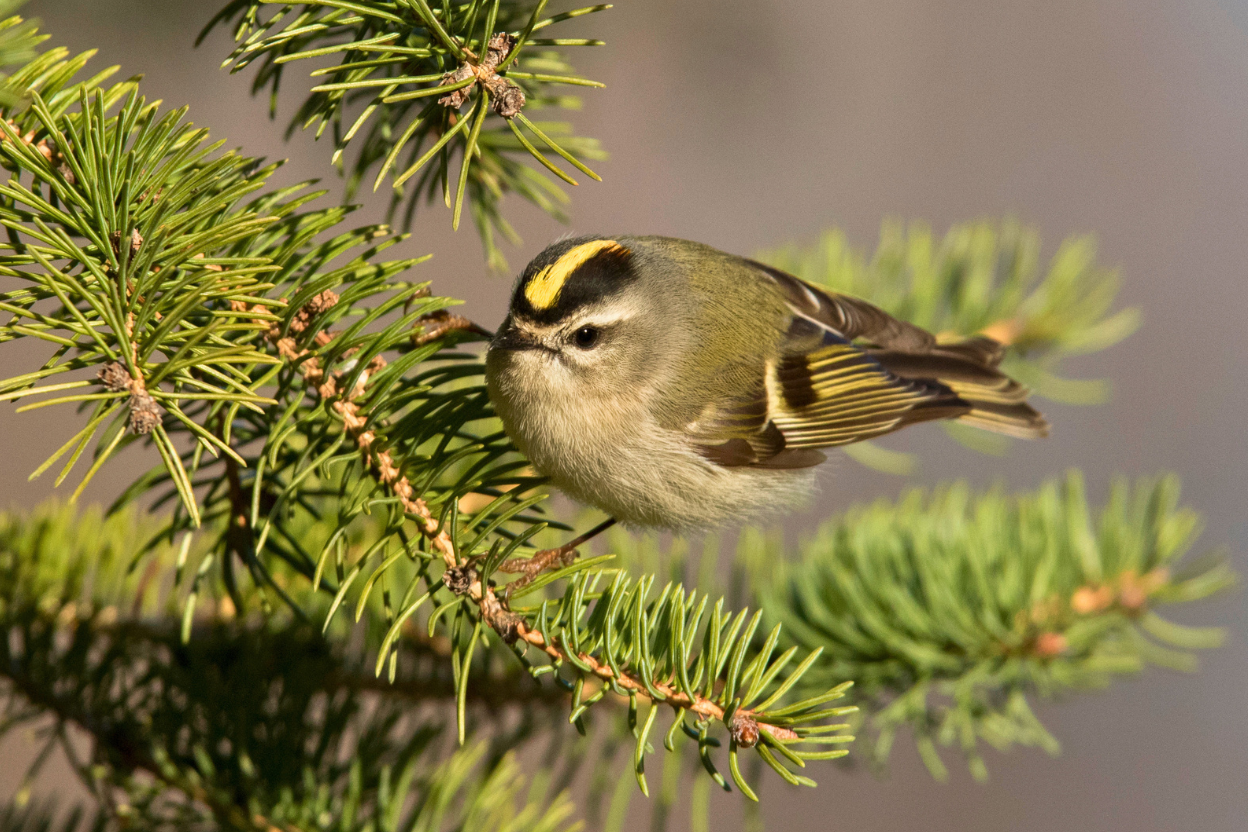
It is always surprising to hear that call in the heart of winter. You are knee-deep in snow, the thermometer reads minus 10 degrees Celsius (14 degrees Fahrenheit), the woods have gone quiet, and then a thin, needle-high note drops out of a spruce. A Golden-crowned Kinglet is working the end of a branch, hovering, flicking, moving on, apparently untroubled by conditions that have sent most of the forest's insect eaters thousands of kilometres south.
It should not be possible. A Golden-crowned Kinglet (Regulus satrapa) weighs about 6 grams. Small bodies lose heat fast, insects are supposedly absent in a boreal January, and the nights are long. And yet it really is true: the species stays. Researchers have spent decades working out how, and the answers are stranger and better than "they just tough it out."
The Problem: A Six-Gram Bird in a Boreal Night
The scale of the challenge is worth stating plainly. Bernd Heinrich, who studied the species in western Maine, describes the Golden-crowned Kinglet as the smallest insectivorous bird that overwinters in boreal forests across North America, from Alaska to Nova Scotia, where nights can last 16 hours and fall below minus 40 degrees, the point where Celsius and Fahrenheit meet.
Size works against it on every count. A tiny body has a large surface area relative to its volume, so heat leaks out quickly. It also has little room to store fuel. And unlike chickadees and nuthatches, kinglets do not cache food for later. Whatever they burn overnight, they have to have eaten that day.
We cover the general toolkit northern birds use to get through winter in our guide to winter survival adaptations in North American birds. The kinglet is the extreme case, and it rewards a closer look.
What They Eat When There Are No Insects
For a long time, the assumption was that kinglets got through winter on springtails, tiny invertebrates related to insects. That idea came largely from the Goldcrest, the kinglet's close Old World relative, whose foraging style suggested a springtail specialist.
Heinrich and his colleague Ross Bell tested it the direct way. Working under a state collecting permit in the spruce and fir forests of western Maine, where winter temperatures routinely drop to minus 30 Celsius, they examined the gizzards of 16 kinglets collected between late November and mid-April. Their results, published in The Wilson Bulletin in 1995, overturned the springtail idea. Of 483 identified prey items, 287, or 59 percent, were moth caterpillars, and 95 percent of those were geometrids, the family better known as inchworms.
That is the detail that makes this bird so remarkable. In the middle of a northern winter there are caterpillars out on the trees, waiting out the cold, and kinglets find them one by one. Naturalists who shake a winter branch over a pale sheet turn up the same thing: small, twig-coloured geometrid caterpillars clinging to bare twigs, so well camouflaged that they pass for bits of bark. The caterpillars in Heinrich and Bell's sample also outweighed most of the other prey by volume, so they were not just common in the diet, they were the bulk of the fuel. One small grace note from the same study: 60 of those caterpillars were themselves parasitized by tachinid fly larvae, a reminder of how much life is quietly running through a winter forest that looks dead.
This is also why kinglets never seem to stop. Prey this small has to be found continuously, and a short winter day leaves no margin for resting.
The Night Shift: Huddling on Open Branches
Food solves the daytime problem. Night is harder. Sixteen hours of darkness with no foraging is a long time for a bird with almost no fuel tank.
Earlier writers had suggested kinglets might shelter in insulated spots such as old squirrel nests. Heinrich spent winter evenings following flocks to see where they actually went, and in 2003 he published the first documentation of Golden-crowned Kinglets huddling together in the field during winter, out on open branches. The birds foraged right up to darkness, and they did not necessarily return to the same site each night. Instead, they huddled wherever they happened to be when the light ran out.
His interpretation was that travelling in groups and huddling where they end up compensates both for their small body size and for any foraging time they would lose by commuting back to a fixed roost. The Tennessee Wildlife Resources Agency describes the same behaviour from the other direction: in very cold weather, tight lines of up to four or five kinglets have been found pressed together on a branch.
That gives the constant calling of a winter flock a new weight. In Winter World, Heinrich suggests that the incessant contact notes may be part of the survival strategy itself: a kinglet that loses its companions during the day may have no one to huddle with that night. He offers it as a hypothesis rather than a measured result, and we pass it on in the same spirit, but it is hard to hear those thin calls the same way afterwards.
A Small Fuel Tank and a Very Good Coat
How much fuel does a kinglet actually carry into the night? Charles Blem and John Pagels measured fat reserves in 16 kinglets collected through the daylight hours in midwinter in central Virginia, publishing in The Condor in 1984. They found only a small daily fat cycle, with maximum reserves of about 0.6 grams of lipid, roughly 22.6 kilojoules of energy. Their conclusion was that the birds probably could not avoid letting their body temperature drop overnight.
That was Virginia, where winter nights are far milder than in the boreal forest, so northern birds are working with even less slack. It also points to the other half of the strategy: insulation. Heinrich reported that kinglets are very well insulated for their size, and a roosting kinglet fluffed into a ball of feathers is, in effect, a much bigger bird than the one you watched flitting about at noon. Pressed against three or four others, it is bigger still.
Do kinglets let their body temperature fall at night, the way many tits and chickadees do? Nobody has measured it directly in a wild Golden-crowned Kinglet, and the two lines of evidence pull in different directions. The fat budget from Virginia suggests they must. Laboratory work on the Goldcrest in Norway, published by Randi Eidsmo Reinertsen, Svein Haftorn and Ellen Thaler in 1988, suggested the opposite for that species: oxygen consumption in five winter Goldcrests indicated they could balance their overnight energy budget at normal body temperature, as long as food was adequate. The same authors pointed out that the energy saved by dropping body temperature shrinks as the air gets colder and the bird gets smaller, so hypothermia may simply be a poor deal for the very smallest birds, and contact roosting the better one. Which answer applies to our kinglet is still open, and we find that more interesting than a tidy verdict.
Why the Ruby-crowned Kinglet Leaves
If you see a Ruby-crowned Kinglet in Quebec in January, it is worth a note. The two kinglets look like close cousins, but Birds of the World states that the Golden-crowned tolerates colder temperatures and winters farther north than the Ruby-crowned. The Ruby-crowned is also not known to huddle in groups at night or to enter hypothermia in cold weather. And the two are less related than they look: DNA and vocal evidence suggest the Golden-crowned's closest relative is the Goldcrest of Europe and Asia, not the Ruby-crowned Kinglet it shares a continent with.
So the winter toughness is not a family trait that both North American kinglets inherited. It belongs to one lineage, and the Ruby-crowned solves winter the conventional way, by moving south.
Finding Golden-crowned Kinglets in a Quebec Winter
The species winters throughout its breeding range, which includes much of Quebec, and it joins mixed-species flocks for the season. That makes finding one mostly a matter of finding the flock.
Where to look: dense conifer stands, especially spruce, fir and hemlock, and the mixed woods around them. In winter they also use a wider range of habitat than in summer, so do not ignore deciduous edges with a few evergreens mixed in.
How to find them: listen before you look. All About Birds recommends tuning in to their high, thin call notes, and that advice is the whole game in winter. If you have lost the top end of your hearing, as many birders do with age, follow the chickadees instead. A noisy chickadee flock moving through conifers is the most reliable carrier of kinglets we know.
How to watch them: be patient and watch the twigs and needles, which is where those overwintering caterpillars are. Kinglets often hang or hover to reach them, and the bird will move every few seconds, so binoculars with a close focus and a wide field help more than magnification. Calm, overcast days are easier than windy ones, when the high calls get lost; our guide to how weather affects bird activity covers why. If you are in the boreal forest anyway, a winter flock may also carry a Boreal Chickadee or bring a Canada Jay in to investigate you.
One thing not to do: kinglets are operating on a margin so thin that disturbance near dusk costs them. Avoid pursuing a flock in the last half hour of light, when they are feeding hard and settling in for the night.
A Tough Bird, Not an Invulnerable One
None of this makes the species immune to trouble. All About Birds reports that North American Breeding Bird Survey data show a decline of about 32 percent between 1966 and 2019, even though the bird remains numerous. A strategy built on cold-hardy caterpillars, dense conifers and a narrow energy budget depends on those forests staying intact.
Heinrich ends Winter World in open admiration of this bird, and it is hard to disagree. The next time a thin call drops out of a frozen spruce, it is worth stopping. You are listening to one of the most improbable success stories in the northern forest, and if you follow it to dusk, to a small row of feathered balls on a bare branch.