
How to Stop Your Cat From Killing Birds
You cannot switch off the hunting instinct, but you control the opportunity. Here is how to stop your cat killing birds, ranked from the most effective fix down.
If you have read why cats kill wild birds, you already know the uncomfortable part. The hunting is instinct, not hunger, and even the gentlest, best fed house cat will kill given the chance. The good news is that this is one of the most solvable problems on the whole list, because while you cannot switch off the instinct, you have complete control over the opportunity. Here is what actually works, ranked honestly from the most effective to the least, so you can pick what fits your cat and your life without guilt.
The one approach that works completely: keep the hunting indoors
There is no getting around it, the single most effective thing you can do is keep your cat from roaming freely outdoors. An indoor cat kills no wild birds, and as a bonus it lives a longer, safer life, away from cars, disease, and fights. For many people that sentence triggers an immediate objection, that it is cruel to keep a cat in, and we understand it. The answer is not a bare apartment but an enriched one, with climbing shelves, scratching posts, window perches, and daily play that gives the cat the stimulation it would otherwise seek outside.
For the best of both worlds, a catio, an enclosed outdoor run, lets a cat feel sun and wind and watch the world without being able to reach a single bird. They range from a window box the size of an air conditioner to a walk in enclosure, and a kit makes the build approachable for most handy owners. (As an Amazon Associate we earn from qualifying purchases.) A ready to assemble catio kit is the simplest way to give an indoor cat safe outdoor time while keeping the local birds entirely off the menu.
If your cat does go out, supervise or contain the time
If full indoor life truly is not possible, the next best thing is to control how and when your cat is outside. Many cats take surprisingly well to a harness and leash with patient training, which turns outdoor time into something you share and oversee. Supervised access in your own yard, where you can interrupt a stalk before it becomes a kill, is far better than an open cat flap and a cat that comes and goes unseen. The principle is simple. The less unsupervised free roaming time a cat has, the fewer birds it can catch.
The collar that gives birds a fighting chance
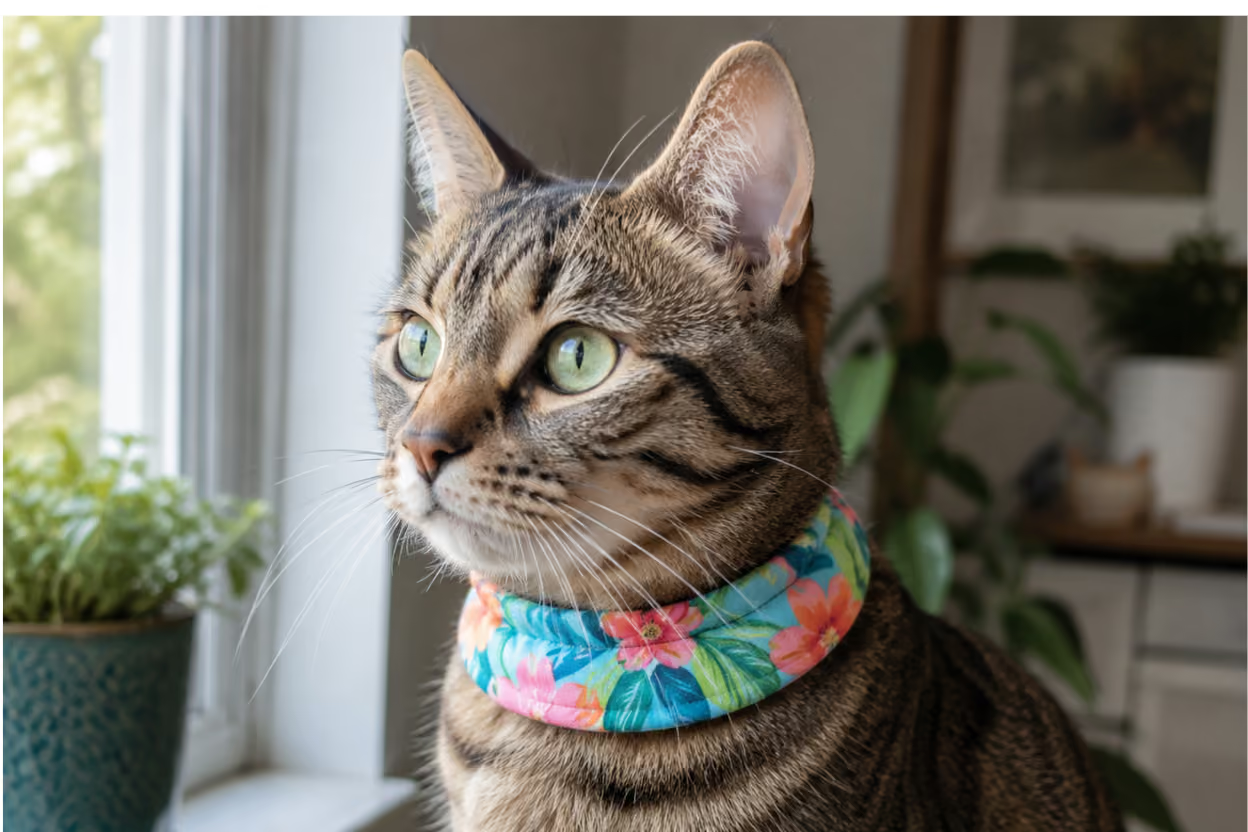
For a cat that will be outside unsupervised at least some of the time, the most effective add on by far is not a bell but a brightly colored collar cover. These wide, vivid fabric collars work because birds see color exceptionally well, so the cat that thinks it is hidden is in fact a beacon, and the birds simply leave before it can pounce. The evidence is striking. In one trial, cats wearing a brightly colored collar cover killed roughly nineteen times fewer birds in spring than the same cats uncollared. A brightly colored collar cover is the single cheapest high impact tool here.
People always ask about bells, and here we have to be honest. Bells help less. The research puts their effect somewhere around a halving of kills at best, and some cats learn to move so smoothly the bell never rings, so a bell is a weak substitute for the colored collar, though it does no harm in addition to one. Whatever you put around a cat's neck, it must be a breakaway collar that releases under pressure, because a fixed collar that snags on a branch can strangle a cat. Fit it so two fingers slide underneath, and check it as the cat grows or gains a winter coat.
Take the edge off the urge to hunt
You cannot remove the hunting instinct, but you can turn down its volume. A revealing study found that two simple changes at home measurably reduced how much cats hunted. The first was a daily session of object play, a few minutes with a wand or feather toy that lets the cat act out the full stalk and pounce on a toy rather than a bird. The second was a shift to a meatier, grain free food, on the theory that some cats hunt to make up for something missing in a plant heavy diet. Neither is a cure on its own, but a played out, well nourished cat is a less driven hunter, and both stack neatly on top of the measures above.
Time the outdoors around the birds
When a cat goes out matters as much as whether it does. Birds are most active and most vulnerable at dawn and in the early evening, so those are the worst hours to let a cat roam and the best hours to keep it in. The single most important season is late spring and early summer, the fledgling weeks, when young birds are on or near the ground and barely able to fly. A cat with outdoor access during fledging can wipe out a whole brood in a day, so if there is one stretch of the year to keep a cat in or strictly supervised, it is then.
You can love both
None of this asks you to love your cat less, and none of it is about blame. It is about closing the gap between a hardwired instinct and a vulnerable wild bird, using whatever combination fits your situation, with indoor life and a catio at the top and a colored breakaway collar as the minimum for any cat that goes out. If your trouble is a feeder that has become a hunting ground, or cats that are not even yours, that has its own playbook in how to stop cats killing birds at your feeder. And to see where this one change sits among all the things that kill birds, step back to the causes of bird deaths in North America. The instinct is not going anywhere, but with a few easy choices the birds get to.
FAQ
They help, but less than people hope. The research suggests a bell reduces bird kills by roughly half at best, and the effect varies a lot because some cats quickly learn to move so smoothly the bell barely rings. A bell does no harm as an addition, but it is a weak substitute for a brightly colored collar cover, which works far better. If you use any collar, make sure it is a breakaway type for safety.
Yes, and the evidence is strong. Brightly colored collar covers work because birds see color very well, so a cat that thinks it is hidden becomes highly visible and the birds leave before it can pounce. In one trial, cats wearing one killed roughly nineteen times fewer birds in spring than the same cats without one. Fit the cover on a breakaway collar so it releases safely if it snags.
No. An indoor cat with climbing shelves, scratching posts, window perches, and daily play lives a stimulating life and a longer, safer one, away from cars, disease, and fights. For outdoor stimulation without the risk to wildlife, a catio, an enclosed outdoor run, lets a cat enjoy fresh air and sights while keeping birds completely out of reach.
Control the opportunity rather than the instinct. Supervise outdoor time or use a harness and leash, fit a brightly colored breakaway collar cover for any unsupervised access, and reduce the drive itself with a daily session of object play and a meatier, grain free diet. Finally, time outdoor access away from dawn and dusk and keep the cat in during the late spring fledgling weeks.
The most dangerous stretch is late spring and early summer, the fledgling weeks, when young birds are on or near the ground and barely able to fly. A cat roaming during this period can take an entire brood in a day. Within any day, dawn and the early evening are the peak hours for bird activity and the worst times to let a cat out.